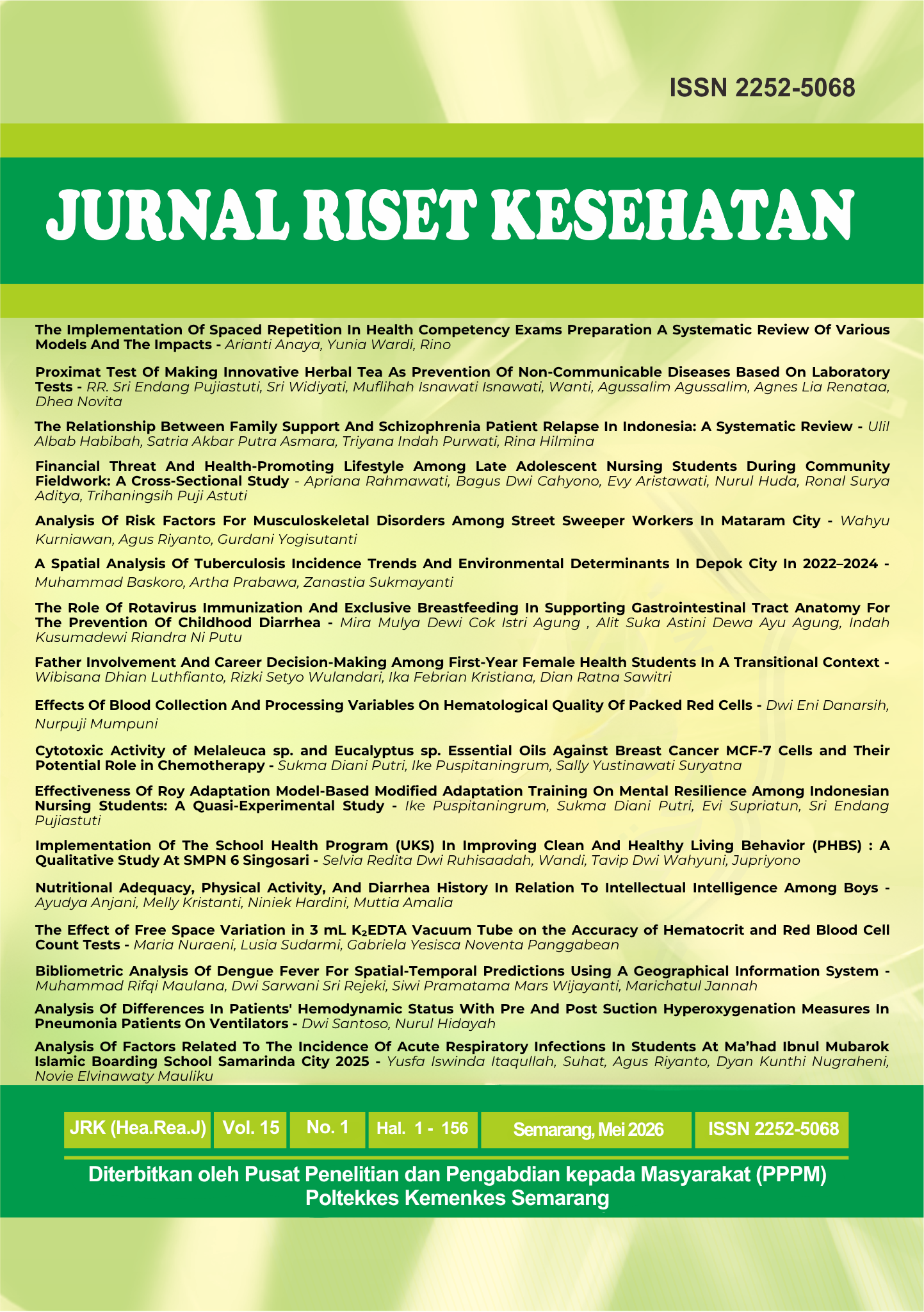
The Effect of Free Space Variation in 3 mL K₂EDTA Vacuum Tube on the Accuracy of Hematocrit and Red Blood Cell Count Tests
DOI:
https://doi.org/10.31983/jrk.v15i1.14641Keywords:
Free Space , K₂EDTA , Hematocrit , Erythrocytes, Pre-Analytical PhaseAbstract
The accuracy of hematology test results is influenced by various factors, including the quality of the pre-analytical phase. One condition that is still encountered in laboratory practice is the inconsistency of blood filling volume in EDTA vacuum tubes, which creates headspace and can alter the ratio of blood to anticoagulant. This condition has the potential to affect hematocrit and erythrocyte count test results. The aim of this study was to analyze the effect of free space variation in 3 mL K₂EDTA vacuum tubes on the accuracy of hematocrit and red blood cell count results. This study was a laboratory experiment with a quantitative approach and a paired design (within subjects). The study subjects consisted of 37 healthy young adults aged 18 to 23 years. Venous blood was collected from each subject and placed in two 3 mL K₂EDTA vacuum tubes with filling volumes of 2.2 mL and 3.0 mL. Hematocrit and erythrocyte counts were examined using a validated automatic hematology analyzer. Data analysis included descriptive statistics, Shapiro–Wilk normality test, and paired samples t-test with a significance level of p < 0.05. The mean erythrocyte count at a filling volume of 2.2 mL was 4.93 ± 0.40 million cells/µL and at a filling volume of 3.0 mL was 4.92 ± 0.39 million cells/µL. The mean hematocrit values were 41.32 ± 3.27% and 41.14 ± 3.18%, respectively. The results of the paired samples t-test showed no statistically significant difference in red blood cell count (p = 0.633) or hematocrit (p = 0.051) between the two filling volume variations. Variations in free space in 3 mL K₂EDTA vacuum tubes with 2.2 mL and 3.0 mL blood filling did not show statistically significant differences in hematocrit and erythrocyte count results. Under well-controlled pre-analytical conditions, blood filling up to 2.2 mL still produced hematological values comparable to full filling.
References
Ahn, S., Cho, S.-M., Shin, H., & Lee, K.-A. (2016). Comparison of Improvacuter EDTA Tube with BD Vacutainer EDTA Tube for Routine Hematological Analysis: Clinical Significance of Differences, Stability Study, and Effects of K₂ and K₃ EDTA. Journal of Laboratory Medicine and Quality Assurance, 38(2), 77–86. https://doi.org/10.15263/jlmqa.2016.38.2.77
Alshaghdali, K., Alcantara, T. Y., Rezgui, R., Cruz, C. P., Alshammary, M. H., Almotairi, Y. A., & Alcantara, J. C. (2022). Detecting Preanalytical Errors Using Quality Indicators in a Hematology Laboratory. Quality Management in Health Care, 31(3), 176–183. https://doi.org/10.1097/QMH.0000000000000343
Benati, M. et al. (2024) ‘Preanalytical Impact of Incomplete K2EDTA Blood Tube Filling in Molecular Biology Testing’, Diagnostics, 14(17). Available at: https://doi.org/10.3390/diagnostics14171934.
Biljak, V. R., Božičević, S., Krhač, M., & Lovrenčić, M. V. (2016). Impact of under-filled blood collection tubes containing K2EDTA and K3EDTA as anticoagulants on automated complete blood count (CBC) testing. Clinical Chemistry and Laboratory Medicine, 54(11), e323–e326. https://doi.org/10.1515/cclm-2016-0169
Dayalan, S. et al. (2020) ‘Underfilled K2EDTA Vacutainer on Automated Haematological Blood Cell IndicesTo Reject or Reconsider?’, Journal of Clinical and Diagnostic Research, 14(3), pp. 18–20. Available at: https://doi.org/10.7860/jcdr/2020/43292.13578.
Fasakin, K. et al. (2014) ‘Lower Sample Volumes Collected Into Spray-Dried K2EDTA Vacuitaner Bottles Are Suitable For Automated Complete Blood Count Analysis Including Differential Leukocyte Count’, IOSR Journal of Dental and Medical Sciences, 13(1), pp. 48–53. Available at: https://doi.org/10.9790/0853-131104853.
Hussain, S. et al. (2018) ‘Evaluation and Comparison of Stability and Reliability of CBC Parameters Determined by Using Automatic Celltac G MEK-9100 Hematology Analyzer during Extended Storage at 4°C’, Journal of Clinical Research & Bioethics, 09(02). Available at: https://doi.org/10.4172/2155-9627.1000324.
Ialongo, C., & Bernardini, S. (2016). Special issue: Responsible writing in science Phlebotomy, a bridge between laboratory and patient. Biochemia Medica, 26(1), 17–33. http://dx.doi.org/10.11613/BM.2016.002
Jaramillo Arbeláez, P.E. et al. (2020) ‘Comparación de parámetros hematológicos y morfología celular en muestras de sangre con EDTA K2 y EDTA K3’, Medicina y Laboratorio, 24(2), pp. 131–140. Available at: https://doi.org/10.36384/01232576.211.
KA, F., CT, O., AJ, E., & OD, A. (2014). Lower Sample Volumes Collected Into Spray-Dried K2EDTA Vacuitaner Bottles Are Suitable For Automated Complete Blood Count Analysis Including Differential Leukocyte Count. IOSR Journal of Dental and Medical Sciences, 13(1), 48–53. https://doi.org/10.9790/0853-131104853
Lima-Oliveira, G., Volanski, W., Lippi, G., Picheth, G., & Guidi, G. C. (2017). Pre-analytical phase management: a review of the procedures from patient preparation to laboratory analysis. Scandinavian Journal of Clinical and Laboratory Investigation, 77(3), 153–163. https://doi.org/10.1080/00365513.2017.1295317
Lippi, G., Plebani, M., Favaloro, E. J., & Guidi, G. C. (2023). Incomplete filling of spray-dried K2EDTA evacuated blood tubes: Impact on measuring routine hematological parameters on Sysmex XN-10. Diagnosis, 10(4), 440–445. https://doi.org/10.1515/dx-2023-0064
Lippi, G., Von Meyer, A., Cadamuro, J., & Simundic, A. M. (2019). Blood sample quality. Diagnosis, 6(1), 25–31. https://doi.org/10.1515/dx-2018-0018
Mehmood, R., Muhammed, R. K., Hussain, S., & Sana, A. (2018). Evaluation of di-potassium and tri-potassium EDTA evacuated tubes for routine haematological testing. Journal of Clinical Laboratory Analysis, 32(1), 2–5. https://doi.org/10.1002/jcla.22188
La Ode Marsudi et al. (2024) ‘The Effect of K3EDTA Blood Volume Variation on Complete Blood Count Results’, Formosa Journal of Science and Technology, 3(8), pp. 1749–1760. Available at: https://doi.org/10.55927/fjst.v3i8.10103.
Unal, K. (2019). Comparison of small-volume tubes and vacuum blood tubes for complete blood count. International Journal of Medical Biochemistry, 2(1), 24–29. https://doi.org/10.14744/ijmb.2019.69188
Vis, J. Y., & Huisman, A. (2016). Verification and quality control of routine hematology analyzers. International Journal of Laboratory Hematology, 38, 100–109. https://doi.org/10.1111/ijlh.12503
Downloads
Published
How to Cite
Issue
Section
License
Copyright (c) 2026 Jurnal Riset Kesehatan

This work is licensed under a Creative Commons Attribution-NonCommercial 4.0 International License.