

INDEXING









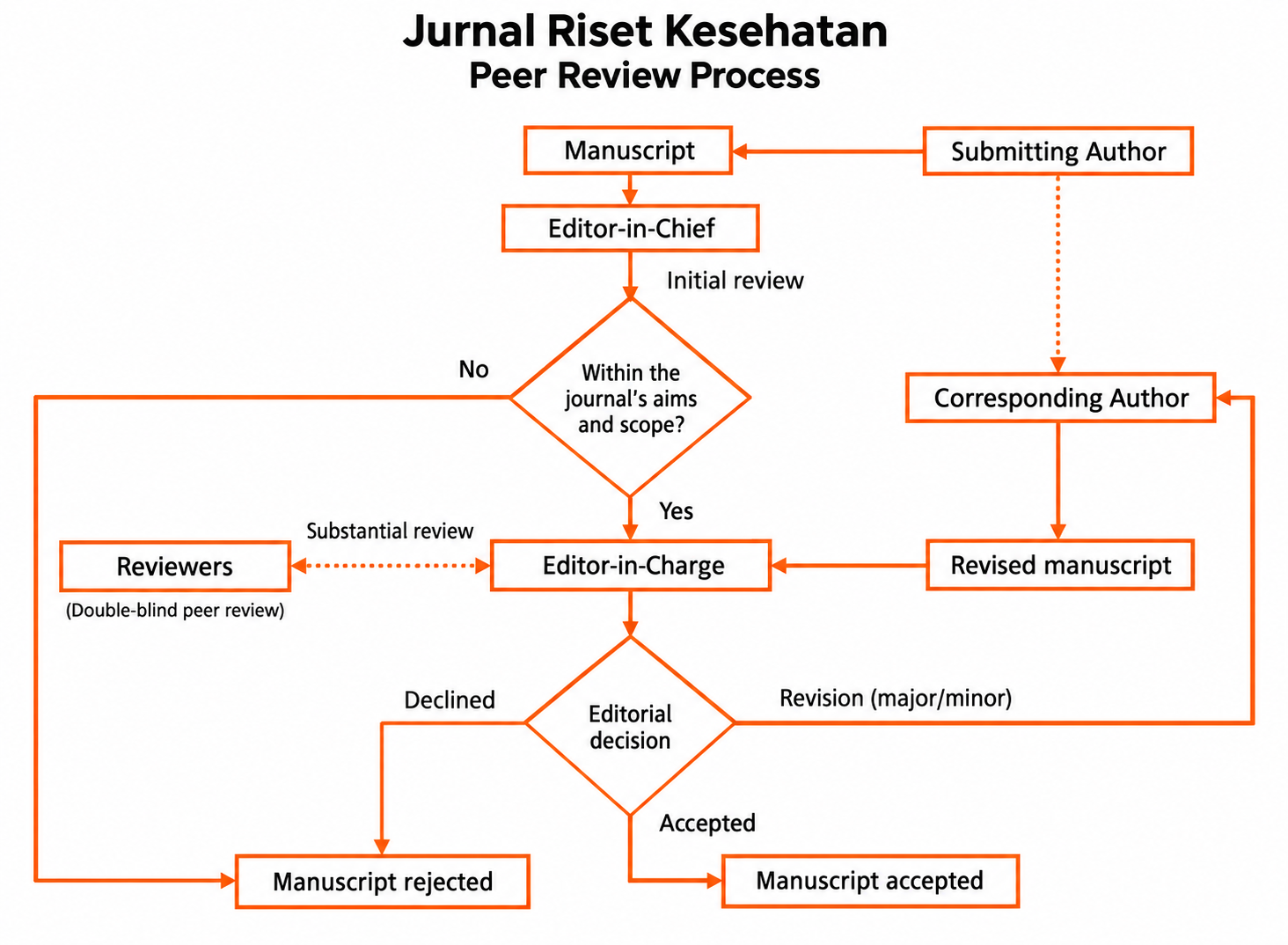
The peer-review process is central to scientific publication and relies on reviewers with expertise relevant to the manuscript’s subject matter. The Editor-in-Charge and peer reviewers play essential roles in ensuring the quality, integrity, and effectiveness of this process. Jurnal Riset Kesehatan implements the following peer-review procedures:
Manuscript Submission
The submitting author submits the manuscript through the Jurnal Riset Kesehatan Open Journal Systems (OJS) platform.
Initial Editorial Screening
The Editor-in-Chief conducts an initial assessment to determine whether the manuscript aligns with the journal’s aims and scope and meets its submission requirements. Manuscripts outside the journal’s scope, lacking sufficient originality, containing serious scientific flaws, or accompanied by incomplete submission documents may be rejected at this stage (desk rejection).
Assignment of the Editor-in-Charge
Manuscripts that meet the initial criteria are assigned to an Editor-in-Charge whose expertise aligns with the manuscript’s subject matter. The Editor-in-Charge oversees the subsequent peer-review process.
Reviewer Assignment and Evaluation
The Editor-in-Charge invites two reviewers with relevant expertise to evaluate the manuscript. Reviewers assess its scientific soundness, originality, methodological rigor, clarity, and contribution to the field, including whether it substantially duplicates previously published work.
Jurnal Riset Kesehatan uses a double-blind peer-review process, in which the identities of authors and reviewers are concealed from one another. Reviewers are selected with consideration of potential conflicts of interest.
Reviewers provide scientific assessments and constructive recommendations. They are not responsible for copyediting or correcting the manuscript’s language. Authors are responsible for ensuring clear and accurate language, with editorial copyediting undertaken during the production stage.
The reviewer evaluation process is estimated to take 4–20 weeks, depending on reviewer availability and the manuscript’s complexity.
Editorial Decision and Revision
Based on the reviewers’ reports, the Editor-in-Charge decides whether to accept the manuscript, reject it, or request revisions. Revision requests fall into two categories:
Minor revisions: The revised manuscript is normally assessed by the Editor-in-Charge without further external review.
Major revisions: The revised manuscript is normally returned to the original reviewers for further evaluation before a final editorial decision is made.
Authors should submit a revised manuscript accompanied by a point-by-point response explaining how each reviewer comment has been addressed.
Re-evaluation of Revised Manuscripts
The Editor-in-Charge evaluates the revised manuscript and the authors’ responses. Additional review rounds may be required, particularly following major revisions, until the scientific and editorial requirements have been adequately addressed.
Final Decision and Publication
The final decision to accept or reject a manuscript rests with the Editor-in-Charge, taking into account the reviewers’ recommendations, the quality of the revisions, and compliance with the journal’s requirements.
These requirements include a similarity index of no more than 20%. Similarity reports are assessed in context; the percentage alone does not determine whether plagiarism has occurred.
The first editorial decision is generally issued within 8–16 weeks of submission, although some manuscripts may require longer. When the review and revision processes proceed smoothly, the estimated time from submission to publication is 12–36 weeks. These timelines are indicative and may vary according to reviewer availability, the extent of revisions, authors’ response times, and the publication schedule.
Researchers and practitioners with relevant expertise who wish to become reviewers for Jurnal Riset Kesehatan are welcome to contact the journal’s editorial office through the contact details provided on the journal’s website.
Reviewing provides an opportunity to evaluate recent research at an early stage, contribute to the quality of scientific publications, and support the development of knowledge in the relevant field. Reviewers may also document their reviewing activities as part of their professional development and receive acknowledgment for their contributions while maintaining the confidentiality of individual manuscript assignments.
Reviewers for Jurnal Riset Kesehatan contribute their expertise voluntarily. No financial remuneration is provided for reviewing manuscripts.
