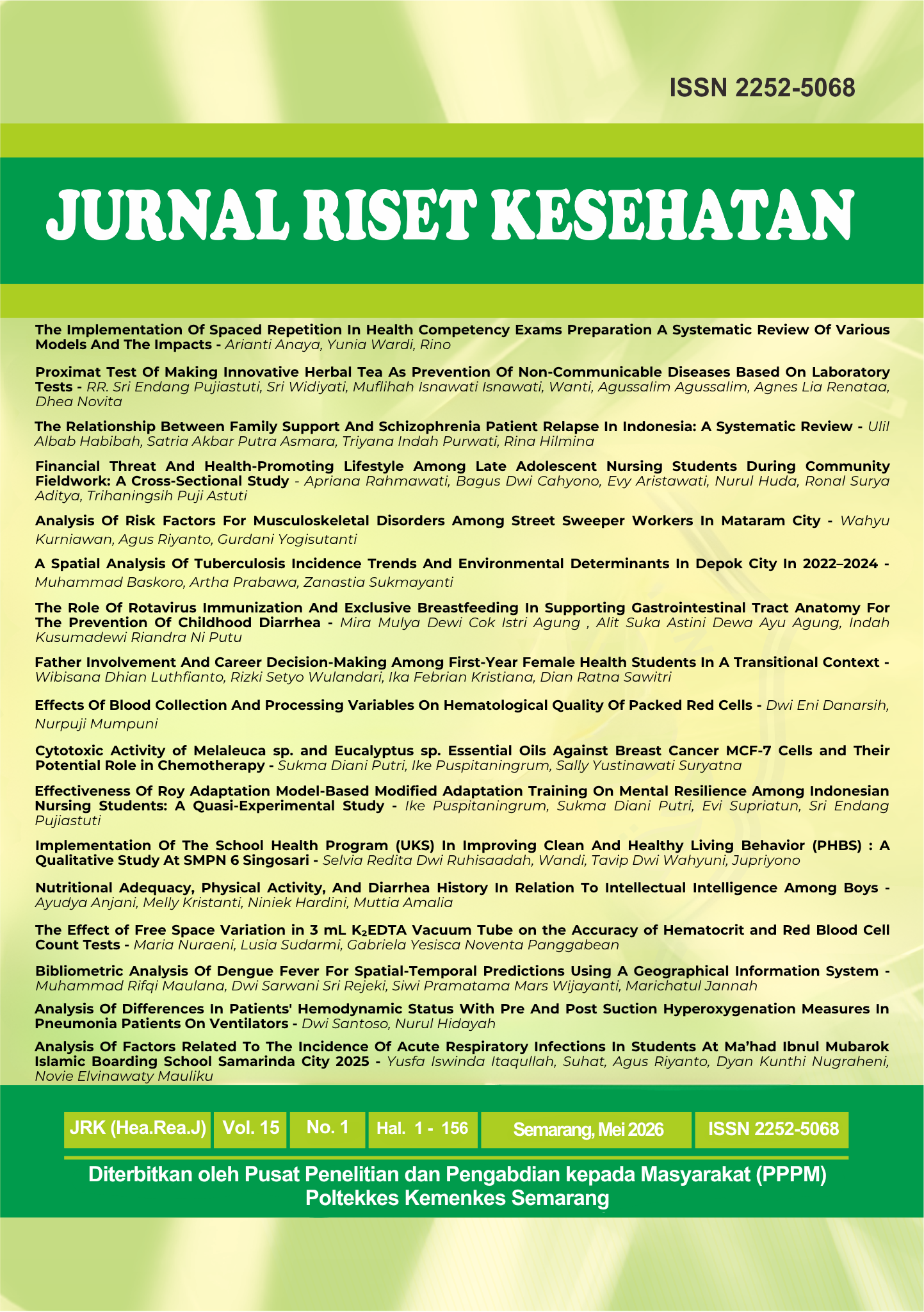
Cytotoxic Activity of Melaleuca sp. and Eucalyptus sp. Essential Oils Against Breast Cancer MCF-7 Cells and Their Potential Role in Chemotherapy
DOI:
https://doi.org/10.31983/jrk.v15i1.14035Keywords:
Breast Cancer , Essential Oil , Eucalyptus Sp , Melaleuca Sp , MCF-7Abstract
Breast cancer remained one of the leading causes of cancer-related deaths among women, motivating the search for effective and accessible therapeutic support. Essential oils from Melaleuca sp. and Eucalyptus sp. had been reported to contain bioactive compounds with anticancer potential. This study aimed to compare their antiproliferative effects when combined with doxorubicin on MCF-7 breast cancer cells in vitro. MCF-7 cells were seeded in 96-well plates and treated with increasing concentrations of each essential oil together with doxorubicin for 48 hours. Cell viability was assessed using the resazurin assay. Both treatments reduced cell viability in a concentration-dependent manner. The combination of Melaleuca sp. and doxorubicin showed stronger inhibition, with an IC₅₀ of 0.1576 µg/mL, while Eucalyptus sp. and doxorubicin produced an IC₅₀ of 0.7792 µg/mL. These findings suggested that Melaleuca sp. demonstrated higher potency under the tested conditions. However, the absence of a doxorubicin-only control limited the interpretation of whether the effects were synergistic or simply additive. In conclusion, Melaleuca sp. appeared to have greater potential as a supportive natural agent in breast cancer treatment. Further studies were recommended to include full drug controls and mechanistic assays to better clarify the interaction with chemotherapy.
References
Assmann, C. E., Cadoná, F. C., Bonadiman, B. da S. R., Dornelles, E. B., Trevisan, G., & Cruz, I. B. M. da. (2018). Tea tree oil presents in vitro antitumor activity on breast cancer cells without cytotoxic effects on fibroblasts and on peripheral blood mononuclear cells. Biomedicine and Pharmacotherapy, 103, 1253–1261. https://doi.org/10.1016/j.biopha.2018.04.096
Banjerdpongchai, R., & Khaw-On, P. (2013). Terpinen-4-ol induces autophagic and apoptotic cell death in human leukemic HL-60 cells. Asian Pacific Journal of Cancer Prevention, 14(12), 7537–7542. https://doi.org/10.7314/APJCP.2013.14.12.7537
Berrouet, C., Dorilas, N., Rejniak, K. A., & Tuncer, N. (2020). Comparison of Drug Inhibitory Effects (IC 50) in Monolayer and Spheroid Cultures. Bulletin of Mathematical Biology, 82(6). https://doi.org/10.1007/s11538-020-00746-7
Blowman, K., Magalhães, M., Lemos, M. F. L., Cabral, C., & Pires, I. M. (2018a). Anticancer Properties of Essential Oils and Other Natural Products. In Evidence-based Complementary and Alternative Medicine (Vol. 2018). Hindawi Limited. https://doi.org/10.1155/2018/3149362
Blowman, K., Magalhães, M., Lemos, M. F. L., Cabral, C., & Pires, I. M. (2018b). Anticancer Properties of Essential Oils and Other Natural Products. In Evidence-based Complementary and Alternative Medicine (Vol. 2018). Hindawi Limited. https://doi.org/10.1155/2018/3149362
Borotová, P., Galovičová, L., Vukovic, N. L., Vukic, M., Tvrdá, E., & Kačániová, M. (2022). Chemical and Biological Characterization of Melaleuca alternifolia Essential Oil. Plants, 11(4). https://doi.org/10.3390/plants11040558
Čmiková, N., Galovičová, L., Schwarzová, M., Vukic, M. D., Vukovic, N. L., Kowalczewski, P. Ł., Bakay, L., Kluz, M. I., Puchalski, C., & Kačániová, M. (2023). Chemical Composition and Biological Activities of Eucalyptus globulus Essential Oil. Plants, 12(5). https://doi.org/10.3390/plants12051076
Ćwiklińska-Jurkowska, M., Wiese-Szadkowska, M., Janciauskiene, S., & Paprocka, R. (2023). Disparities in Cisplatin-Induced Cytotoxicity—A Meta-Analysis of Selected Cancer Cell Lines. Molecules, 28(15). https://doi.org/10.3390/molecules28155761
Dasari, S., & Bernard Tchounwou, P. (2014). Cisplatin in cancer therapy: Molecular mechanisms of action. In European Journal of Pharmacology (Vol. 740, pp. 364–378). Elsevier. https://doi.org/10.1016/j.ejphar.2014.07.025
Hoch, C. C., Petry, J., Griesbaum, L., Weiser, T., Werner, K., Ploch, M., Verschoor, A., Multhoff, G., Bashiri Dezfouli, A., & Wollenberg, B. (2023). 1,8-cineole (eucalyptol): A versatile phytochemical with therapeutic applications across multiple diseases. In Biomedicine and Pharmacotherapy (Vol. 167). Elsevier Masson s.r.l. https://doi.org/10.1016/j.biopha.2023.115467
Huang, Y., An, M., Fang, A., Olatunji, O. J., & Eze, F. N. (2022a). Antiproliferative Activities of the Lipophilic Fraction of Eucalyptus camaldulensis against MCF-7 Breast Cancer Cells, UPLC-ESI-QTOF-MS Metabolite Profile, and Antioxidative Functions. ACS Omega, 7(31), 27369–27381. https://doi.org/10.1021/acsomega.2c02389
Huang, Y., An, M., Fang, A., Olatunji, O. J., & Eze, F. N. (2022b). Antiproliferative Activities of the Lipophilic Fraction of Eucalyptus camaldulensis against MCF-7 Breast Cancer Cells, UPLC-ESI-QTOF-MS Metabolite Profile, and Antioxidative Functions. ACS Omega, 7(31), 27369–27381. https://doi.org/10.1021/acsomega.2c02389
Joy, L., Heinrich, J., Uwe, W., Juergens, R., Juergens, L. J., & Worth, H. (2020). New Perspectives for Mucolytic, Anti-inflammatory and Adjunctive Therapy with 1,8-Cineole in COPD and Asthma: Review on the New Therapeutic Approach. Adv Ther, 37, 1737–1753. https://doi.org/10.6084/m9.figshare.11876436
Kashkoulinejad-Kouhi, T., Safarian, S., Arnaiz, B., & Saa, L. (2021). Enhancement of cisplatin sensitivity in human breast cancer MCF-7 cell line through BiP and 14-3-3ζ co-knockdown. Oncology Reports, 45(2), 665–679. https://doi.org/10.3892/or.2020.7898
Kciuk, M., Gielecińska, A., Mujwar, S., Kołat, D., Kałuzińska-Kołat, Ż., Celik, I., & Kontek, R. (2023). Doxorubicin—An Agent with Multiple Mechanisms of Anticancer Activity. In Cells (Vol. 12, Number 4). MDPI. https://doi.org/10.3390/cells12040659
Khan, H. (2025). Characterization of 1,8-Cineole (Eucalyptol) From Myrtle and its Potential Antibacterial and Antioxidant Activities. Karbala International Journal of Modern Science, 11(1), 199–207. https://doi.org/10.33640/2405-609X.3394
Lashen, A. G., Toss, M. S., Katayama, A., Gogna, R., Mongan, N. P., & Rakha, E. A. (2021). Assessment of proliferation in breast cancer: cell cycle or mitosis? An observational study. Histopathology, 79(6), 1087–1098. https://doi.org/10.1111/his.14542
Lin, C. C., Wu, C. S., Chen, Y. J., Chen, J. J. W., Shieh, J. J., Huang, C. H., Lin, P. S., Chang, G. C., & Chang, J. T. (2012). Terpinen-4-ol induces apoptosis in human nonsmall cell lung cancer in vitro and in vivo. Evidence-Based Complementary and Alternative Medicine, 2012. https://doi.org/10.1155/2012/818261
Markowski, J., & Junka, A. (2025). Multifaceted Action of 1,8-Cineole in Antibacterial and Anti-inflammatory Treatment of Respiratory Tract Diseases. Otolaryngologia Polska, 79(1), 1–5. https://doi.org/10.5604/01.3001.0054.9607
Merghni, A., Belmamoun, A. R., Urcan, A. C., Bobiş, O., & Lassoued, M. A. (2023). 1,8-Cineol (Eucalyptol) Disrupts Membrane Integrity and Induces Oxidative Stress in Methicillin-Resistant Staphylococcus aureus. Antioxidants, 12(7). https://doi.org/10.3390/antiox12071388
Mirmalek, S. A., Jangholi, E., Jafari, M., Yadollah-Damavandi, S., Javidi, M. A., Parsa, Y., Parsa, T., Salimi-Tabatabaee, S. A., Kolagar, H. G., Jalil, S. K., & Alizadeh-Navaei, R. (2016). Comparison of in vitro cytotoxicity and apoptogenic activity of magnesium chloride and cisplatin as conventional chemotherapeutic agents in the MCF-7 cell line. Asian Pacific Journal of Cancer Prevention, 17, 131–134. https://doi.org/10.7314/APJCP.2016.17.S3.131
Putri, S. D., Puspitaningrum, I., & Suryatna, S. Y. (2023). Efektivitas Eucalyptus sp sebagai Disinfektan Spray terhadap Staphylococcus aureus. Al-Asalmiya Nursing, (2). https://jurnal.ikta.ac.id/index.php/keperawatan/
Rodenak-Kladniew, B., Castro, M. A., Crespo, R., Galle, M., & García de Bravo, M. (2020). Anti-cancer mechanisms of linalool and 1,8-cineole in non-small cell lung cancer A549 cells. Heliyon, 6(12). https://doi.org/10.1016/j.heliyon.2020.e05639
Sánchez-Díez, M., Romero-Jiménez, P., Alegría-Aravena, N., Gavira-O’Neill, C. E., Vicente-García, E., Quiroz-Troncoso, J., González-Martos, R., Ramírez-Castillejo, C., & Pastor, J. M. (2025). Assessment of Cell Viability in Drug Therapy: IC50 and Other New Time-Independent Indices for Evaluating Chemotherapy Efficacy. Pharmaceutics, 17(2). https://doi.org/10.3390/pharmaceutics17020247
Sharma, M., Grewal, K., Jandrotia, R., Batish, D. R., Singh, H. P., & Kohli, R. K. (2022). Essential oils as anticancer agents: Potential role in malignancies, drug delivery mechanisms, and immune system enhancement. In Biomedicine and Pharmacotherapy (Vol. 146). Elsevier Masson s.r.l. https://doi.org/10.1016/j.biopha.2021.112514
Shiekh, R. A. E., Atwa, A. M., Elgindy, A. M., Mustafa, A. M., Senna, M. M., Alkabbani, M. A., & Ibrahim, K. M. (2025). Therapeutic applications of eucalyptus essential oils. In Inflammopharmacology (Vol. 33, Number 1, pp. 163–182). Springer Science and Business Media Deutschland GmbH. https://doi.org/10.1007/s10787-024-01588-8
Tacar, O., Sriamornsak, P., & Dass, C. R. (2013). Doxorubicin: An update on anticancer molecular action, toxicity and novel drug delivery systems. In Journal of Pharmacy and Pharmacology (Vol. 65, Number 2, pp. 157–170). https://doi.org/10.1111/j.2042-7158.2012.01567.x
Thalappil, M. A., Singh, P., Carcereri de Prati, A., Sahoo, S. K., Mariotto, S., & Butturini, E. (2024). Essential oils and their nanoformulations for breast cancer therapy. In Phytotherapy Research (Vol. 38, Number 2, pp. 556–591). John Wiley and Sons Ltd. https://doi.org/10.1002/ptr.8054
Zhou, L. J., Li, F. R., Huang, L. J., Yang, Z. R., Yuan, S., & Bai, L. H. (2016). Antifungal activity of Eucalyptus oil against rice blast fungi and the possible mechanism of gene expression pattern. Molecules, 21(5). https://doi.org/10.3390/molecules21050621
Downloads
Published
How to Cite
Issue
Section
License
Copyright (c) 2026 Jurnal Riset Kesehatan

This work is licensed under a Creative Commons Attribution-NonCommercial 4.0 International License.