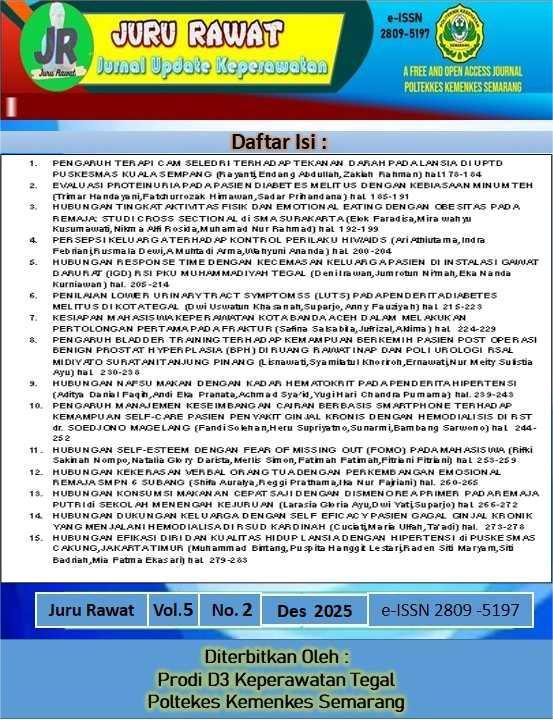
HUBUNGAN TINGKAT AKTIVITAS FISIK DAN EMOTIONAL EATING DENGAN OBESITAS PADA REMAJA: STUDI CROSS-SECTIONAL di SMA SURAKARTA
DOI:
https://doi.org/10.31983/juk.v5i2.13011Kata Kunci:
Aktivitas Fisik, Emotional Eating, Obesitas, RemajaAbstrak
Obesitas pada remaja menjadi masalah kesehatan yang terus meningkat dan dapat menyebabkan gangguan metabolik serta psikologis. Penelitian ini bertujuan mengidentifikasi hubungan antara aktivitas fisik dan emotional eating terhadap kejadian obesitas pada remaja. Metode yang digunakan adalah kuantitatif non- eksperimental dengan desain cross-sectional. Sampel sebanyak 72 siswa kelas X dan XI yang memiliki BMI ≥ 23 dengan Teknik random sampling. Data dikumpulkan menggunakan kuesioner International Physical Activity Questionnaire (IPAQ) dan Dutch Eating Behavior Questionnaire serta pengukuran antropometri untuk BMI. Analisis data menggunakan uji Spearman rho dengan bantuan SPSS. Hasil: Sebagian besar remaja dengan tingkat aktivitas fisik rendah mengalami obesitas kategori Obese 2 (BMI ≥ 30) dan emotional eating tinggi juga berhubungan signifikan dengan obesitas. Nilai signifikansi pada kedua variabel tersebut menunjukkan p-value < 0,05. Kesimpulan dan Saran: rendahnya aktivitas fisik dan tingginya emotional eating menjadi faktor risiko utama obesitas pada remaja. Disarankan sekolah dan pemerintah meningkatkan program aktivitas fisik dan edukasi pengelolaan emosi untuk mencegah obesitas. Dukungan keluarga dan lingkungan juga penting untuk menguatkan gaya hidup sehat remaja
Referensi
Ananthapavan, J., Sacks, G., Brown, V., Moodie, M., Nguyen, P., Veerman, L., Mantilla Herrera, A. M., Lal, A., Peeters, A., & Carter, R. (2020). Priority-setting for obesity prevention—The Assessing Cost-Effectiveness of obesity prevention policies in Australia (ACE-Obesity Policy) study. PLoS ONE, 15(6). https://doi.org/10.1371/journal.pone.023480
Braden abby, D. M.-E. , T. W. , E. E. (2018). Eating when depressed, anxious, bored, or happy: Are emotional eating types associated with unique psychological and physical health correlates? Appetite, 125, 410–417. https://doi.org/10.1016/j.appet.2018.02.022
Clemente, E., Cabral, M. D., Senti, M., & Patel, D. R. (2022). Challenges in the management of obesity in adolescents: an American perspective: a narrative review. In Pediatric Medicine (Vol. 5). AME Publishing Company. https://doi.org/10.21037/pm-21-23
Dakanalis, A., Mentzelou, M., Papadopoulou, S. K., Papandreou, D., Spanoudaki, M., Vasios, G. K., Pavlidou, E., Mantzorou, M., & Giaginis, C. (2023). The Association of Emotional Eating with Overweight/Obesity, Depression, Anxiety/Stress, and Dietary Patterns: A Review of the Current Clinical Evidence. In Nutrients (Vol. 15, Issue 5). MDPI. https://doi.org/10.3390/nu15051173
De Gracia, M., Trujano, P., Nava, C., & Jiménez, N. (2024). Emotional eating patterns in a sample of Mexican adolescents. International Journal Of Community Medicine And Public Health, 11(2), 717–724. https://doi.org/10.18203/2394-6040.ijcmph20240259
Huang, L., Chen, W., Renzaho, A. M. N., & Hall, B. J. (2020). Validation of obesity status based on self-reported data among filipina and indonesian female migrant domestic workers in Macao (SAR), China. International Journal of Environmental Research and Public Health, 17(16), 1–13. https://doi.org/10.3390/ijerph17165927
Jha, S., & Mehendale, A. M. (2022). Increased Incidence of Obesity in Children and Adolescents Post-COVID-19 Pandemic: A Review Article. Cureus. https://doi.org/10.7759/cureus.29348
KEMENKES RI. (2019). Laporan Provinsi Jawa Tengah Riskesdas 2018.
Kharistik, Y., Lanti, Y., & Wekadigunawan, C. S. P. (2018). Path Analysis on the Psychosocial Impact of Obesity or Overweight in Adolescents in Surakarta, Central Java. Path Analysis on the Psychosocial Impact of Obesity, 3, 105–117. https://doi.org/10.26911/jepublichealth.2018.03.02.01
Lin, X., & Li, H. (2021). Obesity: Epidemiology, Pathophysiology, and Therapeutics. In Frontiers in Endocrinology (Vol. 12). Frontiers Media S.A. https://doi.org/10.3389/fendo.2021.706978
Ljubičić, M., Matek Sarić, M., Klarin, I., Rumbak, I., Colić Barić, I., Ranilović, J., Dželalija, B., Sarić, A., Nakić, D., Djekic, I., Korzeniowska, M., Bartkiene, E., Papageorgiou, M., Tarcea, M., Černelič-Bizjak, M., Klava, D., Szűcs, V., Vittadini, E., Bolhuis, D., & Guiné, R. P. F. (2023). Emotions and Food Consumption: Emotional Eating Behavior in a European Population. Foods, 12(4). https://doi.org/10.3390/foods12040872
Lopez-Gonzalez, D., Partida-Gaytán, A., Wells, J. C., Reyes-Delpech, P., Avila-Rosano, F., Ortiz-Obregon, M., Gomez-Mendoza, F., Diaz-Escobar, L., & Clark, P. (2020). Obesogenic lifestyle and its influence on adiposity in children and adolescents, evidence from mexico. Nutrients, 12(3). https://doi.org/10.3390/nu12030819
Mance, G. S. A., Grant, K. E., Roberts, D., Carter, J., Turek, C., Adam, E., & Thorpe, R. J. (2019). Environmental stress and socioeconomic status: Does parent and adolescent stress influence executive functioning in urban youth? Journal of Prevention and Intervention in the Community, 47(4), 279–294. https://doi.org/10.1080/10852352.2019.1617386
Moschonis, G., & Trakman, G. L. (2023). Overweight and Obesity: The Interplay of Eating Habits and Physical Activity. In Nutrients (Vol. 15, Issue 13). Multidisciplinary Digital Publishing Institute (MDPI). https://doi.org/10.3390/nu15132896
Nepal, S., Marhatta, A., Shrestha, S., & Karki, D. K. (2023). Prevalence and factors influencing physical activity among secondary school adolescents: A cross-sectional study. Journal of Gandaki Medical College-Nepal, 16(1), 6–12. https://doi.org/10.3126/jgmcn.v16i1.53428
Obradovic, M., Sudar-Milovanovic, E., Soskic, S., Essack, M., Arya, S., Stewart, A. J., Gojobori, T., & Isenovic, E. R. (2021). Leptin and Obesity: Role and Clinical Implication. In Frontiers in Endocrinology (Vol. 12). Frontiers Media S.A. https://doi.org/10.3389/fendo.2021.585887
Puwar, T., Saxena, D., Yasobant, S., & Savaliya, S. (2018). Noncommunicable diseases among school-going adolescents: A case study on prevalence of risk factors from Sabarkantha District of Gujarat, India. Indian Journal of Community Medicine, 43(5), S33–S37. https://doi.org/10.4103/ijcm.IJCM_117_18
Rachmawati, Y., & Anantanyu, S. (2019). Emotional eating, snacking behavior and nutritional status among adolescents. International Journal of Public Health Science (IJPHS), 8(4), 413–418. https://doi.org/10.11591/ijphs.v8i4.20398ˆ413
Rachmawati, Y., Anantanyu, S., & Kusnandar. (2019). Emotional eating, snacking behavior and nutritional status among adolescents. International Journal of Public Health Science, 8(4), 413–418. https://doi.org/10.11591/ijphs.v8i4.20398
Rao, W. W., Zong, Q. Q., Zhang, J. W., An, F. R., Jackson, T., Ungvari, G. S., Xiang, Y., Su, Y. Y., D’Arcy, C., & Xiang, Y. T. (2020). Obesity increases the risk of depression in children and adolescents: Results from a systematic review and meta-analysis. In Journal of Affective Disorders (Vol. 267, pp. 78–85). Elsevier B.V. https://doi.org/10.1016/j.jad.2020.01.154
Reyes, L. I., Constantinides, S. V., Bhandari, S., Frongillo, E. A., Schreinemachers, P., Wertheim-Heck, S., Walls, H., Holdsworth, M., Laar, A., Nguyen, T., Turner, C., Wellard, K., & Blake, C. E. (2021). Actions in global nutrition initiatives to promote sustainable healthy diets. In Global Food Security (Vol. 31). Elsevier B.V. https://doi.org/10.1016/j.gfs.2021.100585
Robinson, T. N., Banda, J. A., Hale, L., Lu, A. S., Fleming-Milici, F., Calvert, S. L., & Wartella, E. (2017). Screen Media Exposure and Obesity in Children and Adolescents. In PEDIATRICS (Vol. 140).
Romieu, I., Dossus, L., Barquera, S., Blottière, H. M., Franks, P. W., Gunter, M., Hwalla, N., Hursting, S. D., Leitzmann, M., Margetts, B., Nishida, C., Potischman, N., Seidell, J., Stepien, M., Wang, Y., Westerterp, K., Winichagoon, P., Wiseman, M., & Willett, W. C. (2017). Energy balance and obesity: what are the main drivers? Cancer Causes and Control, 28(3), 247–258. https://doi.org/10.1007/s10552-017-0869
Romieu, Isabelle., Dossus, Laure., & Willett, Walter. (2017). Energy balance and obesity. International Agency for Research on Cancer.
Roy, S. K., Jahan, K., Alam, N., Rois, R., Ferdaus, A., Israt, S., & Karim, M. R. (2021). Perceived stress, eating behavior, and overweight and obesity among urban adolescents. Journal of Health, Population and Nutrition, 40(1). https://doi.org/10.1186/s41043-021-00279-2
Schmidt, S. C. E., Anedda, B., Burchartz, A., Eichsteller, A., Kolb, S., Nigg, C., Niessner, C., Oriwol, D., Worth, A., & Woll, A. (2020). Physical activity and screen time of children and adolescents before and during the COVID-19 lockdown in Germany: a natural experiment. Scientific Reports, 10(1). https://doi.org/10.1038/s41598-020-78438-4
Shriver, L. H., Dollar, J. M., Calkins, S. D., Keane, S. P., Shanahan, L., & Wideman, L. (2021a). Emotional eating in adolescence: effects of emotion regulation, weight status and negative body image. Nutrients, 13(1), 1–12. https://doi.org/10.3390/nu13010079
Shriver, L. H., Dollar, J. M., Calkins, S. D., Keane, S. P., Shanahan, L., & Wideman, L. (2021b). Emotional eating in adolescence: effects of emotion regulation, weight status and negative body image. Nutrients, 13(1), 1–12. https://doi.org/10.3390/nu13010079
Stival, C., Lugo, A., Barone, L., Fattore, G., Odone, A., Salvatore, S., Santoro, E., Scaglioni, S., van den Brandt, P. A., & Gallus, S. (2022). Prevalence and Correlates of Overweight, Obesity and Physical Activity in Italian Children and Adolescents from Lombardy, Italy. Nutrients, 14(11). https://doi.org/10.3390/nu14112258
Sundar, T. K. B., Løndal, K., Lagerløv, P., Galvin, K., & Helseth, S. (2018). Overweight adolescents’ views on physical activity - Experiences of participants in an internet-based intervention: A qualitative study. BMC Public Health, 18(1). https://doi.org/10.1186/s12889-018-5324-x
Tham, K. W., Abdul Ghani, R., Cua, S. C., Deerochanawong, C., Fojas, M., Hocking, S., Lee, J., Nam, T. Q., Pathan, F., Saboo, B., Soegondo, S., Somasundaram, N., Yong, A.
M. L., Ashkenas, J., Webster, N., & Oldfield, B. (2023). Obesity in South and Southeast Asia—A new consensus on care and management. In Obesity Reviews (Vol. 24, Issue 2). John Wiley and Sons Inc. https://doi.org/10.1111/obr.13520
van der Valk, E. S., Savas, M., & van Rossum, E. F. C. (2018). Stress and Obesity: Are There More Susceptible Individuals? In Current obesity reports (Vol. 7, Issue 2, pp. 193–203). https://doi.org/10.1007/s13679-018-0306-y
Wardani, H. S., Sapja Anatayu, S., & Febrinasari, R. P. (2024). Stress level and emotional eating in obese and non-obese adolescents. AcTion: Aceh Nutrition Journal, 9(1), 57. https://doi.org/10.30867/action.v9i1.1311
Wyszyńska, J., Ring-Dimitriou, S., Thivel, D., Weghuber, D., Hadjipanayis, A., Grossman, Z., Ross-Russell, R., Dereń, K., & Mazur, A. (2020). Physical Activity in the Prevention of Childhood Obesity: The Position of the European Childhood Obesity Group and the European Academy of Pediatrics. In Frontiers in Pediatrics (Vol. 8). Frontiers Media S.A. https://doi.org/10.3389/fped.2020.535705
Zahrah, N. I., Fanani, M., & Ardyanto, T. D. (2023). THE RELATIONSHIP BETWEEN EMOTIONAL EATING, MEAL SKIPPING AND UNHEALTHY FOOD CONSUMPTION PATTERN IN ADOLESCENT GIRLS. Indonesian Journal of Public Health, 18(1), 47–58. https://doi.org/10.20473/ijph.v18i1.2023.47-58
Unduhan
Diterbitkan
Cara Mengutip
Terbitan
Bagian
Lisensi
Hak Cipta (c) 2025 Juru Rawat. Jurnal Update Keperawatan

Artikel ini berlisensi Creative Commons Attribution 4.0 International License.