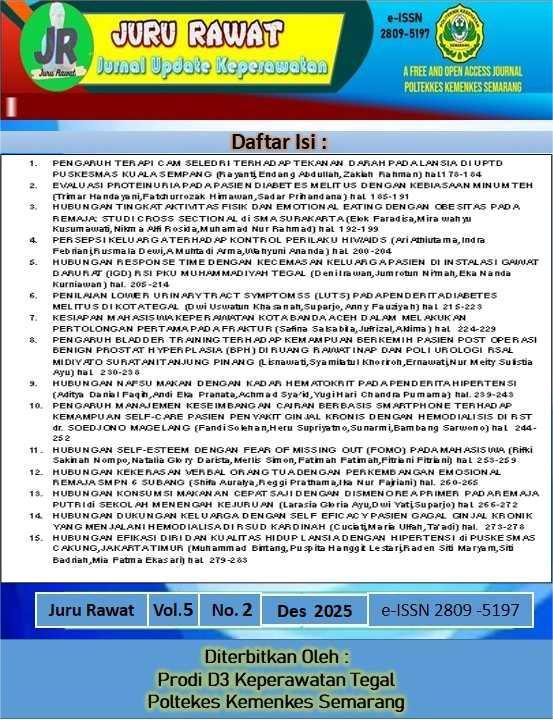
ASSESMENT OF LOWER URINARY TRACT SYMPTOMS (LUTS) IN DIABETES MELLITUS PATIENTS IN TEGAL CITY
DOI:
https://doi.org/10.31983/juk.v5i2.13644Keywords:
Diabetes Mellitus, LUTS, LURN SI-29, nocturia, urgensiAbstract
Diabetes Mellitus (DM) was associated with urological complications, particularly Lower Urinary Tract Symptoms (LUTS). LUTS included nocturia, urgency, frequency, decreased urine flow, incomplete bladder emptying, and incontinence, which could cause physical and psychological distress and reduce quality of life. Early identification of LUTS in patients with DM was essential to prevent progression and improve symptom management. This descriptive study aimed to identify LUTS in DM patients in Tegal City. A total of 106 respondents with DM were selected through purposive sampling from the service areas of Tegal Timur, Bandung, Debong Lor, and Margadana public health centers. Data were collected through interviews using the LURN Symptom Index-29 (LURN SI-29). Descriptive statistics were applied to analyze mean, standard deviation, minimum, and maximum values. The findings revealed that the highest mean score was in Section E (Nocturia) with 65.89 (SD = 22.16), followed by Section D (Urgency) with 22.42 (SD = 22.66). The lowest score was in Section B (Bladder Pain), with 7.02 (SD = 14.19). The total LURN SI-29 score had a mean of 19.15 (SD = 9.98), ranging from 5.70 to 53.30. In conclusion, nocturia was the most dominant symptom experienced by DM patientsin Tegal City, followed by urgency. Meanwhile, bladder pain was relatively rarely reported. Overall, the total LUTS score indicated that most DM patients experienced lower urinary tract symptoms with varying levels of severity. Early detection of LUTS was recommended to help DM patients recognize symptoms earlier and receive appropriate interventions.
References
Alghamdi, M. A., Amer, K. A., Aldosari, A. A. S., Al Qahtani, R. F., Shar, H. S., Al-Tarish, L. M., Shawkhan, R. A., Alahmadi, M. A., Alsaleem, M. A., & AL-Eitan, L. N. (2023). Assessment of the Impact of Lower Urinary Tract Dysfunction on Quality of Life in Multiple Sclerosis Patients in Saudi Arabia—A Cross-Sectional Study. Healthcare, 11(2694). https://doi.org/10.3390/healthcare11192694
Barua, S. K., Borah, S. J., & Rajeev, T. P. (2019). Current Understanding of Diabetes Mellitus-Induced Lower Urinary Tract Dysfunction. Journal of Health Research and Reviews, 6(2), 50–56. https://doi.org/10.4103/jhrr.jhrr_9_19
Blair, Y., Wessells, H., Pop-Busui, R., Ang, L., & Sarma, A. V. (2022). Urologic complications in diabetes. Journal of Diabetes and Its Complications, 36(10), 1–14. https://doi.org/10.1016/j.jdiacomp.2022.108288
Breyer, B. N., & Sarma, A. V. (2014). Hyperglycemia and Insulin Resistance and the Risk of BPH/ LUTS: an Update of Recent Literature. Curr Urol Rep, 15 (12)(462).
Cella, D., Smith, A. R., Griffith, J. W., Flynn, K. E., Bradley, C. S., Gillespie, B. W., Kirkali, Z., Talaty, P., Jelovsek, J. E., Helfand, B. T., & Weinfurt, K. P. (2019). A new outcome measure for LUTS: Symptoms of Lower Urinary Tract Dysfunction Research Network Symptom Index-29 (LURN SI-29) questionnaire. Neurourology and Urodynamics, 38(6), 1751–1759. https://doi.org/10.1002/nau.24067
Degirmencioglu, A. Z., Kocaoz, S., & Cirpan, R. (2021). Prevalence of lower urinary tract symptoms and influencing factors in women. Cukurova Medical Journal, 46(3), 1040–1049. https://doi.org/10.17826/cumj.908652
Dhait, S. R., Vardhan, V., & Walke, R. (2023). Efficacy of Arm Ergometer Exercise on Glycaemic Control in Type 2 Diabetes Mellitus- An Interventional Study. Journal of Clinical and Diagnostic Research, 17(4), YK01–YK03. https://doi.org/10.7860/jcdr/2023/57942.17753
Dinas Kesehatan Kota Tegal. (2016). Profil Kesehatan Kota Tegal Tahun 2015. Dinas Kesehatan Kota Tegal. www.depkes.go.id
Dinas Kesehatan Kota Tegal. (2022). Profil Kesehatan Kota Tegal 2022. Dinas Kesehatan Kota Tegal.
Drake, M. J. (2018). Fundamentals of terminology in lower urinary tract function. Neurourology and Urodynamics, 37, S13–S19. https://doi.org/10.1002/nau.23768
Eskidemir, Ü., Şimşir, A., Yıldırım Şimşir, I., Kızılay, F., & Özyurt, C. (2019). Evaluation of Lower Urinary Tract Functions in Diabetic Patients. Journal of Urological Surgery, 6(1), 46–53. https://doi.org/10.4274/jus.galenos.2018.2314
International Diabetes Federation. (2021). Diabetes Atlas (10th ed.). https://doi.org/10.1016/j.diabres.2013.10.013
Kementerian Kesehatan RI. (2013). Riset Kesehatan Dasar 2013. Kemenkes RI.https://doi.org/10.1517/13543784.7.5.803
Kementerian Kesehatan RI. (2019). Laporan Nasional Riskesdas 2018. Lembaga Penerbit Badan Penelitian dan Pengembangan Kesehatan.http://labdata.litbang.kemkes.go.id
Kementerian Kesehatan RI. (2019). Laporan Provinsi Jawa Tengah Riskesdas 2018. Lembaga Penerbit Badan Penelitian dan Pengembangan Kesehatan.
Khasanah, D. U., Himawan, F., & Suparjo, S. (2021). Stress Levels for People With Diabetes Mellitus During the Covid-19 Pandemic. Juru Rawat. Jurnal Update Keperawatan, 1(1), 39–43. https://doi.org/10.31983/juk.v1i1.8065
Liu, S. P., Chuang, Y. C., Sumarsono, B., & Chang, H. C. (2019). The prevalence and bother of lower urinary tract symptoms in men and women aged 40 years or over in Taiwan. Journal of the Formosan Medical Association, 118(1P1), 170–178. https://doi.org/10.1016/j.jfma.2018.03.006
LURN Study Group. (2019). User Manual LURN SYMPTOM INDEX-29 ( LURN SI-29 ) LURN SYMPTOM INDEX 10 ( LURN SI-10 ). Juni.
Pahlawati, A., & Nugroho, S. (2019). Hubungan Tingkat Pendidikan dan Usia dengan Kejadian Diabetes Melitus di Wilayah Kerja Puskesmas Palaran Kota Samarinda Tahun 2019. Borneo Student Research.
Park, J. C., Nam, G. E., Yu, J., McWhorter, K. L., Liu, J., Lee, H. S., Lee, S. S., & Han, K. (2023). Association of Sustained Low or High Income and Income Changes With Risk of Incident Type 2 Diabetes Among Individuals Aged 30 to 64 Years. JAMA Network Open, 6(8), e2330024. https://doi.org/10.1001/jamanetworkopen.2023.30024
Powell, C., & Gehring, V. (2023). Mechanisms of Action for Diabetic Bladder Dysfunction — State of the Art. In Current Bladder Dysfunction Reports (Vol. 18, Issue 18, pp. 173–182). Springer. https://doi.org/10.1007/s11884-023-00691-w
Pranata, S., & Khasanah, D. U. (2017). Merawat Penderita Diabetes Melitus. Pustaka Panasea.
Qasrawi, H., Tabouni, M., Almansour, S. W., Ghannam, M., Abdalhaq, A., Abushamma, F., Koni, A. A., & Zyoud, S. H. (2022). An evaluation of lower urinary tract symptoms in diabetic patients: a cross-sectional study. BMC Urology, 22(1), 1–10. https://doi.org/10.1186/s12894-022-01133-1
Smeltzer, S., & Bare, B. (2013). Buku Ajar Keperawatan Medikal Bedah Brunner & Suddarth (8th ed.). EGC.
Xin, C., Fan, H., Xie, J., Hu, J., Sun, X., & Liu, Q. (2022). Impact of Diabetes Mellitus on Lower Urinary Tract Symptoms in Benign Prostatic Hyperplasia Patients: A Meta-Analysis. In Frontiers in Endocrinology (Vol. 12). Frontiers Media S.A. https://doi.org/10.3389/fendo.2021.741748
Xu, Z., Elrashidy, R. A., Li, B., & Liu, G. (2022). Oxidative Stress: A Putative Link Between Lower Urinary Tract Symptoms and Aging and Major Chronic Diseases. Frontiers in Medicine, 9(March), 1–15. https://doi.org/10.3389/fmed.2022.812967
Yogahutama, N., Abshor, M. R. U., & Affan, M. I. F. (2024). Analysis of lower urinary tract symptoms (LUTS) in diabetes mellitus type 2 (DM2) patients at an indonesian primary health care: A cross-sectional study. Journal of Medicinal and Pharmaceutical Chemistry Research, 6(9), 1312–1326. https://doi.org/10.48309/jmpcr.2024.445490.1131
Downloads
Published
How to Cite
Issue
Section
License
Copyright (c) 2025 Juru Rawat. Jurnal Update Keperawatan

This work is licensed under a Creative Commons Attribution 4.0 International License.