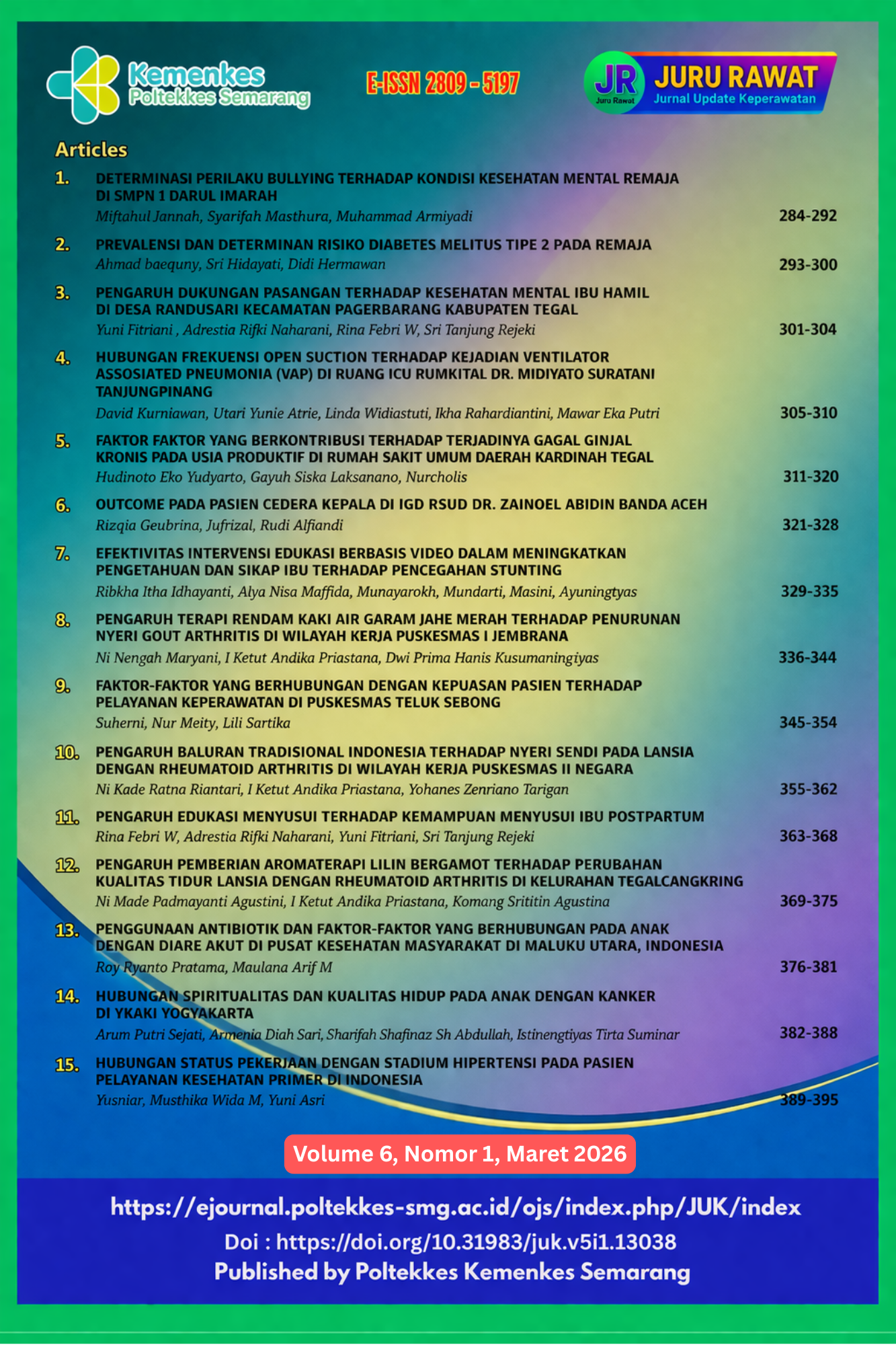
THE RELATIONSHIP BETWEEN THE FREQUENCY OS OPEN SUCTION AND THE INCIDANCE OF VENTILATOR ASSOSIATED PNEUMONIA (VAP) IN THE ICU OF NAVAL HOSPITAL DR. MIDIYATO SURATANI TANJUNGPINANG
DOI:
https://doi.org/10.31983/juk.v6i1.14028Keywords:
Open Suction, Ventilator Associated, PneumoniaAbstract
Ventilator Associated Pneumonia (VAP) is a lung infection after 48 hours of mechanical ventilation. During the use of mechanical ventilation, medical action is always required. suction which is a procedure for suctioning secretions from the airways. However, this procedure suction Improper use can potentially increase the risk of infection by pushing microorganisms from the oropharynx into the lungs. The aim of the study was to determine the relationship between the frequency of open suction to the incident Ventilator Assosiated Pneumonia (VAP). This study uses a descriptive design. cross-sectional with the method analytical observation. Data were collected from all mechanically ventilated patients who met the inclusion and exclusion criteria in the ICU Room of Naval Hospital dr. Midiyato Suratani, Tanjungpinang from August 13 to November 30, 2024, with a sample size of 30 respondents. The sampling technique was purposive sampling accidental sampling. Test results Pearson Chi-Square obtained p-Value = 0,013 (a-0,05) so Ho is rejected, meaning there is a frequency relationship open suction against VAP incidents. Suction Excessive use of tobacco causes irritation and injury to the respiratory tract, encouraging microorganisms from the oropharynx to enter and multiply in the lungs, ultimately increasing the risk of infection and weakening the body's defenses. Suction must be done in a balanced way, not too often, but also not too rarely with a frequency threshold. Suction< 7x/day and adjusted to the patient's condition. Furthermore, proper technique and maintaining equipment hygiene are crucial to reducing the risk of VAP.
References
Abdullah, H., Weingart, M. F., Fuller, R., Pegues, D., & Kelly, B. J. (2021). Frekuensi hisap subglotis dan kejadian buruk terkait ventilator selama penyakit kritis Perkenalan. 42(7), 826–832. https://doi.org/10.1017/ice.2020.1298.Frekuensi
Affanin, S. (2015). Prevalence of ventilator-associated pneumonia (VAP) and its association with gender and other factors: A study of 22 cases. Journal of Critical Care and Respiratory Medicine, 15(4), 125–131.
Awalin, F., Faridah, I., & Ridwan, U. S. (2019). FaktorFaktor yang berhubungan dengan Ventilation Associated Pneumonia (VAP) pada Populasi Pasien Gangguan Persyarafan di Ruang ICU RSU Provinsi Banten. Jurnal Kesehatan, 8(2), 1–15.
Baredes, N. C., Desmery, P., & Palizas, F. (2003). Resolusi pneumonia terkait ventilator: Evaluasi prospektif skor infeksi paru klinis sebagai prediktor klinis awal terhadap hasil*. 2.
Bickley, L. S., & Szilagyi, P. G. (2023). Bates’ Guide to Physical Examination and History Taking (13th ed.). Wolters Kluwer.
Centers for Disease Control and Prevention. (2019). Guidelines for the Prevention of Ventilator Associatde Pneumonia in Adults. Retreived from CDC Website.
Clara, H. (2015). Current Trends and Challenges in Managing Ventilator-Associated Pneumonia: Mortality Rates and Prevention Strategies. Critical Care Research and Practice, 987654.
Dewi, H., & Harahap, M. (2015). Hubungan Usia Penderita Ventilator Associated Pneumonia Dengan Lama Rawat Inap Di Icu Rsup Dr. Kariadi Semarang. Jurnal Kedokteran Diponegoro, 4(2), 111–119.
Diling, et al. (2019). Risk Factors of Ventilator-Associated Pneumonia in Critically III Patients ICU Center. The Second Xiangya Hospital. Central South University.
Dodek, P., Keenan, S. P., & Bergman, J. (2014). Clinical Practice Guidelines for the Prevention of Ventilator-Associated Pneumonia. American Journal of Respiratory and Critical Care Medicine, 171(4), 508–513.
Doenges, M. E. (2020). Nursing Care Plans: Guidelines for Individualizing Client Care Across the Life Span. F.A. Davis Company.
Indonesia, K. K. R. (2022). Laporan Kesehatan Nasional Tahun 2022.
Insani, F. T. (2019). Hubungan Frekuensi Suction Terhadap Kejadian Ventilator Assosiated Pneumonia (Vap) Di Ruang Icu Rsud Dr. M. Yunus Bengkulu Tahun 2019. Jurnal, 3(1), 18–23.
Koenig, S. M., & Truwit, J. D. (2012). Ventilator-Associated Pneumonia: Diagnosis, Treatment, and Prevention. Clinical Infectious Diseases, 54(2), 210–217.
Lange, T., Smith, J., & Zhang, W. (2013). Respiratory and cardiovascular risk factors in intensive care unit admissions: A study of patients aged 40-60 years. The Lancet Respiratory Medicine, 7(5), 452–459.
Mer, J. (2015). The Impact of Suctioning Techniques on Ventilator-Associated Pneumonia: Mechanisms and Recommendations. Respiratory Care, 60(4), 565–573.
Miguel-Díez, J., López-de-Andrés, A., Hernández-Barrera, V., Ji, Z., Jiménez-García, R., & López-Herranz, M. (2020). Gender differences in incidence and in-hospital outcomes of community-acquired, ventilator-associated and non-ventilator hospital-acquired pneumonia in Spain. Respirology, 25(11), 1171–1179.
Nency, C., Irawan, D., & Andrini, F. (2015). Gambaran Kejadian Ventilator-Associated Pneumonia pada Pasien yang Dirawat di ICU Dan CVCU Rsud Arifin Achmad Periode Januari 2013 S/D Agustus 2014. Jom FK, 2(2), 1–9.
Nikolich, Z., & J. (2018). The twilight of immunity: emerging concepts in aging of the immune system. Nature Immunology, 19(1), 10–19.
Noviyanti, D. W., Wahyuni, A., Ramdini, D. A., & Rahmayani, F. (2022). HUBUNGAN LAMA PENGGUNAAN VENTILATOR MEKANIK DENGAN MORTALITAS DI INTENSIVE CARE UNIT (ICU) RSUD Dr. H. ABDUL MOELOEK. Medical Profession Journal of Lampung, 12(1), 153–159. https://doi.org/10.53089/medula.v12i1.391
Riatsa, A., Nana, R., & Nur, K. (2017). Faktor-Faktor yang Berhubungan dengan Kejadian Ventilator Associated Pneumonia (VAP) pada Pasien yang Menggunakan Ventilator Mekanik di ICU RSUD Tugurejo Semarang. Jurnal Ners Widya Husada, 4(3), 85–94.
Soetjipto, S. (2020). Comprehensive Strategies for Preventing Ventilator-Associated Pneumonia in Critical Care. Journal of Critical Care Nursing, 35(2), 123–130.
Suparjo, S., Himawan, F., & Cuciati, C. (2021). Pengetahuan Perawat Tentang Australasian Triage Scale ( ATS ) dengan Pelaksanaan ATS di IGD RSU Kota Tegal. Jurnal Ilmu Kesehatan, 5(2), 289–294. https://doi.org/DOI: http://dx.doi.org/10.33757/jik.v5i2.451
Wahyuningsih, I. S. (2017). Profil Demografi Pasien Kritis Dewasa Berventilator Yang Mengalami Nyeri. Jurnal Keperawatan Dan Pemikiran Ilmiah, 3(7), 54–61.
Wang, X., Zhang, J., & Liu, J. (2021). Frequency of Endotracheal Suctioning and the Risk of Ventilator-Associated Pneumonia in Mechanically Ventilated ICU Patients. Journal of Intensive Care Medicine, 36(8), 950–957.
Who. (2023). Mechanical Ventilation in the ICU. Guidelines and Procedures.
Winarno, I., Aviasena, A., & Dwi, L. (2020). Kerusakan pada batang otak dan fungsinya dalam pernapasan: Anastesiologi dan therapy intensif RSUD Ajibarang. Jurnal Keperawatan Dan Pemikiran Ilmiah, 3(9), 54–61.
Yuliani, S., Syahrul, F., & Sari, Y. (2019). Pengaruh Tindakan Suction ETT Terhadap Kadar Saturasi Oksigen Pada Pasien Gagal Nafas di Ruang ICU dan IGD Rumah Sakit Umum Daerah Prabumulih Tahun 2017. Jurnal Berita Ilmu Keperawatan, 12(2), 84–90.
Downloads
Published
How to Cite
Issue
Section
License
Copyright (c) 2026 Utari Yunie Atrie, Linda Widiastuti, David Kurniawan, Ikha Rahardiantini, Mawar Eka Putri

This work is licensed under a Creative Commons Attribution 4.0 International License.