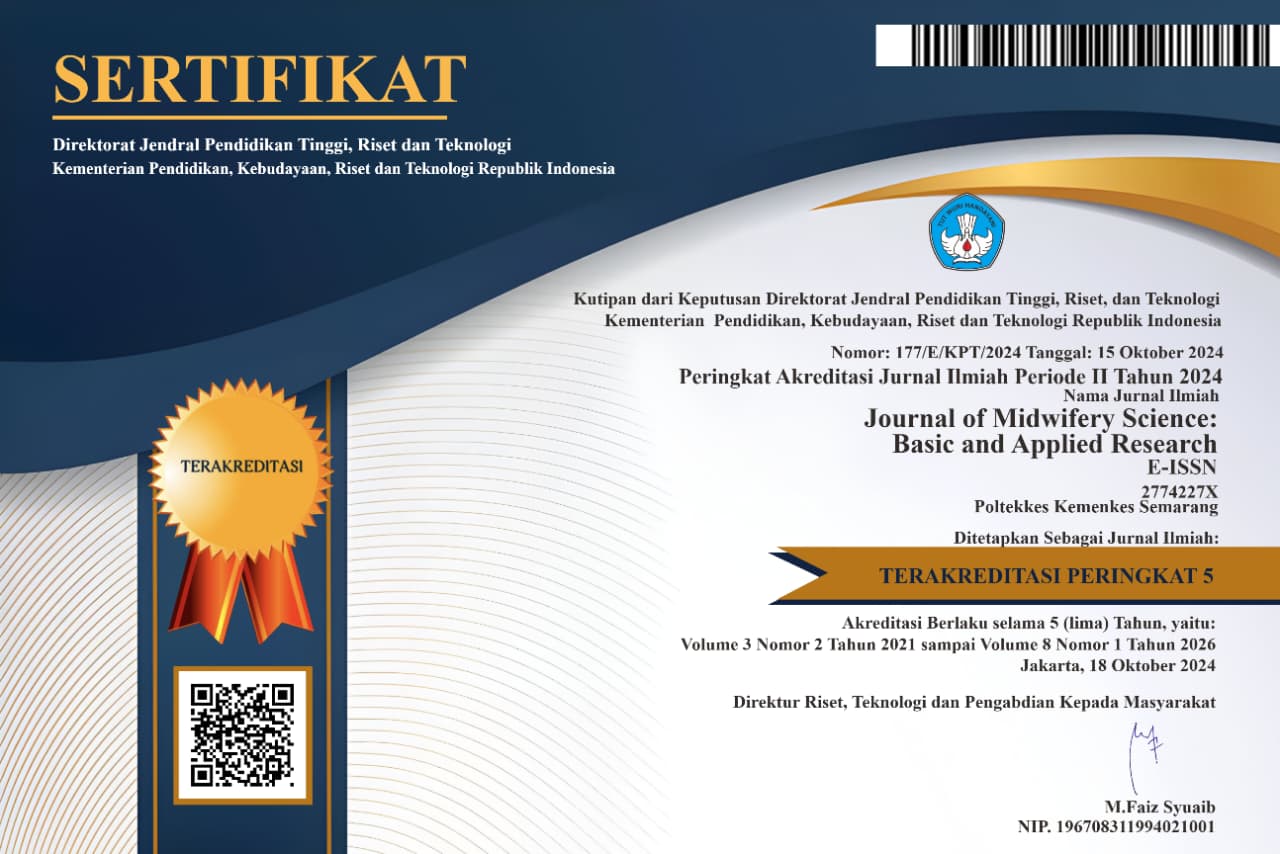
Sample Certificate
We understand that the authors worked carefully to prepare the manuscripts, and we have undertaken a peer-review process. However, published articles may sometimes be recalled or removed for scientific reasons. This should not be done easily and can only happen under extraordinary circumstances. Therefore, corrections, clarifications, retractions, and apologies, when necessary, will be carried out with strict standards to maintain trust in the authority of its electronic records. Our commitment and policy are to maintain the integrity and completeness of important scientific archives for archival researchers and librarians.
The papers published in the Journal of Midwifery Science: Basic and Applied Research will be considered retracted in the publication if:
To ensure that retractions are handled according to publication best practice and by retraction guidelines from COPE, the Journal of Midwifery Science: Basic and Applied Research adopts the following retraction process:
Note that even if an author holds the copyright for an article, they do not automatically have the right to revoke it after publication. The integrity of published scientific records is paramount, and the retraction guidelines from COPE still apply in such cases.
Authors are allowed to make withdrawals for articles that have been accepted as long as the article has not been officially published as scheduled and the DOI has not been activated. If the author requests to withdraw manuscripts, a formal letter signed by all authors and the institutional directors of the first author must be sent to the Editor-in-Chief. There are no fees for the withdrawal process. However, if the article has been published on a schedule and the article's DOI is active, then the withdrawal cannot be made, and the authors must ask for a retraction if the article still wants to be withdrawn. When an article is withdrawn, its PDF and XML content are removed and replaced with PDF and XML that merely state that it has been withdrawn following the Journal Policy. It includes a link to the most recent version of the policy document.
Journal of Midwifery Science: Basic and Applied Research should consider issuing a correction if:
Corrections to peer-reviewed content fall into one of three categories:
The Editor-in-Chief decides whether a correction should be issued, sometimes with advice from reviewers or editorial board members. Editor-in-Charge will contact the paper's authors concerned with a request for clarification, but the final decision about whether a correction is required and which type rests with the Editor-in-Chief. After being approved by all parties, the correction statement is posted online and published in the next available issue of the journal.
It might be necessary to inform readers with an Editorial Note if there is a potential issue with an article that has not yet been fixed. For instance, if the Journal of Midwifery Science: Basic and Applied Research learns that research or publishing misconduct may have occurred or if there is a significant disagreement between the authors or between the authors and third parties, an editorial note of this kind may be published. Typically, the Editorial Note will be published while additional inquiries are made and until a more permanent answer has been found (such as releasing a revised "corrected" or a Retraction).
Suppose there are significant concerns about an article, but no concrete evidence can be found to support a retraction unambiguously. In that case, the Journal of Midwifery Science: Basic and Applied Research may, in exceptional circumstances, choose to publish an Expression of Concern linked to the problematic article. This might comprise:
Sample Certificate