Instruction for Author
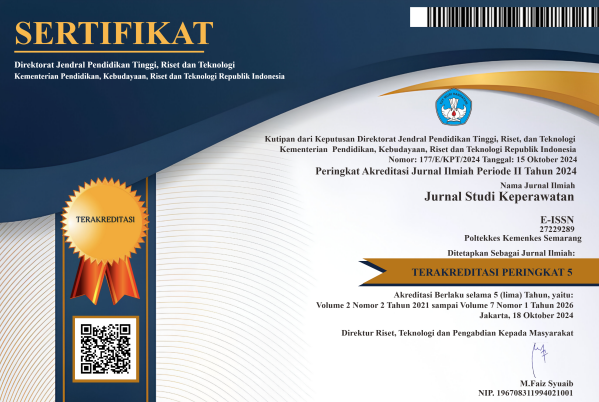
Accreditation
Collaboration
Auxiliary Tools

Statistic


Jurnal Studi Keperawatan (J-SiKep) is committed to maintaining academic integrity and originality in all published articles. Plagiarism in any form is considered unethical and unacceptable.
Plagiarism includes, but is not limited to:
All submitted manuscripts will be checked for plagiarism using plagiarism detection software before the review process. The editorial team evaluates both the similarity percentage and the context of the similarity.
The journal allows a maximum similarity index of 20%, excluding references, quotations, and commonly used phrases. Manuscripts exceeding this limit may be returned to the authors for revision or rejected.
If plagiarism is identified at any stage of the publication process, the journal may take the following actions:
Authors are responsible for ensuring that their work is original and properly cited. By submitting a manuscript to the journal, authors confirm that their work is free from plagiarism and has not been published or submitted elsewhere.
The Journal of Nursing Studies (J-SiKep) follows the ethical guidelines of the Committee on Publication Ethics (COPE) and is committed to handling plagiarism cases transparently and fairly.
Editorial Office of Jurnal Studi Keperawatan
Program Studi Keperawatan Blora -Politeknik Kesehatan Kemenkes Semarang
Jl. Gatot Subroto No. 119, Blora, Jawa Tengah, Indonesia
Telp. +6282134246369| Email: [email protected]


Jurnal Studi Keperawatan disseminated below Creative Commons Attribution-ShareAlike 4.0 International License.
Powered by Public Knowledge Project OJS
