Peer Review Prosess
The peer-review process is the core of scientific publication, relying on peer reviewers with expertise in the manuscript's topic. Thus, the Editor-in-Charge and the peer reviewers are important figures in ensuring the peer-review process goes smoothly. The peer-review process in the LINK Journal applies as follows:
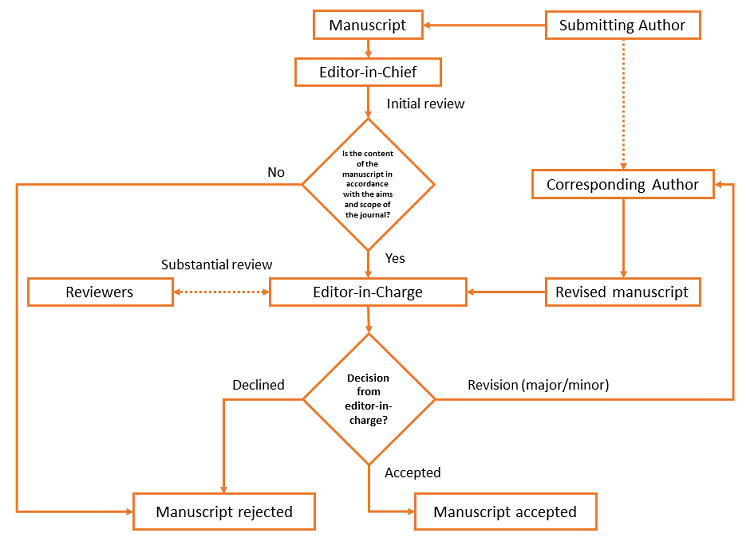
- The submitting author submits the manuscript via the OJS LINK Journal.
- Editor-in-Chief Conduct an initial review to assess the suitability of the manuscript's contents with the aims and scope of the LINK Journal. If the manuscript does not match, the Editor-in-Chief will immediately reject the article (desk rejection). Those rejected at this stage are also insufficiently original or have serious scientific flaws.
- If the manuscript is within its aims and scope and meets the minimum criteria, the Editor-in-Chief will assign one editor to continue the peer-review process of the manuscript. Editor-in-Charge is an editor whose areas of expertise match the substance of the manuscript. Although very rare, it is entirely feasible for an exceptional manuscript to be accepted at this stage.
- The Editor-in-Charge asks 2 reviewers with appropriate areas of expertise to conduct a substantial review of the manuscript. The reviewer will be asked to evaluate whether the manuscript is scientifically sound and coherent, whether it duplicates previously published work, and whether it is sufficiently clear for publication. Reviewers are not expected to correct or copyedit manuscripts since language correction is not part of the peer-review process and will be done by the Editor-in-Charge. The selection of reviewers is made by ensuring there is no conflict of interest between authors and reviewers. We use a double-blind peer-review method. The peer-review process by reviewers is estimated to take 4 to 20 weeks.
- After obtaining the reviewers' consideration, the Editor-in-Charge decides whether to accept, reject, or return it to the corresponding author for revision. There are two possible types of revision: minor and major. Minor revisions indicate that the Editor-in-Charge will review the authors' corrected results without involving the previously on-duty reviewers. In contrast, the major revisions suggest that previously on-duty reviewers will re-examine the authors' improvements before forwarding them to the Editor-in-Charge for a final decision.
- After the authors make revisions, the Editor-in-Charge re-evaluates the manuscript. If needed, especially if the previous decision was a major revision, the Editor-in-Charge can conduct a 2nd round review.
- The final decision to accept or reject the manuscript rests with the Editor-in-Charge, who takes into account the reviewers' previous recommendations, the manuscript revisions, and other requirements, such as a similarity level of no more than 20%. The Editor-in-Charge's decision is final, and the authors are not allowed to challenge any of the Editor-in-Charge's final decisions. The average time from initial submission to the first decision is usually between 8 and 16 weeks. If the revision process goes smoothly, the average time from submission to publication is 12-36 weeks.

Becoming a Reviewer
If you are not currently a reviewer for the LINK Journal but would like to be added to the list of reviewers, please contact us. The benefits of reviewing for the LINK Journal include the opportunity to see and evaluate the latest work in the related research area at an early stage and to be acknowledged in our list of reviewers. You may also be able to cite your work for the LINK Journal as part of your professional development requirements. LINK Journal's reviewers are volunteers who contribute their expertise to the science. Thus, no financial payments are made. If you are interested in becoming a reviewer for the LINK Journal, please get in touch with [email protected].