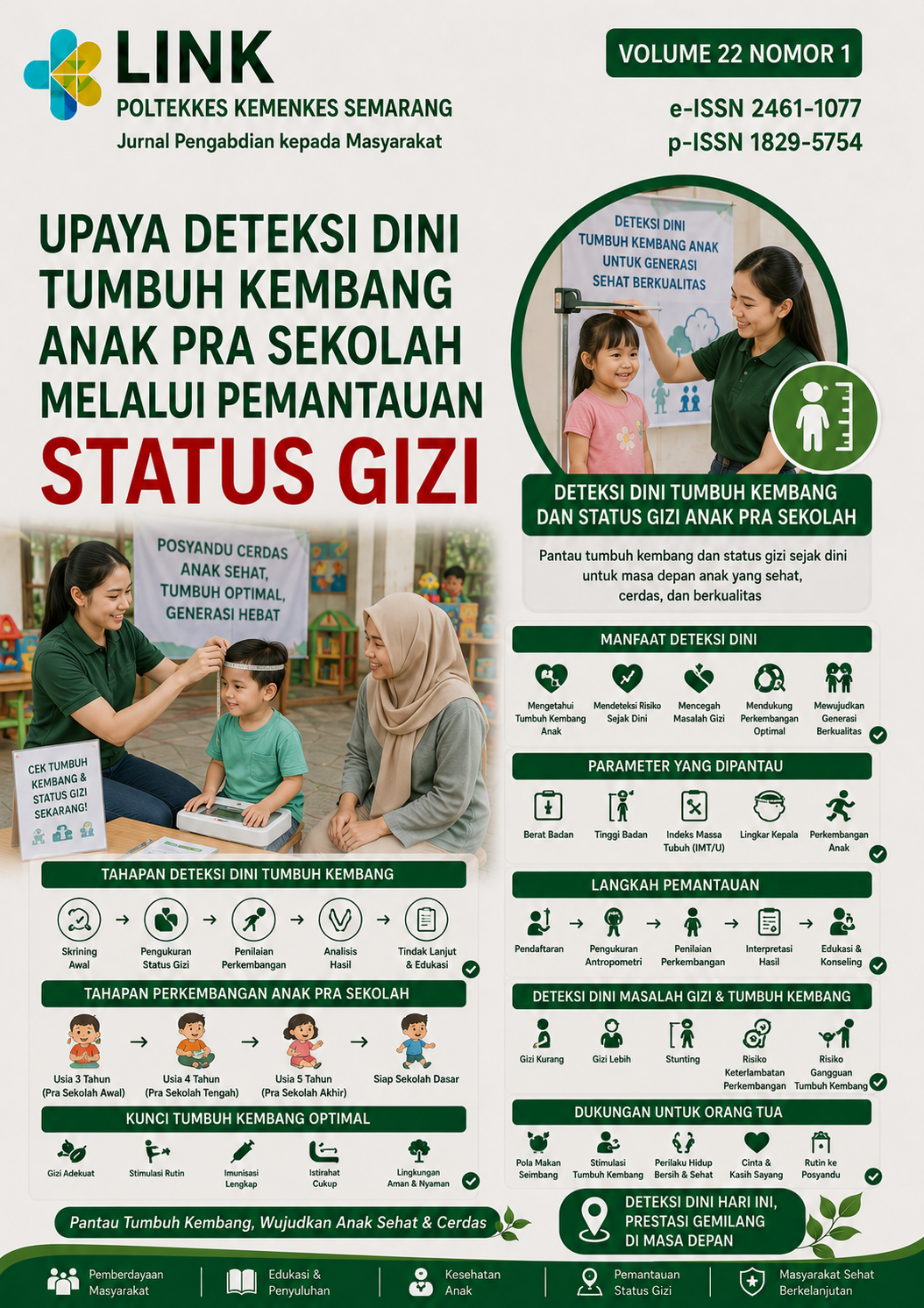
Early Detection of the Growth and Development of Pre-School Children Through Monitoring of Nutritional Status
DOI:
https://doi.org/10.31983/link.v22i1.15012Keywords:
Early childhood, Anthropometrics, Nutritional statusAbstract
Issues relating to undernutrition, stunting, and overnutrition remain public health challenges that can affect children’s growth and development. Therefore, efforts are needed to ensure early detection and raise awareness of the importance of monitoring children’s nutritional status. The objective of this community service activity was to determine the nutritional status of young children through anthropometric measurements of pupils at 20. The activity was carried out using a participatory approach through the stages of planning, coordination, anthropometric measurement, and data analysis, involving 952 children. Measurements included weight, height, upper arm circumference (UAC), and anthropometric index assessments based on WHO standards. Based on UAC measurements, almost all children fell into the ‘good nutrition’ category. Based on height-for-age, many children had normal height, although some children were still classified as short or very short, and some children were underweight, malnourished, or overweight, even obese. These findings indicate the existence of a double burden of malnutrition among young children. This initiative helps detect nutritional problems in young children at an early stage and raises awareness among schools and parents regarding the importance of regular growth monitoring. The results of this initiative can serve as a basis for developing nutritional interventions to support optimal child growth and development.
References
Alemu, C., Wudu, H., & Abeje, M. (2024). Determinants of nutritional status of children aged 6–59 months in the case of Itang special woreda, Gambella, Ethiopia. Scientific Reports, 14(1). https://doi.org/10.1038/s41598-024-59507-4
Alristina, A. D., Laili, R. D., Nagy, É., & Feith, H. J. (2025). The Importance of Socioeconomic Factors Associated with Maternal Nutrition Knowledge and Undernutrition Among Children Under Five. Nutrients , 17(21). https://doi.org/10.3390/nu17213355
Andi Nurlinda, S. K. M. (2019). Gizi dalam Siklus Daur Kehidupan: Seri Baduta (Untuk Anak 1-2 Tahun). Penerbit Andi.
Badan Pusat Statistik. (2025). Indeks Pembangunan Manusia (IPM) Indonesia tahun 2025 mencapai 75,90, meningkat 0,88 poin dibandingkan tahun sebelumnya yang sebesar 75,02.
Black, R. E., Victora, C. G., Walker, S. P., Bhutta, Z. A., Christian, P., De Onis, M., Ezzati, M., Grantham-Mcgregor, S., Katz, J., Martorell, R., & Uauy, R. (2013). Maternal and child undernutrition and overweight in low-income and middle-income countries. In The Lancet (Vol. 382, Number 9890, pp. 427–451). Elsevier B.V. https://doi.org/10.1016/S0140-6736(13)60937-X
Iwan Ariawan, Razak Thaha, Nur Indrawati Lipoeto, Witoelar, F., Ahmad Syafiq, I., & Avenzora, A. (2025). Survei Status Gizi Indonesia 2024 I Tim Penyusun SSGI 2024 dalam Angka.
Kolčić, I. (2012). Double burden of malnutrition: A silent driver of double burden of disease in low- and middle-income countries. Journal of Global Health, 2(2). https://doi.org/10.7189/jogh.02.020303
Koshy, A. P., & Koshy, A. P. (2026). Application Of Ordinal Logistic Regression Analysis In Determining Risk Factors In Children With Malnutrition. International Journal of Drug Delivery Technology, 16(15), 108–115. https://doi.org/10.25258/ijddt.16.15s.12
Masruroh, L. D., & Mansur, H. (2026). Korelasi Status Gizi dengan Kesesuaian Perkembangan Anak Balita Usia 12-59 Bulan Menggunakan Skrining KPSP. Indonesian Journal of Early Childhood: Jurnal Dunia Anak Usia Dini, 8(1), 72. http://jurnal.unw.ac.id/index.php/IJEC
Mauludyani, A. V. R., Khomsan, A., Riyadi, H., Nurhidayati, V. A., & Fatchiya, A. (2025). Determinants of children’s nutritional status in rural and urban areas of West Java, Indonesia. Nutricion Clinica y Dietetica Hospitalaria, 45(2), 20–26. https://doi.org/10.12873/452ali-khomsan
Niraj, K. C., & Kuaanan, T. (2025). The Impact of Climate Change and Socioeconomic Factors on Child Undernutrition in Karnali Nepal. Indian Journal of Public Health, 69(4), 398–404. https://doi.org/10.4103/ijph.ijph_195_24
Putri, F. A., Sianturi, R., & Mulyana, E. H. (2025). Pengukuran Status Gizi pada Anak Usia Dini dengan Metode Antropometri. JECIE (Journal of Early Childhood and Inclusive Education), 8(2), 463–471. https://doi.org/10.31537/jecie.v8i2.1842
Putri, R. A., Sendari, S., & Widiyaningtyas, T. (2018). Classification of Toddler Nutrition Status with Anthropometry Calculation using Naïve Bayes Algorithm. 2018 International Conference on Sustainable Information Engineering and Technology (SIET), 66–70. https://doi.org/10.1109/SIET.2018.8693169
Qaodriyah, D. M., Subiastutik, E., & Jamhariyah, J. (2023). Provision of MP - Early Breastfeed with The Nutrition Status of Children Age 7 - 24 Months in Panduman Village, Jember District. LINK, 19(2), 111–116. https://doi.org/10.31983/link.v19i2.10021
Ramírez-Luzuriaga, M. J., Hoddinott, J., Martorell, R., Patel, S. A., Ramírez-Zea, M., Waford, R., & Stein, A. D. (2021). Linear Growth Trajectories in Early Childhood and Adult Cognitive and Socioemotional Functioning in a Guatemalan Cohort. Journal of Nutrition, 151(1), 206–213. https://doi.org/10.1093/jn/nxaa337
Setia, A., Saleh, A. S., Mirah, A. A. A. A., & Demu, Y. D. B. (2021). Determinants of Nutritional Status of Two-Year-Old Infant’s First Thousand Days of Life in Work Area of Oepoi Public Health Center, Kupang, Indonesia. International Journal of Nutrition Sciences, 6(2), 81–89. https://doi.org/10.30476/IJNS.2021.90302.1124
Swakarsa, J., Ardhianingtyas, N., Narulita Sari, R., & Hasniati Rahmah, A. (2025). Penilaian Status Gizi Balita Berdasarkan IMT dan LiLA Dalam Upaya Deteksi Dini Stunting. Jurnal Ilmiah Ilmu Kesehatan, 11(2), 118–123.
Thompson, K. L., Barth, M. M., & Gutschall, M. D. (2024). Life Cycle Nutrition for Public Health Professionals. Springer Publishing Company.
Umiatin, Mauldy, R. M., & Indrasari, W. (2021). Design, prototype of arduino and android-based anthropometry system for toddler’s head and upper arm circumference measurement. Journal of Physics: Conference Series, 2019(1). https://doi.org/10.1088/1742-6596/2019/1/012090
UNICEF. (2025). Perkembangan anak usia dini.
UNICEF, World Bank Group, & World Health Organization. (2025). Levels and trends in child malnutrition.
Zsakai, A., Annar, D., Koronczai, B., Molnar, K., Varro, P., Toth, E., Szarvas, S., Tauber, T., Karkus, Z., Varnai, D., & Muzsnai, A. (2023). A new monitoring system for nutritional status assessment in children at home. Scientific Reports, 13(1). https://doi.org/10.1038/s41598-023-30998-x