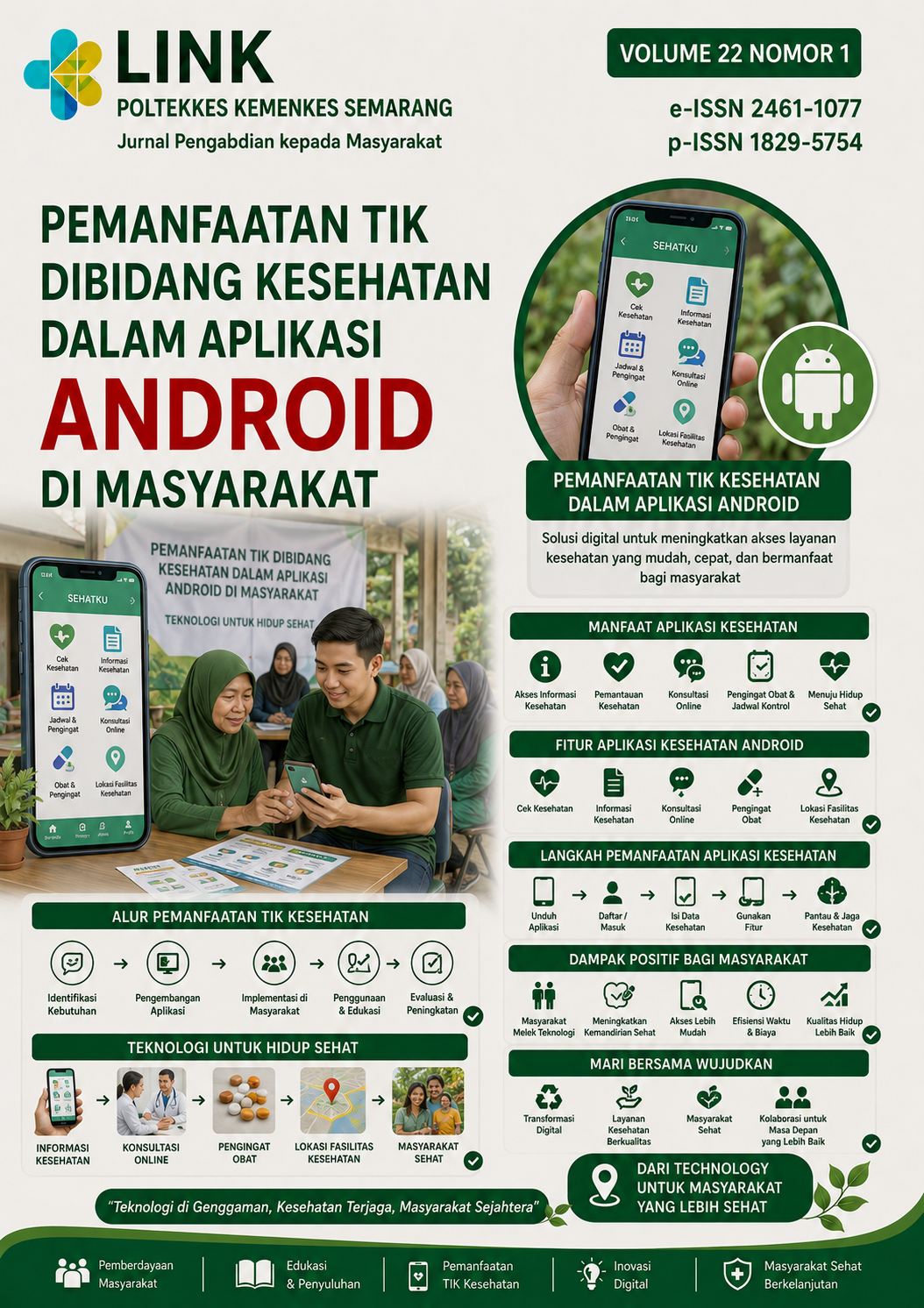
Utilization of Information and Communication Technology in The Field of Health in The Community
DOI:
https://doi.org/10.31983/link.v22i1.14967Keywords:
Android Applications, Community Empowerment, Health, Health Information TechnologyAbstract
The development of Information and Communication Technology (ICT) in the healthcare sector has provided various conveniences in accessing digital health services, such as online consultations, medication ordering, and access to health information through Android-based applications. However, the utilization of these technologies in the community remains suboptimal due to low levels of digital literacy and limited public trust in health applications. This community service activity aimed to improve public knowledge, skills, interest, and trust in using Android-based health applications. The activity was conducted through counseling sessions and hands-on workshops for residents of Alfatih Regency Phase IV, Tenayan Raya, Pekanbaru City. The results showed improvements across all indicators after the implementation of the program. Public knowledge, capabilities, and trust in health applications are increasing. The N-Gain analysis demonstrated high-category improvements in knowledge (0.79) and application usage skills (0.73), while interest (0.58) and trust (0.54) were categorized as moderate. This activity proved effective in improving community digital literacy in the healthcare sector and can serve as an initial step toward broader utilization of digital health services within the community.
References
Ausserhofer D, Piccoliori G, Engl A, et al. Community-dwelling older adults' readiness for adopting digital health technologies. JMIR Form Res. 2024;8.
Bates DW, Landman A, Levine DM. Health apps and digital health adoption. NPJ Digit Med. 2021;4(1):1–8.
Blondino CT, Knoepflmacher A, Johnson I, et al. The use and potential impact of digital health tools at the community level. BMC Public Health. 2024;24:650.
Giebel GD, Abels C, Plescher F, et al. Problems and barriers related to the use of mHealth apps from the perspective of patients. J Med Internet Res. 2024;26.
Hake RR. Interactive-engagement versus traditional methods: A six-thousand-student survey of mechanics test data for introductory physics courses. Am J Phys. 1998;66(1):64–74.
Iyengar K, Upadhyaya GK, Vaishya R, Jain V. COVID-19 and applications of digital health technologies. J Fam Med Prim Care. 2020;9(5):2252–2257.
Kementerian Kesehatan Republik Indonesia. Transformasi Digital Kesehatan Indonesia 2024–2029. Jakarta: Kemenkes RI; 2024.
Kim H, Schnall R, Yoon N, et al. Development and validation of mobile-centered digital health readiness scale. J Med Internet Res. 2024.
Kruse CS, Krowski N, Rodriguez B, et al. Telehealth and patient satisfaction: a systematic review. BMJ Open. 2022;12.
Labrique AB, Vasudevan L, Kochi E, Fabricant R, Mehl G. Digital health and health systems of the future. Lancet Digit Health. 2023;5(6)–e354.
Levin-Zamir D. Digital health literacy and health technology in health systems and beyond. Inf Serv Use. 2023;43(2):147–156.
Liu D, Yang S, Cheng CY, et al. Online health information seeking, eHealth literacy and health behavior. J Med Internet Res. 2024.
Mesko B, Győrffy Z. The rise of the empowered patient in the digital health era. J Med Internet Res. 2023.
Portz J, Moore S, Bull S. Evolutionary trends in the adoption, adaptation, and abandonment of mobile health technologies. J Med Internet Res. 2024;26.
Pratama R, Nugroho Y. Digital literacy and technology acceptance in healthcare applications: A community perspective. J Health Inform. 2024;10(3):201–210.
Rahmawati D, Sari NP, Putra A. Effectiveness of digital health education through community-based training in improving digital literacy. J Kesehat Masy. 2024;19(2):115–123.
Schroeder T, Haug M, Georgiou A, et al. Evidence of how physicians and their patients adopt mHealth apps in Germany. JMIR Mhealth Uhealth. 2024;12.
Shaw T, McGregor D, Brunner M, et al. What is eHealth literacy? A systematic review. Digital Health. 2022;8:1–16.
Tuitert I, Marinus JD, Dalenberg J, et al. Digital health technology use across socioeconomic groups. JMIR Public Health Surveill. 2024.
van Kessel R, Wong BLH, Rubinić I, et al. Is Europe prepared for digital health? Lancet Reg Health Eur. 2023;14:100316.
Wijaya H, Santoso B. Factors influencing trust in digital health applications among community users. Int J Public Health Sci. 2024;13(1):45–52.
World Health Organization. Digital Health: Transforming and Extending Care Delivery. Geneva: World Health Organization; 2021.
World Health Organization. Global Strategy on Digital Health 2020–2025. Geneva: World Health Organization; 2021.
Yuen E, Winter N, Savira F, et al. Digital health literacy and its association with sociodemographic characteristics, health resource use, and health outcomes. Interact J Med Res. 2024;13.