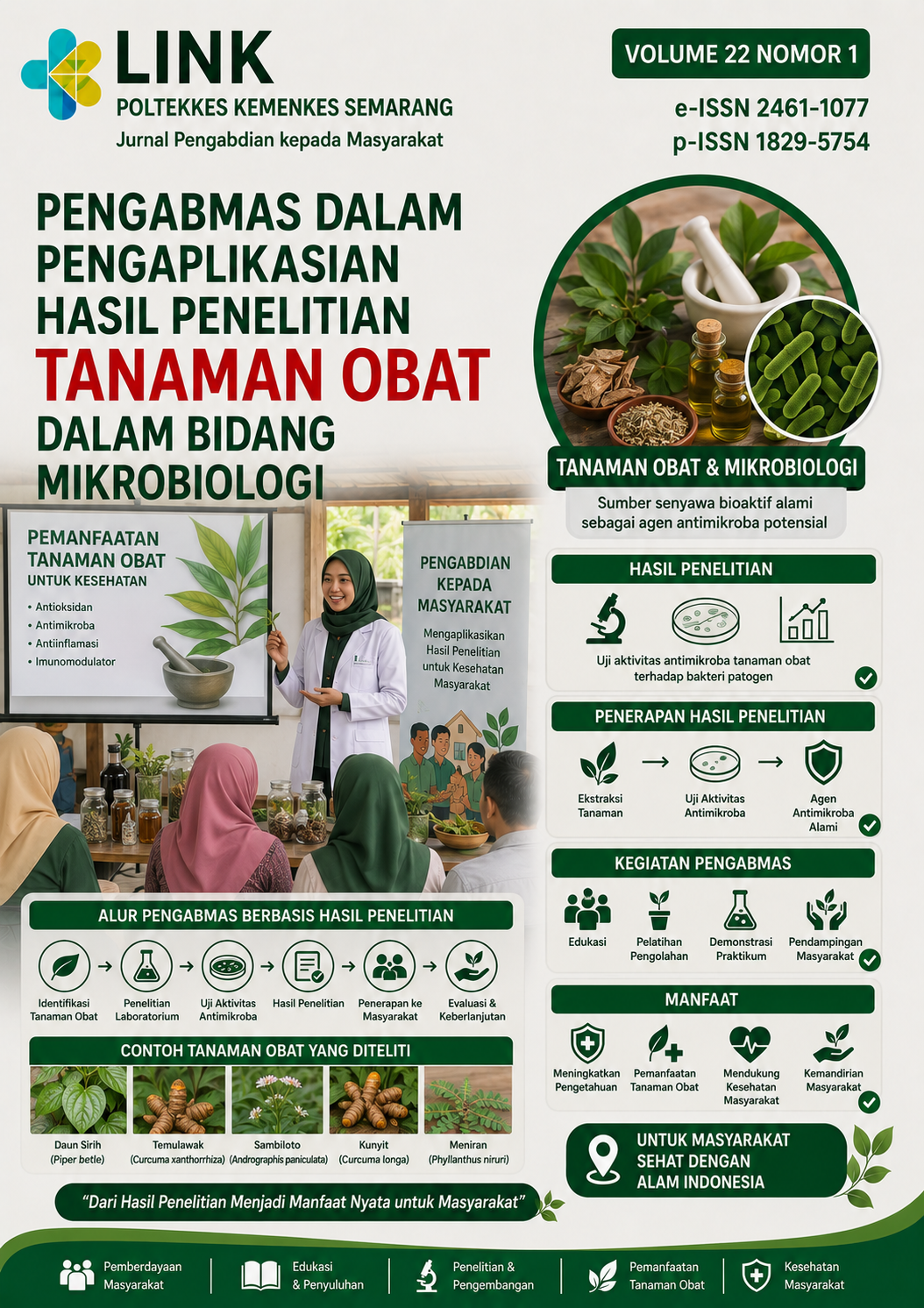
Community Service in the Context of Research Application: The Importance of Medicinal Plants in the Field of Microbiology
DOI:
https://doi.org/10.31983/link.v22i1.14709Keywords:
Antibacterial, Community empowerment, Fermentation, noni (Morinda citrifolia)Abstract
Morinda citrifolia is efficacious for treating several degenerative diseases such as cancer, tumors, and diabetes. These substances have been proven to be antibacterial substances due to infectious bacteria such as, Proteus morganii, Bassilus subtilis, Staphylococus aureus, Pseudomonas aeruginosa and Echercia coli. This community service aims to utilize noni fruit, ginger, and honey as a form of application for the application of research results in community outreach held in Bangetayu Wetan village. Noni fruit that has been fermented is then tested against Eschericia coli and Salmonella typhi bacteria using micro titers. The results showed that at a concentration of 25%, there was inhibition of the growth of Salmonella typhi bacteria, while for Escheria coli at a concentration of 25%, growth inhibition began to occur. With a very large concentration of the taste of this fermentation, the acidity and smell of noni that is typical for some people may find it difficult to accept. Based on the results of the community service to the community, the community welcomes the results of the community that have been distributed to the entire community properly.
References
Agrawal, D. K., Saikia, D., Tiwari, R., Ojha, S., Shanker, K., Kumar, J. K., … Khanuja, S. P. S. (2008). Demethoxycurcumin and its semisynthetic analogues as antitubercular agents. Planta Medica, 74(15), 1828–1831. https://doi.org/10.1055/s-0028-1088335
Ali, M., Kenganora, M., & Manjula, S. N. (2016). Health benefits of morinda citrifolia (Noni): A review. Pharmacognosy Journal, 8(4), 321–334. https://doi.org/10.5530/pj.2016.4.4
Baldin, V. P., Bertin de Lima Scodro, R., Mariano Fernandez, C. M., Ieque, A. L., Caleffi-Ferracioli, K. R., Dias Siqueira, V. L., … Cardoso, R. F. (2019). Ginger essential oil and fractions against Mycobacterium spp. Journal of Ethnopharmacology, 244, 112095. https://doi.org/10.1016/j.jep.2019.112095
Barua, N., & Buragohain, A. K. (2021). Therapeutic potential of curcumin as an antimycobacterial agent. Biomolecules, 11(9), 1–13. https://doi.org/10.3390/biom11091278
Bussmann, R. W., Hennig, L., Giannis, A., Ortwein, J., Kutchan, T. M., & Feng, X. (2013). Anthraquinone content in noni (Morinda citrifolia L.). Evidence-based Complementary and Alternative Medicine, 2013, 20–22. https://doi.org/10.1155/2013/208378
Elpers, L., & Hensel, M. (2020). Expression and Functional Characterization of Various Chaperon-Usher Fimbriae, Curli Fimbriae, and Type 4 Pili of Enterohemorrhagic Escherichia coli O157:H7 Sakai. Frontiers in Microbiology, 11(March), 1–11. https://doi.org/10.3389/fmicb.2020.00378
Fauziyah, R., Mulqie, L., & Choesrina, R. (2022). Studi Literatur Aktivitas Antibakteri Buah Mengkudu (Morinda citrifolia). Bandung Conference Series: Pharmacy, 2(2). https://doi.org/10.29313/bcsp.v2i2.4673
Fitriana, W. D., & Islami, M. F. (2025). Antioxidant and Antibacterial Activities of Noni Fruit ( Morinda citrifolia ) Extract. 10(1), 92–101.
Hardiyanti, R., Hidayat, M., & Affan, M. (2024). Noni Fruit ( Morinda citrifolia L .) Extraction and Phytochemical Analyses : A Mini Review. 47(4), 1139–1156.
Hou, S., Ma, D., Wu, S., Hui, Q., & Hao, Z. (2025). Morinda citrifolia L .: A Comprehensive Review on Phytochemistry , Pharmacological Effects , and Antioxidant Potential. (June 2024), 1–43.
Id, M. S., Maria, E., Id, V., Salehi, B., & Sharifi-rad, J. (2017). Plants of the Genus Zingiber as a Source of Bioactive Phytochemicals : From Tradition to Pharmacy. 1–20. https://doi.org/10.3390/molecules22122145
Kadeřábková, N., Mahmood, A. J. S., & Mavridou, D. A. I. (2024). Antibiotic susceptibility testing using minimum inhibitory concentration (MIC) assays. npj Antimicrobials and Resistance, 2(1). https://doi.org/10.1038/s44259-024-00051-6
Kim, Y., Pyeon, J., Lee, J., Kim, E., La, I., Lee, O., … Kim, Y. (2024). Chemical fingerprint analysis of fermented Morinda citrifolia L . ( Noni ) juice by UHPLC Q-TOF / MS combined with chemometric analysis.
Kuschner, O’connor, & Butz, A. M. (2017). 乳鼠心肌提取 HHS Public Access. Physiology & behavior, 176(12), 139–148. https://doi.org/10.1002/cpz1.20.Growth
Liu, Q., Meng, X., Li, Y., Zhao, C. N., Tang, G. Y., & Li, H. Bin. (2017). Antibacterial and antifungal activities of spices. International Journal of Molecular Sciences, 18(6), 1–62. https://doi.org/10.3390/ijms18061283
Liu, Y., Sun, Y., Zhang, X., Zhang, Z., Xing, Q., Ren, W., … Li, C. (2021). Evaluation of the frequency of mutation genes in multidrug-resistant tuberculosis ( MDR-TB ) strains in Beijing , China.
Lohani, M., Majrashi, M., Govindarajulu, M., Patel, M., Darien, B., Maurice, D. V, … Dhanasekaran, M. (2019). Complementary Therapies in Medicine Immunomodulatory actions of a Polynesian herb Noni ( Morinda citrifolia ) and its clinical applications. Complementary Therapies in Medicine, 47(October), 102206. https://doi.org/10.1016/j.ctim.2019.102206
Madhavan, K., Rukayadi, Y., & Abdul-Mutalib, N. A. (2023). Controlling vegetative cells and spores growth of Bacillus spp. using ethanolic Ketapang (Terminalia catappa L.) leaf extract. Heliyon, 9(8), e18749. https://doi.org/10.1016/j.heliyon.2023.e18749
Malikah, A. M., Auza, F. A., Tesse, A. M., Asminaya, N. S., & Napirah, A. (2022). In Vitro Antibacterial Activities of Noni Fruit ( Morinda citrifolia L .) Ethanolic Extract against Escherichia coli and Salmonella typhimurium. In Vitro Antibacterial Activities of Noni Fruit (Morinda citrifolia L.) Ethanolic Extract against Escherichia coli and Salmonella typhimurium, 7(2), 56–62. Diambil dari https://dx.doi.org/10.31327/chalaza.v7i2.1818%0A©
Marini, E., Di Giulio, M., Magi, G., Di Lodovico, S., Cimarelli, M. E., Brenciani, A., … Facinelli, B. (2018). Curcumin, an antibiotic resistance breaker against a multiresistant clinical isolate of Mycobacterium abscessus. Phytotherapy Research, 32(3), 488–495. https://doi.org/10.1002/ptr.5994
Ni, Q., Zhang, Z., Niu, L., Yang, R., Xiong, L., Li, D., & Dai, Z. (2025). Research Progress on Nutritional Properties of Noni ( Morinda citrifolia L .) Fruit and Its Fermented Foods. 1–29.
Putri, V. A., Widodo, R., Wiliana, T., & Panjaitan, S. (2025). Herbal Jelly Candy Mengkudu and Red Ginger Extract , Physicochemical and Organoleptic Properties Reviews. 8(2).
Wang, Z., Dou, R., Yang, R., Cai, K., Li, C., & Li, W. (2021). Changes in Phenols, Polysaccharides and Volatile Profiles of Noni ( Morinda citrifolia L.) Juice during Fermentation. Changes in Phenols, Polysaccharides and Volatile Profiles of Noni (Morinda citrifolia L.) Juice during Fermentation, 26(9), 1–15.
Wang, S. Y., Zhao, H., Xu, H. T., Han, X. D., Wu, Y. S., Xu, F. F., … Liu, B. (2021). Kaempferia galanga L.: Progresses in Phytochemistry, Pharmacology, Toxicology and Ethnomedicinal Uses. Frontiers in Pharmacology, 12(October), 1–17. https://doi.org/10.3389/fphar.2021.675350
Yunus, A., Rinanto, Y., Suherlan, Y., & Ramli, M. (2024). Profile of chemical compounds and potency of galangal ( Kaempferia galanga L .) essential oils from Kemuning Village , Karanganyar District , Central Java , Indonesia. 25(4), 1386–1393. https://doi.org/10.13057/biodiv/d250406
Zhang, S., Kou, X., Zhao, H., Mak, K. K., Balijepalli, M. K., & Pichika, M. R. (2022). Zingiber officinale var. rubrum : Red Ginger’s Medicinal Uses.
Zhou, S., & Huang, G. (2024). The chemical composition and pharmacological activities of Morinda citrifolia. Applied Biological Chemistry. https://doi.org/10.1186/s13765-024-00960-0