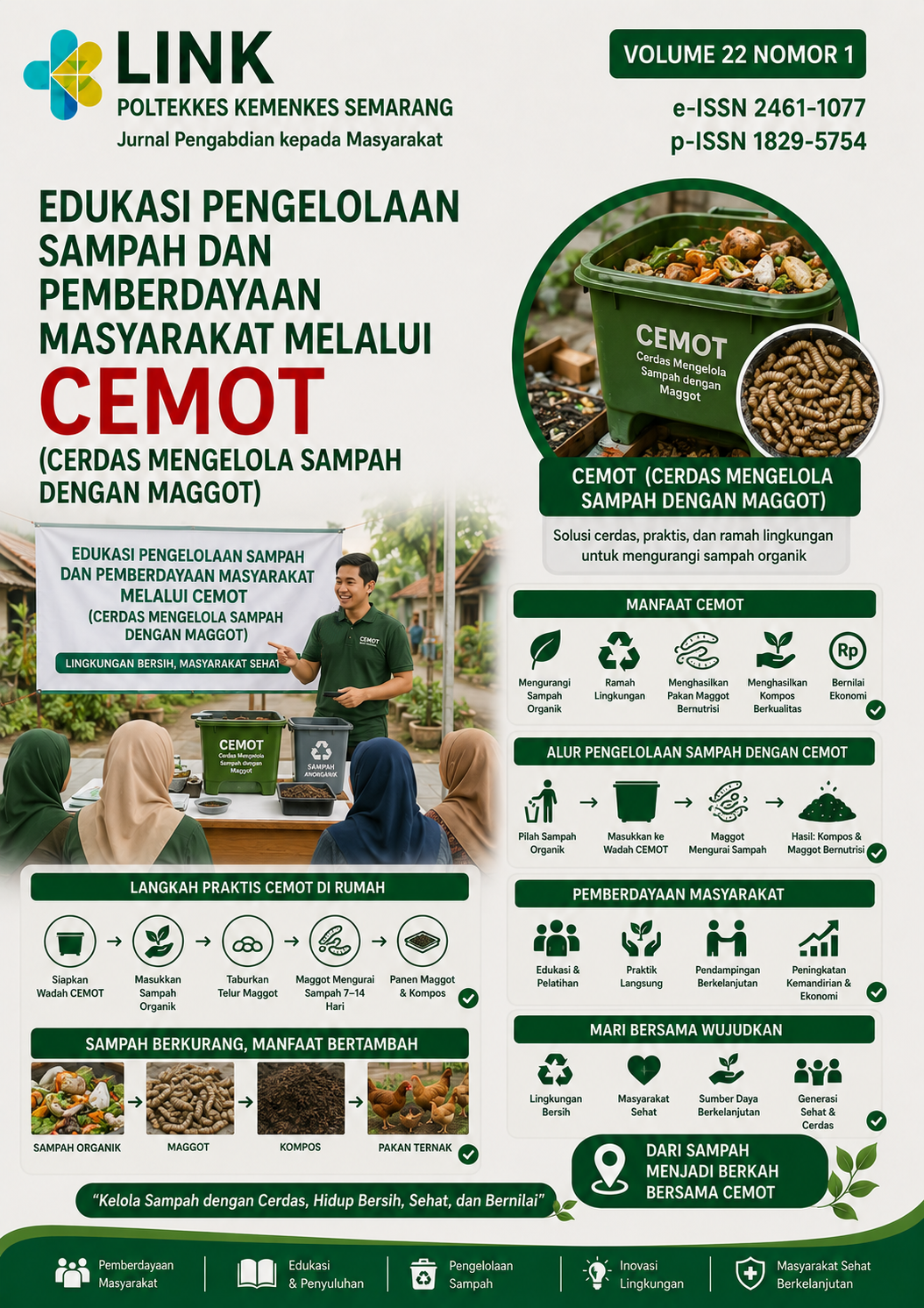
Waste Management and Community Empowerment Education Through The CEMOT (Cerdas Mengelola Sampah Dengan Maggot)
DOI:
https://doi.org/10.31983/link.v22i1.14707Keywords:
Organic waste management, Black Soldier Fly Maggot, Waste bioconversion, Community educationAbstract
The problem of organic waste accumulation in RW 011, Cipayung Village, is increasingly crucial due to the limited capacity of the landfill and the discourse of suspending waste collection. This condition risks causing environmental pollution and health problems. The CEMOT community service activity was carried out to increase public knowledge and awareness regarding waste sorting and organic waste management using Black Soldier Fly larvae (maggots) as bioconversion agents. Activities using educational-participatory design through counseling, maggot cultivation demonstrations, and mentoring were conducted. Evaluation was carried out using pre-test and post-test questionnaires on 17 participants, accompanied by observations of the practical process. The Wilcoxon test results showed a significant difference between the pre-test and post-test scores (p = 0.009), with an increase in the mean score from 5.2 to 8.0, indicating an increase in participants' knowledge regarding maggot-based organic waste management. Qualitatively, participants showed enthusiasm and interest in implementing maggot cultivation at home, although there were still limitations in participation and program sustainability. CEMOT has the potential to become a model for adaptive and sustainable community-based organic waste management.
References
Ali Syahbana, M., Ayu Dewi Puspithaloka, S., Anugrah Cahyaningtyas, F., Farezi Rachmadani, M., Zahro, M., Indah Lestari, M., Ghaisani Fildzah, P., Rosalina, V., Purnama, C., & Diana Seviya, A. (2025). Optimalisasi pengelolaan sampah organik di Desa Genteng Kulon melalui Program Sigmaggot. Jurnal Pengabdian Magister Pendidikan IPA, 8(3), 1021–1041. https://doi.org/10.29303/jpmpi.v8i3.12928
Andrio, D., Elystia, S., Priyambada, G., Reza, M., Sasmita, A., & Asmura, J. (2022). Pelatihan pemanfaatan maggot Black Soldier Fly (BSF) untuk pengolahan sampah organik sebagai alternatif pakan ternak pada santri Pondok Pesantren Syekh Burhanuddin Kuntu, Kab. Kampar, Prov. Riau. Jurnal Abdi Masyarakat Indonesia, 3(1), 35–42. https://doi.org/10.54082/jamsi.583
Dewi, R. K., Wahyuningsih, D., Sari, D. E., Jatiningrum, S. H., & Handayani, W. (2021). Waste management of traditional dairy farming for alternative energy: A feasibility study on biogas processing in Dusun Banyudono, Semarang Regency, Indonesia. Sustinere: Journal of Environment and Sustainability, 5(1), 9–24. https://doi.org/10.22515/sustinere.jes.v5i1.117
Ferdinan, Utomo, S. W., Soesilo, T. E. B., & Herdiansyah, H. (2021). Changes community behavior in management of household waste in Bekasi City, Indonesia. IOP Conference Series: Earth and Environmental Science, 716(1). https://doi.org/10.1088/1755-1315/716/1/012071
Ghasemi, A., & Zahediasl, S. (2012). Normality tests for statistical analysis: A guide for non-statisticians. International Journal of Endocrinology and Metabolism, 10(2), 486–489. https://doi.org/10.5812/ijem.3505
Givi Efgivia, M., & Fitriani, E. (2021). Analysis of andragogy theory and practice. Atlantis Press SARL., 585.
Habibzadeh, F. (2024). Data distribution: Normal or abnormal? Journal of Korean Medical Science, 39(3), 1–8. https://doi.org/10.3346/jkms.2024.39.e35
Kaza, S., Yao, L., Bhada-Tata, P., & Van Woerden, F. (2018). What a waste 2.0: A global snapshot of solid waste management to 2050 (The World Bank, Ed.). World Bank Publications, The World Bank. https://doi.org/10.1596/978-1-4648-1329-0
Kementrian Lingkungan Hidup. (2024). Capaian Kinerja Pengelolaan Sampah. SIPSN. https://sipsn.kemenlh.go.id/sipsn/
Kim, C. H., Ryu, J., Lee, J., Ko, K., Lee, J. Y., Park, K. Y., & Chung, H. (2021). Use of black soldier fly larvae for food waste treatment and energy production in asian countries: A review. In Processes (Vol. 9, Issue 1, pp. 1–17). MDPI AG. https://doi.org/10.3390/pr9010161
Lamin, S., Juswardi, J., Tanzerina, N., Hanum, L., Muharni, M., & Rosmania, R. (2024). Pelatihan pembuatan pupuk organik dari sampah rumah tangga dengan memanfaatkan lalat tentara hitam Hermentia Illucens (Diptera: Stratiomyidae). Jurnal Altifani Penelitian Dan Pengabdian Kepada Masyarakat, 4(1), 97–105. https://doi.org/10.59395/altifani.v4i1.525
Munawar, A., Samad, N., & Maifa Diapati, dan. (2025). Pemberdayaan terintegrasi bermodal limbah domestik dengan memanfaatkan teknologi biokonversi berbasis serangga larga BSF (Maggot) di KWT Seruni Kelurahan Buntusu Kecamatan Tamalanrea. Jurnal Dinamika Pengabdian, 10(2), 233–241.
Nurdiyah, N., Pagala, Muh. A. Y., Fausiah, A., Anfas, A., Bulkis, B., Syamsuddin, F. R., & Thamrin, S. H. (2023). Pengolahan limbah organik pasar melalui biokonversi maggot lalat tentara hitam (Hermentia Illucens) menjadi pupuk kasgot. SIPISSANGNGI Jurnal Pengabdian Kepada Masyarakat, 3(3), 269. https://doi.org/10.35329/sipissangngi.v3i3.4767
O. Emmanuel, B., T. Maureen, N., & Wonu, N. (2020). Detection of non-normality in data sets and comparison between different normality tests. Asian Journal of Probability and Statistics, 5(4), 1–20. https://doi.org/10.9734/ajpas/2019/v5i430149
Perolat, J., Couso, I., Loquin, K., & Strauss, O. (2015). Generalizing the Wilcoxon rank-sum test for interval data. International Journal of Approximate Reasoning, 56(PA), 108–121. https://doi.org/10.1016/j.ijar.2014.08.001
Rahmawati, S., Nurlela, A., Rahmat, I. A., Putri, E. O., A’idah Arrahman, W., Guruh, J., Jeremy, M., Windari, A. S., & Muharry, A. (2025). Pemberdayaan masyarakat melalui pemanfaatan sampah organik dengan membuat pupuk kompos. Jurnal Penyuluhan Dan Pemberdayaan Masyarakat (JPPM), 4(1), 31–35.
Rif’an, A., Rachmadianto, M. F., Priyana, F. C., & Hartono, B. (2024). Maggot cultivation: Transforming agricultural waste into kasgot organic fertilizer in Daleman Kidul Village. Jurnal Pengembangan Penyuluhan Pertanian, 21(2), 198–211. http://jurnal.polbangtanyoma.ac.id/jp3/article/view/1272
Ruhmawati, T., Wahyudin, U., Sardin, S., Sharaf Eldin Khair, A., & Shantini, Y. (2023). Mitigating environmental threats: An intervention study on household waste management in Pasirkaliki Village. Jurnal Pemberdayaan Masyarakat: Media Pemikiran Dan Dakwah Pembangunan, 7(2), 179–192. https://doi.org/10.14421/jpm.2023.072-05
Saidi, D., Wahyuning Widiarti, I., & Agus Widodo, R. (2023). Pengolahan sampah organik melalui ternak maggot dan mikroorganisme lokal (MOL) di Wonocatur Banguntapan Bantul DIY. Dharma: Jurnal Pengabdian Masyarakat , 4(2), 9–20. http://jurnal.upnyk.ac.id/index.php/dlppm
Saputri, D. Y., Asrowi, Sukarmin, & Riyadi. (2025). An analysis of the university waste bank role in increasing students’ environmental awareness. IOP Conference Series: Earth and Environmental Science, 1462(1). https://doi.org/10.1088/1755-1315/1462/1/012040
Selvia, D. S. E., Suri, I. R. A., & Widiyanto, L. (2024). Pemberdayaan masyarakat dalam rangka membangun desa bersih, sehat, dan mandiri sebagai upaya mewujudkan pelestarian lingkungan berkelanjutan Desa Trimomukti. Jurnal Pengabdian Masyarakat Bangsa, 2(4), 1162–1171.
Sugiarto, Y., Ratri Ramadhani, V., Yudha Himawan, R., Tahta Anggriawan Putra Semana, P., Mathias Engelbert Silubun, I., Xaverius Anofa, F., Damar Pratama, H., Ridha Sulthan Faanin, M., Natalie Fiko, H., Satriana Trissandy, M., & Rosiana Puspitasari, D. (2022). Pemanfaatan limbah organik rumah tangga untuk budidaya maggot di Desa Pamotan oleh KKN R-18 Universitas Janabadra. JOMPA ABDI: Jurnal Pengabdian Masyarakat, 1(4). https://jurnal.jomparnd.com/index.php/jpabdi
Suryani, A. S. (2014). Peran bank sampah dalam efektivitas pengelolaan sampah (Studi kasus bank sampah Malang). Aspirasi: Jurnal Masalah-Masalah Sosial, 5(1), 71–84.
Syaharuddin, Mutiani, & Hidayanti. (2020). Strengthening environmental awareness through waste bank activities. Advances in Social Science, Education and Humanities Research, 525, 454–458. https://doi.org/10.2991/assehr.k.210222.077
Hakim, L., Suryani, E., & Prasetyo, B. (2022). Participatory community education in solid waste management: A systematic review. Environmental Education Research, 28(4), 512–530. https://doi.org/10.1080/13504622.2022.2041110
Kolb, A. Y., & Kolb, D. A. (2005). Learning styles and learning spaces: Enhancing experiential learning in higher education. Academy of Management Learning & Education, 4(2), 193–212. https://doi.org/10.5465/amle.2005.17268566
Prüss-Ustün, A., Wolf, J., Bartram, J., Clasen, T., Cumming, O., Freeman, M. C., Gordon, B., Hunter, P. R., Medlicott, K., & Johnston, R. (2019). Burden of disease from inadequate water, sanitation and hygiene for selected adverse health outcomes: An updated analysis with a focus on low- and middle-income countries. International Journal of Hygiene and Environmental Health, 222(5), 765–777. https://doi.org/10.1016/j.ijheh.2019.05.004
Wilson, D. C., Rodic, L., Modak, P., Soos, R., Carpintero, A., Velis, K., Iyer, M., & Simonett, O. (2021). Global waste management outlook 2.0 – Why waste cannot be ignored. Resources, Conservation and Recycling, 167, 105372. https://doi.org/10.1016/j.resconrec.2021.105372