Mother's Toddler Class Plus, Coping Skill Training to Prevent Stunting
DOI:
https://doi.org/10.31983/link.v21i2.14082Keywords:
Coping Skill Training, Stunting, Toddler Mothers ClassAbstract
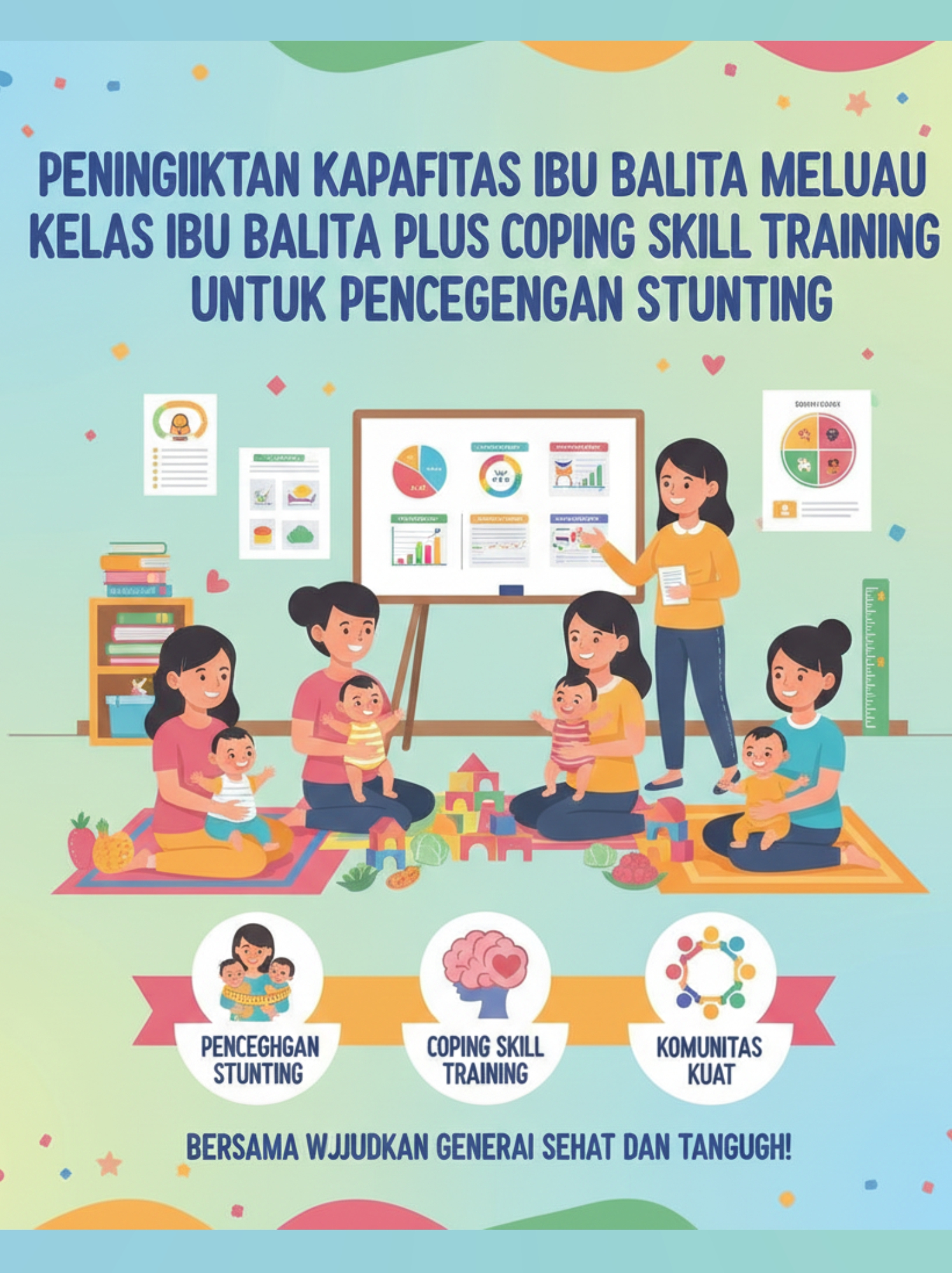
Stunting is a chronic nutritional problem that affects children’s physical growth, cognitive development, and long-term quality of life. Prevention efforts require integrated interventions, including nutrition education and the strengthening of emotional management skills for mothers of children under five. This community service program aims to improve mothers’ knowledge through mother classes combined with coping skill training (CST) as a strategy to monitor child growth and detect stunting early. The program was implemented through several stages: planning, coordination with posyandu cadres, pretest-Posttets, health education using leaflets, posttest, data analysis, and evaluation. The participants were mothers of children under five at Posyandu Mawar Merah, Kedungkelor Village, Warurejo District, Tegal Regency. The results showed an increase in knowledge among 29 respondents, while 1 respondent experienced a decrease, with a statistically significant difference between pretest and posttest scores (p = 0.000; p < 0.05). These findings demonstrate that enhancing the capacity of mothers with toddlers through the Toddler Mothers Class combined with coping skill training for stunting prevention in Kedung Kelor, Tegal is effective in improving mothers’ knowledge of emotional management in monitoring child growth and development for stunting prevention. The program is recommended to be further developed with varied counseling methods to enhance sustainability and effectiveness.
Author Biography
Runjati Runjati, (SCOPUS ID 57194598039) Poltekkes Kemenkes Semarang


References
Abdullah, Dian Khairani, M., Syaifurrohman, A., & Elva Junita, D. (2023). Upaya Meningkatkan Pengetahuan Ibu Balita Dengan Edukasi Pentingnya Posyandu Di Pekon Blitarejo Kecamatan Gadingrejo Kabupaten Pringsewu. Jurnal Pengabdian Kepada Masyarakat Ungu( ABDI KE UNGU), 5(2), 153–158. https://doi.org/10.30604/abdi.v5i2.1366
Arianty, R., Fatmawati Syamsu, A., Kolomboy, F., Yulita Siregar, N., Kesehatan Kemenkes Palu, P., & Pengabmas, A. (2024). Edukasi Stunting Sebagai Upaya Meningkatkan Pengetahuan Ibu Balita Dalam Pencegahan Stunting di Desa. Ju Jurnal Kolaboratif Sains, 7(11), 4003–4012. https://doi.org/10.56338/jks.v7i11.6617
Badan Kebijakan Pembangunan Kesehatan Kementerian Kesehatan RI. (2024). Prevalensi Stunting Nasional.
Citra Dinanda, Ratna Mutu Manikam, & Nursita Angesti, A. (2024). Pengaruh Edukasi Gizi menggunakan Media Leaflet terhadap Pengetahuan Gizi Seimbang pada Ibu Balita di Kelompok Bermain Al-Muttaqin Desa Ladan Kabupaten Kepulauan Anambas. Jurnal Ilmiah Kesehatan, 16(2), 432–442. https://doi.org/10.37012/jik.v16i2.2351
Gani, H. A., Elviani, Y., Detiana, & kamestworo. (2023). Stunting Training For Women With Toddlers. Journal of Applied Nursing and Health, 5(1), 25–30. https://doi.org/10.55018/janh.v5i1.125
Kementrian Kesehatan RI. (2023). Stunting di Indonesia dan Determinannya (Stunting in Indonesia and Its Determinants). 1–2.
Nirmalasari, N. O. (2020). Stunting Pada Anak : Penyebab dan Faktor Risiko Stunting di Indonesia. Qawwam: Journal For Gender Mainstreming, 14(1), 19–28. https://doi.org/10.20414/Qawwam.v14i1.2372
Perpres. (2020). Peraturan Presiden No. 28 (Issue 1).
Perpres. (2021). Peraturan Presiden Republik Indonesia No. 72 Tahun 2021 Tentang Percepatan Penurunan Stunting. Republik Indonesia, 1, 23.
Rahayu, F. S., Budiyanto, D., & Palyama, D. (2017). Analisis Penerimaan E-Learning Menggunakan Technology Acceptance Model (Tam) (Studi Kasus: Universitas Atma Jaya Yogyakarta). Jurnal Terapan Teknologi Informasi, 1(2), 87–98. https://doi.org/10.21460/jutei.2017.12.20
Rueda-Guevara, P., Botero-Tovar, N., Trujillo, K. M., & Ramírez, A. (2021). Worldwide evidence about infant stunting from a public health perspective: a systematic review. Biomedica, 41(4), 1–38. https://doi.org/10.7705/biomedica.6017
Runjati, R., Rahayu, S., & Octaviani, D. A. (2022). The influence of smart mother classes toward stress, childbirth self-efficacy and birth outcomes. International Journal of Public Health Science, 11(3), 868–876. https://doi.org/10.11591/ijphs.v11i3.20756
Runjati, Susanto, H., Sawitri, D. R., & Thaufik, S. (2018). The impact of antenatal coping skill training (ACST) towards cortisol and igg serum level among pregnant women. Hiroshima Journal of Medical Sciences, 67, 21–28.
Vaivada, T., Akseer, N., Akseer, S., Somaskandan, A., Stefopulos, M., & Bhutta, Z. A. (2020). Stunting in childhood: An overview of global burden, trends, determinants, and drivers of decline. American Journal of Clinical Nutrition, 112, 777S-791S. https://doi.org/10.1093/ajcn/nqaa159
Wingo, N. P., Ivankova, N. V., & Moss, J. A. (2017). Faculty perceptions about teaching online: Exploring the literature using the technology acceptance model as an organizing framework. Online Learning Journal, 21(1), 15–35. https://doi.org/10.24059/olj.v21i1.761