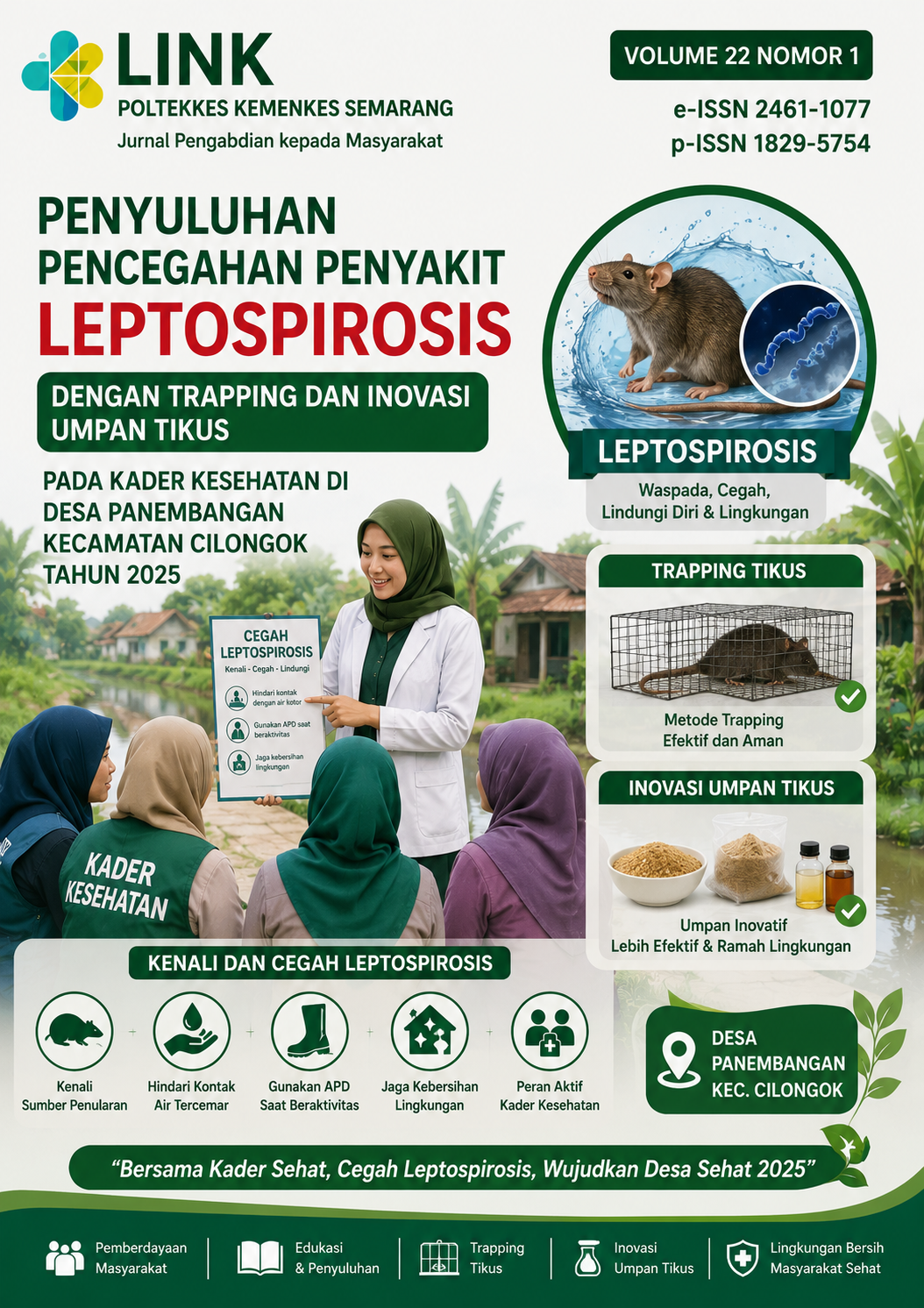
Prevention of Leptospirosis Through Rodent Trapping and Innovative Bait Strategies Among Health Cadres
DOI:
https://doi.org/10.31983/link.v22i1.13426Keywords:
Bintaro Fruit, Community Service, Leptospirosis, Rats, TrappingAbstract
Leptospirosis is a zoonotic disease transmitted through the urine of infected animals, particularly rats, and remains a public health concern in various regions, including Banyumas Regency. Increasing rodent populations and poor environmental sanitation may increase the risk of disease transmission. This community service activity aimed to improve community knowledge and participation in leptospirosis prevention through education and rat control practices. The activity was conducted on July 10, 2025, in Panembangan Village, Cilongok District, Banyumas Regency, involving 30 health cadres. The methods used included health education, demonstrations of rat trapping techniques, interactive discussions, and pre-test and post-test evaluations. The results showed an increase in the average knowledge score of participants from 56.00 before the intervention to 82.00 after the intervention, with a statistically significant difference (p = 0.001). Participants also demonstrated improved understanding regarding environmentally friendly rodent control methods and the potential use of Bintaro fruit as a natural rodenticide alternative. This activity indicates that educational and participatory approaches are effective in improving community capacity in preventing leptospirosis through environmental-based rodent control.
References
Amin, L. Z. (2016). Leptospirosis. Cermin Dunia Kedokteran, 43(8), 576–580.
Astyandini, B., Khobibah, & Dewanto, I. R. (2025). Pendidikan Kesehatan Sebagai Upaya Peningkatkan Pengetahuan Pencegahan Stunting pada Perempuan Pesisir. LINK, 21(2), 145–151. https://doi.org/10.31983/link.v21i2.14081
Bakari, F., Jusuf, H., & Rahma, C. (2026). Determinan Lingkungan dan Perilaku Leptospirosis: Studi Cross-sectional di Provinsi Gorontalo, Indonesia. Jurnal Promotif Preventif, 9(1), 26–35. http://journal.unpacti.ac.id/index.php/JPP
Banawestri, K., Putri, I. A., & Widyasari, G. (2024). Pemberdayaan Masyarakat dan Intervensi Kesehatan Lingkungan terhadap Penanggulangan Stunting dan Penyakit Menular (Vol. 03, Number 02).
Dinas Kesehatan Kabupaten Banyumas. (2024). Jumlah Kasus Leptospirosis Menurut Kabupaten Kota Tahun 2023. Portal Data Jawa Tengah. https://data.jatengprov.go.id/dataset/showcases/jumlah-kasus-leptospirosis-menurut-kabupatenkota-tahun-2023
Diyana, S., Sutiningsih, D., Adi, M. S., & Hitipeuw, D. (2024). Detection of Leptospira sp. Bacteria and Factors Related to the Incidence of Leptospirosis in Semarang City. International Journal of Integrated Health Sciences, 12(1). https://doi.org/10.15850/ijihs.v12.n1.3767
Hidayah, A. R., Utomo, N., Firdaust, M., IW, H. R., & Ma’ruf, F. (2026). Efektivitas Formulasi Baiting Dengan Bahan Aktif Buah Bintaro Terhadap Kematian Tikus Mencit Putih. Buletin Keslingmas, 45(1), 1–9. https://doi.org/10.31983/keslingmas.v45i1.13408
Hidayat, W., Nura’eny, N., & Wahyuni, I. S. (2019). Gambaran Pre dan Post Test Kegiatan Penyuluhan Kesehatan terhadap Kader Posyandu di Puskesmas Babatan Bandung. Jurnal Aplikasi Iptek Untuk Masyarakat, 8, 225–226.
Hidayati, A. O., Zubad, M., Meilani, B. C., & Virgita, J. W. (2025). Edukasi Berbasis Masyarakat sebagai Upaya Pencegahan dan Penanganan Penyakit Leptospirosis. APMa Jurnal Pengabdian Masyarakat, 5(1). https://doi.org/10.47575/apma.v5i1.684
Hidayati, F., Sudarnika, E., Latif, H., Lukman, D. W., Ridwan, Y., Zahid, A., & Wicaksono, A. (2019). Intervensi Penyuluhan dengan Metode Ceramah dan Buzz untuk Peningkatan Pengetahuan dan Sikap Kader Posyandu dalam Pengendalian Rabies di Kabupaten Sukabumi. Jurnal Penyuluhan, 15.
Isni, K., Kusuma Wardhani, M., Ernia, F., & Amalia Dianty, S. (2020). Edukasi PHBS dan GERMAS sebagai upaya pencegahan penyakit leptospirosis di Gedangsari, Gunung Kidul. Jurnal Pemberdayaan: Publikasi Hasil Pengabdiankepada Masyarakat, 4, 67–2. https://doi.org/10.12928/jp.v3i1.1973
Jahja, S. J., & Drew, C. (2024). Peningkatan Pengetahuan dalam Upaya Pencegahan Kasus Baru Leptospirosis di Wilayah Kerja Puskesmas Kresek. Malahayati Nursing Journal, 6(2), 725–735. https://doi.org/10.33024/mnj.v6i2.12875
Lestari, M. W., Qurrohman, M. T., Yuliana, T., Wibowo, V. R., Istikhomah, V., Setianingrum, W., Ningsih, Y. C., & Farida, Z. (2024). Edukasi Pencegahan Leptospirosis dan Pengendalian Pestisida Rumah Tangga bagi Ibu-ibu PKK. Jurnal Abdi Masyarakat Indonesia (JAMSI), 4, 53–58. https://doi.org/10.54082/jamsi.1036
Ningsih, I., & Wahid, M. H. (2022). Leptospirosis Ditinjau dari Aspek Mikrobiologi. EKOTONIA: Jurnal Penelitian Biologi, Botani, Zoologi Dan Mikrobiologi, 7(1), 31–43. https://doi.org/10.33019/ekotonia.v7i1.3141
Rasyid, W. O. R. H., Hajri, W. S., Tosepuu, R., & Mubarak. (2025). Dampak Lingkungan dan Perilaku terhadap Kasus Leptospirosis di Wilayah Puskesmas Lepo-lepo. Jurnal Keselamatan Kesehatan Kerja Dan Lingkungan, 06(1), 42–51. http://jk3l.fkm.unand.ac.id/index.php/jk3l/index
Rizki Dwi Fitriana, B., Novemi Amelia, E., Rahmah, L., & Fitra Aprilia, M. (2018). Buser Tikus Dengan Mousetrap. Jurnal Program Kreatif Mahasiswa, 2.
Rohman, A. F. N., Utomo, B., & Firdaust, M. (2021). Eksplorasi Bakteri Leptospira pada Tikus di Daerah Leptospirosis di Kecamatan Cilongok Kabupaten Banyumas Tahun 2019. Buletin Keslingmas, 40(3), 94–99. https://doi.org/https://doi.org/10.31983/keslingmas.v40i3.5981
Waladani, B., Istikmal, A., Handayani, A., Kasiyatno, K., Marleni, Rahmawati, P., & Wahyuningsih, T. (2023). Edukasi untuk Meningkatkan Pengetahuan danKesadaran Masyarakat dalam Pencegahan Leptospirosis. Jurnal Salingka Abdimas, 3, 177–182.
WHO. (2022). Leptospirosis - Fact Sheet. https://iris.who.int/server/api/core/bitstreams/03dce7b9-40db-44be-ae2e-76acc39b8e66/content
Widyastutik, D., Hapsari, E., Yessy, M., Rohmatika, D., Hapsari, Y., Kusuma, U., & Surakarta, H. (2022). Penerapan Pendidikan Kesehatan tentang Menarche dengan Metode Audiovisual terhadap Tingkat Pengetahuan Remaja. Jurnal Kesehatan Kusuma Husada, 13(1), 18–23.