Optimizing Student Skills Through Critical Nursing Hands-on
DOI:
https://doi.org/10.31983/link.v21i2.12893Keywords:
critical nursing, student skillsAbstract
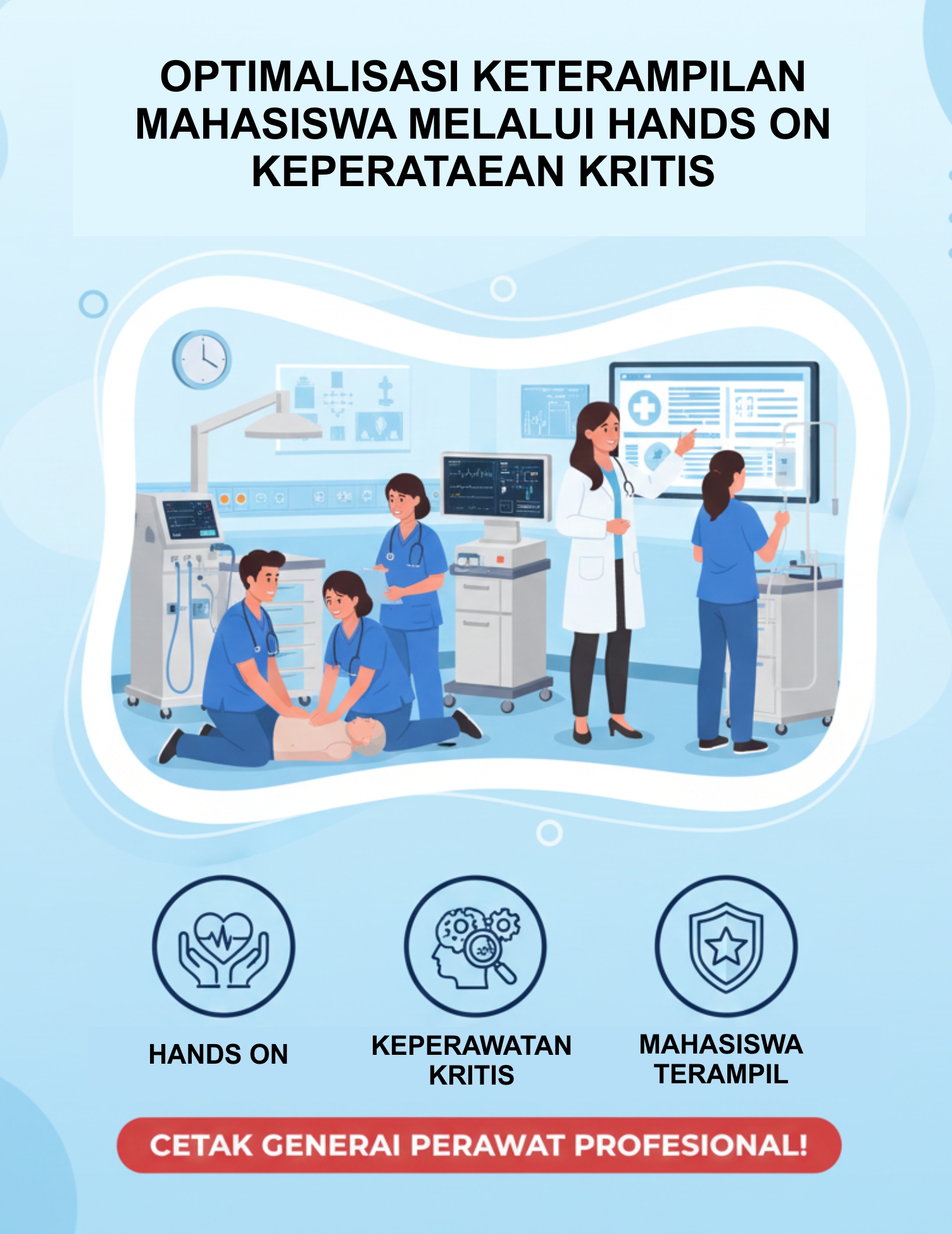
Student competence in critical care is of particular concern. Various studies highlight barriers and deficiencies in knowledge and skills. These gaps can adversely affect students' readiness to provide quality care to critically ill patients. This community service aims to improve knowledge in dealing with critical nursing conditions. The method used was hands on / training with a blended learning approach demonstrating 4 skills to 202 participants consisting of students of Poltekkes Kemenkes Semarang. The skills provided were Ventilator, ECG interpretation, Set Titration and Acid-Base analysis. Data analysis test using the Paired t-test. The results of this community service found that knowledge increased from an average of 68 to 92. The results of the Paired t-test show that there is a significant difference between the pretest and posttest scores, with a p-value of 0.001. This critical nursing training is effective in improving student readiness through increased knowledge, skills and basic competencies for students.
References
Antón-Solanas, I., Tambo-Lizalde, E., Hamam-Alcober, N., Vanceulebroeck, V., Dehaes, S., Kalkan, I., Kömürcü, N., Coelho, M., Coelho, T., & Casa Nova, A. (2021). Nursing students’ experience of learning cultural competence. PLoS One, 16(12), e0259802.
Baidhowy, A. S., Pranata, S., Ratih, E. P., & Dewi4, A. (2025). Nurse Awareness In Implementing Oral Hygiene As. 3rd Lawang Sewu International Symposium on Medical and Health Sciences (3rd-LEWIS-MHS), 85, 233.
Costa, M. P. D., Leccio, B. J., Unissa, S. S., & Al-Shezawi, H. A. (2023). Student nurses’ experiences of their first clinical placement in intensive care unit: A descriptive phenomenology study. Saudi Journal for Health Sciences, 12(3), 195–200.
Dewart, G., Corcoran, L., Thirsk, L., & Petrovic, K. (2020). Nursing education in a pandemic: Academic challenges in response to COVID-19. Nurse Education Today, 92, 104471.
Elkader, H. M. A., Shahin, E. S. M., & El-Ata, A. B. A. (2020). Effect of Applying Program Based Learning on Nurse’s Performance and Self-efficacy Regarding Arterial Blood Puncture. American Journal of Nursing Research, 8(2), 192–198. https://doi.org/10.12691/ajnr-8-2-8
González-García, M., Lana, A., Zurrón-Madera, P., Valcárcel-Álvarez, Y., & Fernández-Feito, A. (2020). Nursing students’ experiences of clinical practices in emergency and intensive care units. International Journal of Environmental Research and Public Health, 17(16), 5686.
Hesham, S. (2016). Assessment of Nurses’ Performance Regarding Management of Patients on Mechanical Ventilator. Port Said Scientific Journal of Nursing, 3(1), 161–177. https://doi.org/10.21608/pssjn.2019.32327
Hickey, S. M., & Giwa, A. O. (2020). Mechanical Ventilation. In StatPearls. StatPearls Publishing, Treasure Island (FL).
Huh, S., & Kang, H. (2019). Effects of an educational program on disaster nursing competency. Public Health Nursing, 36(1), 28–35.
Huitema, A. A., Alemayehu, M., Steiner, O. L., Bagur, R., & Lavi, S. (2019). Improving electrocardiography diagnostic accuracy in emergency medical services personnel. CJC Open, 1(1), 28–34.
Inayat, S., Younas, A., Sundus, A., & Khan, F. H. (2021). Nursing students’ preparedness and practice in critical care settings: a scoping review. Journal of Professional Nursing, 37(1), 122–134.
Kuiper, R., Pesut, D., & Kautz, D. (2009). Promoting the self-regulation of clinical reasoning skills in nursing students. The Open Nursing Journal, 3, 76–85. https://doi.org/10.2174/1874434600903010076
Linda, D. U. (2018). Critical care nursing: Diagnosis and management. Elsevier health sciences.
Liu, Y., Wang, L., Shao, H., Han, P., Jiang, J., & Duan, X. (2022). Nursing students’ experience during their practicum in an intensive care unit: A qualitative meta-synthesis. Frontiers in Public Health, Volume 10. https://www.frontiersin.org/journals/public-health/articles/10.3389/fpubh.2022.974244
Motefakker, S., Shirinabadi Farahani, A., Nourian, M., Nasiri, M., & Heydari, F. (2022). The impact of the evaluations made by Mini-CEX on the clinical competency of nursing students. BMC Medical Education, 22(1), 634.
Nisa, F. H., Setioputro, B., & Fitria, Y. (2023). Pengalaman Praktik Klinis Mahasiswa Keperawatan Di Intensive Care Unit (ICU): Studi Kualitatif: Clinical Practice Experience of Nursing Students in Intensive Care Unit (ICU): Qualitative Study. Jurnal Ilmiah Keperawatan (Scientific Journal of Nursing), 9(3), 496–503.
Pontes, P. A. I., Chaves, R. O., Castro, R. C., Souza, É. F. de, Seruffo, M. C. R., & Francês, C. R. L. (2018). Educational software applied in teaching electrocardiogram: a systematic review. BioMed Research International, 2018(1), 8203875.
Scholtz, S., Nel, E. W., Poggenpoel, M., & Myburgh, C. P. H. (2016). The culture of nurses in a critical care unit. Global Qualitative Nursing Research, 3, 2333393615625996.
Tang, C.-Y. (2021). Learning experience of Chinese nursing students during clinical practicum: A descriptive qualitative study. Nursing Reports, 11(2), 495–505.
Wang, H., Xie, Y. D., Li, X. Y., Liu, Q., Chen, J., Wang, X. Q., Wang, J., Luo, D., Yang, B. X., Fang, Y. X., & Li, T. (2025). Bridging the theory-practice gap: A simulation-based crossover study on competency and critical thinking in transitioning new nurses. Clinical Simulation In Nursing, 109. https://doi.org/10.1016/j.ecns.2025.101854
Wang Jr, J. (2021). Clinical practice in ICU contributes better learning results to nursing students and newly graduated nurses.
Yi-Chen, H., Chair-Hua, L., Ting-Yu, Y., Tsung-Han, L., Tsay-I, C., & Chih Hao, L. (2025). The impact of simulation-based emergency training on novice critical care nurses: a quasi-experimental study. International Journal of Medical Education, 16, 138–144. https://doi.org/10.5116/ijme.68a2.dc6f