Sawdust as a Reducing Agent of Ammonia Levels in the Wastewater Treatment Plant of a Community Health Center
DOI:
https://doi.org/10.31983/keslingmas.v45i2.14646Keywords:
Activated charcoal, Ammonia, Filtration, Sawdust, WWTPAbstract
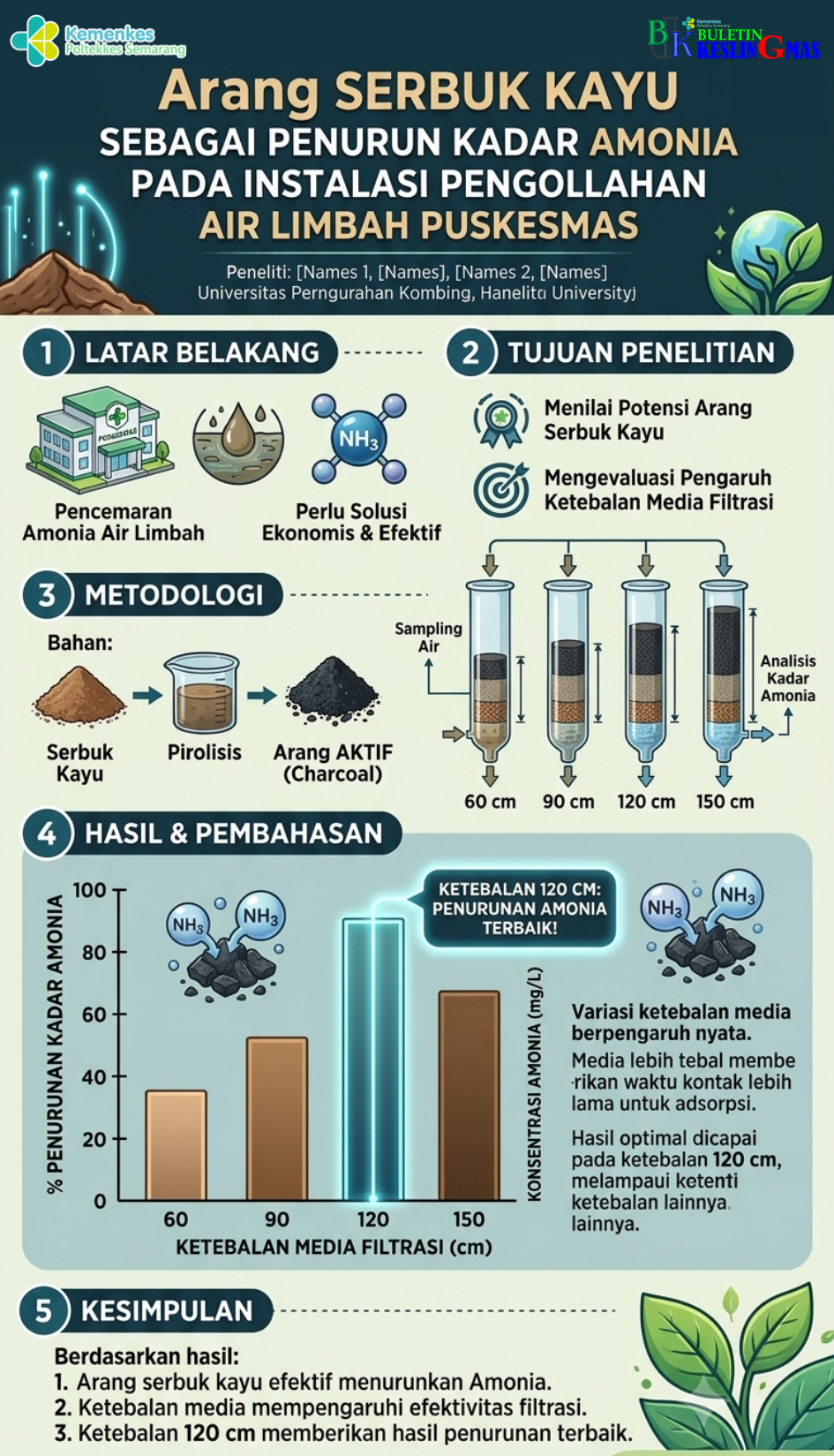
Wastewater generated from healthcare facilities such as health centers contains various pollutants, including ammonia (NH₃), which can potentially pollute the environment. This study aims to determine the effectiveness of activated charcoal made from sawdust as a filtration medium in reducing ammonia levels in the Wastewater Treatment Plant (WWTP) at Sukadamai Inpatient Health Center. This research is an experimental study using a pretest-posttest design without a control group. The filtration media were created using activated charcoal derived from sawdust that had undergone carbonization and activation with H₃PO₄ solution. The variations in media thickness used were 100 cm, 110 cm, and 120 cm. Filtration was carried out using a vertical flow (downflow) system with different contact times. The tested parameters included ammonia levels, pH, and temperature. The results showed that activated sawdust charcoal significantly reduced ammonia levels. Variations in media thickness affected the filtration effectiveness, with the 120 cm thickness yielding the best ammonia reduction compared to the others. It can be concluded that activated sawdust charcoal has potential as an effective, low-cost, and environmentally friendly alternative media for reducing ammonia levels in wastewater from health centers. This study is expected to serve as a reference for the development of small-scale wastewater treatment systems.
References
1. KLHK. Peraturan Menteri Lingkungan Hidup Republik Indonesia. Https://JdihMaritimGoId/ [Internet]. 2014;1–83. Available from: https://jdih.maritim.go.id/en/peraturan-menteri-negara-lingkungan-hidup-no-5-tahun-2014
2. Syaripuddin S, Arifin A, Haris A, Hamzani S. Pengaruh Kapur Terhadap Efisiensi Penurunan Amoniak (NH3) Air Limbah Rumah Sakit Umum Daerah Pangeran Jaya Sumitra Kotabaru Tahun 2024. J Penelit Multidisiplin Bangsa. 2025;1(12):2074–86. doi:10.59837/jpnmb.v1i12.409
3. Haoxing Z, System C. No Analisis Struktur Kovarians Indikator Terkait Kesehatan pada Lansia yang Tinggal di Masyarakat, dengan Fokus pada Status Kesehatan Subjektif. Vol. 3. 3.
4. Marisa L, Mukarramah A, Fatya AI. Pengaruh Variasi Aktivator ZnCl 2 dan NaOH terhadap Efisiensi Adsorpsi Karbon Aktif dari Kayu Cempedak ( Artocarpus Champeden ) sebagai Adsorben dalam Limbah Sasirangan. Vol. 3. 2024;3(2):26–35. doi:10.18592/ak.v3i2.12671
5. Malik U. Efek Suhu Terhadap Pembentukan Besaran Butiran Arang Karbon Tempurung Kelapa Sawit. J Ilm Edu Res. 2013;2(1):1–8.
6. Eko, Malik U. Efek Suhu Terhadap Pembentukan Besaran Butiran Arang Karbon Tempurung Kelapa Sawit. Jurusan Fisika FMIPA Universitas Riau Pekanbaru. Vol. 2. 2013;2(1):1–8.
7. Pramulia, Rahmi Fitri S D. Pembuatan Karbon Aktif Dari Serbuk Gergaji Kayu Jati ( Tectona Making Actived Carbon From Teak Wood Saws ( Tectona grandis L , f ) ( Temperature and Time of Carbonation ) The 8 th University Research Colloquium 2018, Universitas Muhammadiyah Purwokerto. 2018;105–12.
8. Tchobanoglous G, L. Burton F, Stensel DH. Metcalf &Eddy 4th ed. McGraw Hill Companies, Inc. 2014. p. 421.
9. Pradana AA, Yulianto B, Ruhmawati T, Aktif K. Perbedaan waktu kontak karbon aktif terhadap penurunan kadar amonia pada limbah cair domestik. J Ris Kesehat. 2016;11(1):215–20.
10. Tampubolon A, Sinaga R, Abi A, Tanjung D, Simarmata E, Silaban P. Pengaruh Model Pembelajaran Kooperatif Tipe Student TeamAchievement Division Terhadap Hasil Belajar Siswa Pada MataPelajaran Ipas Kelas Iv Sd. Pendas J Ilm Pendidik Dasar. 2024;09(04):880–92.
11. Norjanna F. © e-JRTBP Volume 4 No 1 Oktober 2015. IV. 2015;IV(1).
12. Juna Sihombing, The Effect of Coffee Ground ’ s Activated Carbon On Reducing COD And BOD. DIS& GG. JURNAL REKAYASA , TEKNOLOGI PROSES. Vol. 9211. 2025;9211(3):9–14.
13. Kristianto H. REVIEW : Sintesis Karbon Aktif dengan Menggunakan Aktivasi Kimia ZnCL 2 Studi Teknik Kimia , Fakultas Teknologi Industri , Universitas Katolik Parahyangan , Jl . Ciumbuleuit 94 , JURNAL INTEGRASI PROSES. Vol. 6. 2017;6(3):104–11. Website : http://jurnal.untirta.ac.id/index.php/jip
14. Mangkurat W, Nurdiana E, Budianto A, Arief J, Hakim R, Sby K, et al. Penurunan Kadar Amonia , Nitrit , dan Nitrat pada Air Sungai Menggunakan Karbon Aktif sebagai Solusi Efisiensi Chlorine. 279–84.
15. Rahmilaila E, Yoga A, Yulianti A, Desmiarti R. Studi Efektivitas Pemanfaatan Arang Aktif Cangkang Kelapa Sawit ( Elaeis guineensis ) Sebagai Adsorben Pengurangan Kadar Amonia Limbah Cair Tahu Effectivity Study of Palm Shell Activated Charcoal Utilization ( Elaeis guineensis ) as Adsorbent for Reducing Ammonia Concentration in Tofu Liquid Waste. Vol. 21. 2024;21(1):24–8.
16. Reza S, Yun CS, Afroze S, Radenahmad N, Bakar MSA, Saidur R, et al. Preparation of activated carbon from biomass and its ’ applications in water and gas purification , a review. Arab J Basic Appl Sci. 2020;27(1):208–38. doi:10.1080/25765299.2020.1766799
17. Rifka Alkhilyatul Ma’rifat, I Made Suraharta IIJ. Vol. 2. 2024. 306–312 p. PubMed PMID: 38252772.
18. Dina Fajrina Nurhaliq, Rahman, Hidayat. Efektivitas Karbon Aktif Dalam Menurunkan Konsentrasi COD Pada Limbah Cair RSUD Massenrempulu Kabupaten Enrekang. Wind Public Heal J. 2022;3(2):332–8. doi:10.33096/woph.v3i2.386
19. Kasiński S, Kowal P, Czerwionka K. Advanced Technologies for Nitrogen Removal and Recovery from Municipal and Industrial Wastewater. Materials (Basel). 2025;18(7). doi:10.3390/ma18071422
20. Islam MA, M.M. M. We are IntechOpen , the world ’ s leading publisher of Open Access books Built by scientists , for scientists TOP 1 %. 2012;0–19.
Downloads
Published
How to Cite
Issue
Section
License
Copyright (c) 2026 Buletin Keslingmas

This work is licensed under a Creative Commons Attribution 4.0 International License.