The Role of Knowledge and Attitudes in Promoting Nurses’ Compliance with Medical Waste Sorting
DOI:
https://doi.org/10.31983/keslingmas.v45i2.15176Keywords:
Knowledge, Attitude, Compliance, Medical Waste Segregation, Medical Solid WasteAbstract
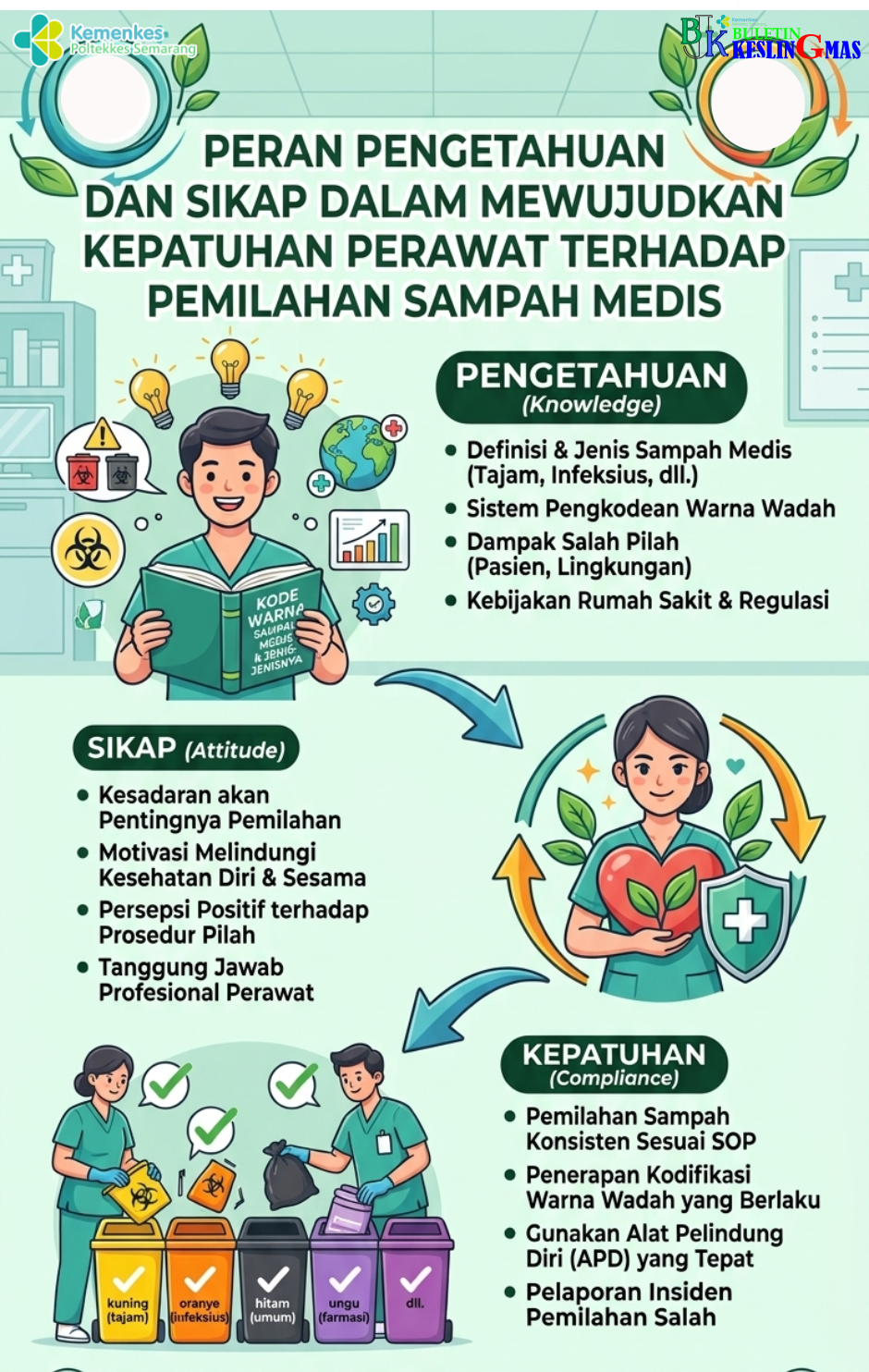
Hospitals generate medical solid waste that has the potential to pollute the environment and pose health risks. At Andi Makkasau Regional General Hospital Parepare, the mixing of infectious and non infectious waste is still observed despite the average generation of medical waste reaching 3 tons per month. This study aimed to analyze the relationship between nurses’ knowledge and attitudes and their compliance with medical waste segregation practices. A cross sectional study design was employed involving 51 nurses from the Anggrek and Nusa Indah wards selected through total sampling. Data were collected through questionnaires, observations, and direct interviews and analyzed using the chi square test. The results showed that 35 respondents (68.6%) were compliant with medical waste segregation practices. Most respondents had good knowledge (70.6%) and positive attitudes (84.3%). There was a significant relationship between knowledge and compliance (p = 0.012), as well as between attitude and compliance (p = 0.013). Knowledge and attitude were significantly associated with nurses’ compliance with medical waste segregation practices. Hospitals are encouraged to conduct regular training and supervision programs to improve nurses’ compliance with medical waste segregation procedures.
References
1. Mane M, Das SK, Hasan F, Sharma M V. Assessing healthcare waste management practices among healthcare workers in medical facilities. Health Leadership and Quality of Life. 2022;1. doi:10.56294/hl2022104 PubMed PMID: 104.
2. Hasiany S, Naibaho RTE, Lisafitri Y, Putri IA. Toxic and hazardous (B3) solid waste management at Abdul Moeloek General Hospital: An implementation assessment in 2022 and recommendations. Indonesian Journal of Environmental Management and Sustainability. 2023;7(1):32–7. doi:10.26554/ijems.2023.7.1.32-37
3. Lelyana N. Analysis of medical waste management compliance in health facilities in Indonesia. Miracle Journal of Public Health. 2024;7(2). doi:10.36566/mjph.v7i2.357
4. Miamiliotis AS, Talias MA. Healthcare workers’ knowledge about the segregation process of infectious medical waste management in a hospital. Healthcare. 2023;12(1). doi:10.3390/healthcare12010094 PubMed PMID: 94.
5. Kim MY, Kim SH, Kim YK, Yu YB, Kim S. Knowledge, attitude, and practice of medical waste management in medium-sized hospital among health care workers. Biomedical Science Letters. 2024;30(3):143–51. doi:10.15616/BSL.2024.30.3.143
6. Diwan T, Jain K, Singh N, Verma N, Jain V. Biomedical waste management: An assessment of knowledge, attitude and practice among healthcare workers in tertiary care hospital, Chhattisgarh. J Pure Appl Microbiol. 2023;17(1):211–21. doi:10.22207/JPAM.17.1.10
7. Akkajit P, Romin H, Assawadithalerd M, Al-Khatib IA. Assessment of knowledge, attitude, and practice in respect of medical waste management among healthcare workers in clinics. J Environ Public Health. 2020;2020. doi:10.1155/2020/8745472 PubMed PMID: 8745472.
8. Mannocci A, di Bella O, Barbato D, Castellani F, La Torre G, De Giusti M, et al. Assessing knowledge, attitude, and practice of healthcare personnel regarding biomedical waste management: A systematic review of available tools. Waste Management & Research. 2020;38(7):717–25. doi:10.1177/0734242X20922590
9. Dewi GK, Saryono S, Muslihudin M. Health workers’ attitude mediates the relation of knowledge and interest in medical waste management practice. Jurnal Indonesia Sosial Teknologi. 2024;5(5). doi:10.59141/jist.v5i5.1106
10. Salamah NP, Nina N, Yaser M. Hubungan pengetahuan, masa kerja dan pengawasan terhadap perilaku pemilahan limbah medis pada tenaga kesehatan di Rumah Sakit Hermina Depok tahun 2023. Jurnal Kesehatan Indra Husada. 2024;12(1). doi:10.36973/jkih.v12i1.538
11. Prianto F, Kusumaningtiar DA, Handayani R, Azteria V. Relationship between knowledge and service period on nurse behavior in disposing of medical solid waste at the container stage. Jurnal Sosial Terapan. 2024;2(1):48–55. doi:10.29244/jstr.2.1.48-55
12. Thirunavukkarasu A, Al-Hazmi AH, Dar UF, Alruwaili AM, Alsharari SD, Alazmi FA, et al. Knowledge, attitude and practice towards bio-medical waste management among healthcare workers: A northern Saudi study. PeerJ. 2022;10. doi:10.7717/peerj.13773 PubMed PMID: e13773.
13. Letho Z, Yangdon T, Lhamo C, Limbu CB, Yoezer S, Jamtsho T, et al. Awareness and practice of medical waste management among healthcare providers in National Referral Hospital. PLoS One. 2021;16(1). doi:10.1371/journal.pone.0243817 PubMed PMID: e0243817.
14. Mitiku G, Admasie A, Birara A, Yalew W. Biomedical waste management practices and associated factors among health care workers in the era of the COVID-19 pandemic at metropolitan city private hospitals, Amhara region, Ethiopia, 2020. PLoS One. 2022;17(4). doi:10.1371/journal.pone.0266037 PubMed PMID: e0266037.
15. Atalay YA, Gelaw KA. Healthcare waste management practices and its associated factors among healthcare workers in health facilities in Ethiopia: A systematic review and meta-analysis. Environ Health Insights. 2024;18. doi:10.1177/11786302241253792 PubMed PMID: 11786302241253792.
16. Sahoo MC, Pillai JSK, Sahoo B. Exploring biomedical waste management practices among healthcare professionals: A study from a tertiary care teaching hospital in Eastern India. Cureus. 2024;16(6). doi:10.7759/cureus.61823 PubMed PMID: e61823.
17. Ashtari A, Tabrizi JS, Rezapour R, Rashidian Maleki M, Azami-Aghdash S. Health care waste management improvement interventions specifications and results: A systematic review and meta-analysis. Iran J Public Health. 2020;49(9):1611–21. doi:10.18502/ijph.v49i9.4074
18. Conti A, Viottini E, Comoretto RI, Piovan C, Martin B, Albanesi B, et al. The effectiveness of educational interventions in improving waste management knowledge, attitudes, and practices among healthcare workers: A systematic review and meta-analysis. Sustainability. 2024;16(9). doi:10.3390/su16093513 PubMed PMID: 3513.
19. Organization WH. Safe management of wastes from health-care activities [Internet]. 2nd ed. World Health Organization; 2014. Available from: https://iris.who.int/handle/10665/85349
20. Janik-Karpinska E, Brancaleoni R, Niemcewicz M, Wojtas W, Foco M, Podogrocki M, et al. Healthcare waste: A serious problem for global health. Healthcare. 2023;11(2). doi:10.3390/healthcare11020242 PubMed PMID: 242.
21. Sakti DE. Pengetahuan dan sikap tenaga kesehatan dengan penanganan sampah medis sebuah rumah sakit di Lampung Tengah. Buletin Keslingmas. 2022;41(4):186–91. doi:10.31983/keslingmas.v41i4.9410
22. Pradnyana IGNG, Mahayana IMB. Hubungan pengetahuan dan sikap dengan perilaku perawat dalam pengelolaan sampah medis di Rumah Sakit Daerah Mangusada Kabupaten Badung. Jurnal Kesehatan Lingkungan. 2020;10(2). doi:10.33992/jkl.v10i2.1271
23. Khan BA, Cheng L, Khan AA, Ahmed H. Healthcare waste management in Asian developing countries: A mini review. Waste Management & Research. 2019;37(9):863–75. doi:10.1177/0734242X19857470
24. Leonard CM, Chunga CC, Nkaama JM, Banda K, Mibenge C, Chalwe V, et al. Knowledge, attitudes, and practices of health care waste management among Zambian health care workers. PLOS Global Public Health. 2022;2(6). doi:10.1371/journal.pgph.0000655 PubMed PMID: e0000655.
25. Ajzen I. The theory of planned behavior. Organ Behav Hum Decis Process. 1991;50(2):179–211. doi:10.1016/0749-5978(91)90020-T
26. Nwosu IA, Ekpechu JO, Njemanze VC, Semidara B, Eyisi EC, Ohuruogu B, et al. Assessment of awareness, attitude, and consequences of healthcare waste among health workers at health facilities in Southeast Nigeria. Sage Open. 2024;14(1). doi:10.1177/21582440241229598
27. Furqon A, Dewi O, Herniwanti H, Devis Y, Rahayu EP, Trismon I. Nurses practices in segregating solid hazardous medical waste. Media Penelitian dan Pengembangan Kesehatan. 2025;35(4):1559–71. doi:10.34011/jmp2k.v35i4.2445
28. Pawar MD, Kamala KA. Knowledge, awareness, and perceived attitude of biomedical waste management among healthcare personnel. Cureus. 2024;16(11). doi:10.7759/cureus.73492 PubMed PMID: e73492.
29. Cahwariwasya W, Purnaini R, Asbanu GC. Evaluasi pengelolaan limbah medis padat bahan berbahaya dan beracun (B3) di Rumah Sakit ‘X’ Kota Pontianak. Buletin Keslingmas. 2025;44(1):52–60. doi:10.31983/keslingmas.v44i1.12810
30. Adu RO, Gyasi SF, Essumang DK, Otabil KB. Medical waste-sorting and management practices in five hospitals in Ghana. J Environ Public Health. 2020;2020. doi:10.1155/2020/2934296 PubMed PMID: 2934296.
31. Hamed AEM, Sefouhi L, Ibrahim MIT, Attia AS, Barakat AM, Elsayed EE. From knowledge to impact: Revolutionizing nursing practices in biomedical waste management for sustainable healthcare excellence. BMC Nurs. 2025;24. doi:10.1186/s12912-025-03073-1 PubMed PMID: 469.
Downloads
Published
How to Cite
Issue
Section
License
Copyright (c) 2026 Buletin Keslingmas

This work is licensed under a Creative Commons Attribution 4.0 International License.