Ergonomic Risk Evaluation Using Rapid Entire Body Assessment among Healthcare Workers
DOI:
https://doi.org/10.31983/keslingmas.v45i2.15094Keywords:
Ergonomics, Healthcare Workers, Musculoskeletal disorders, Rapid entire body assessment, Work posture assessmentAbstract
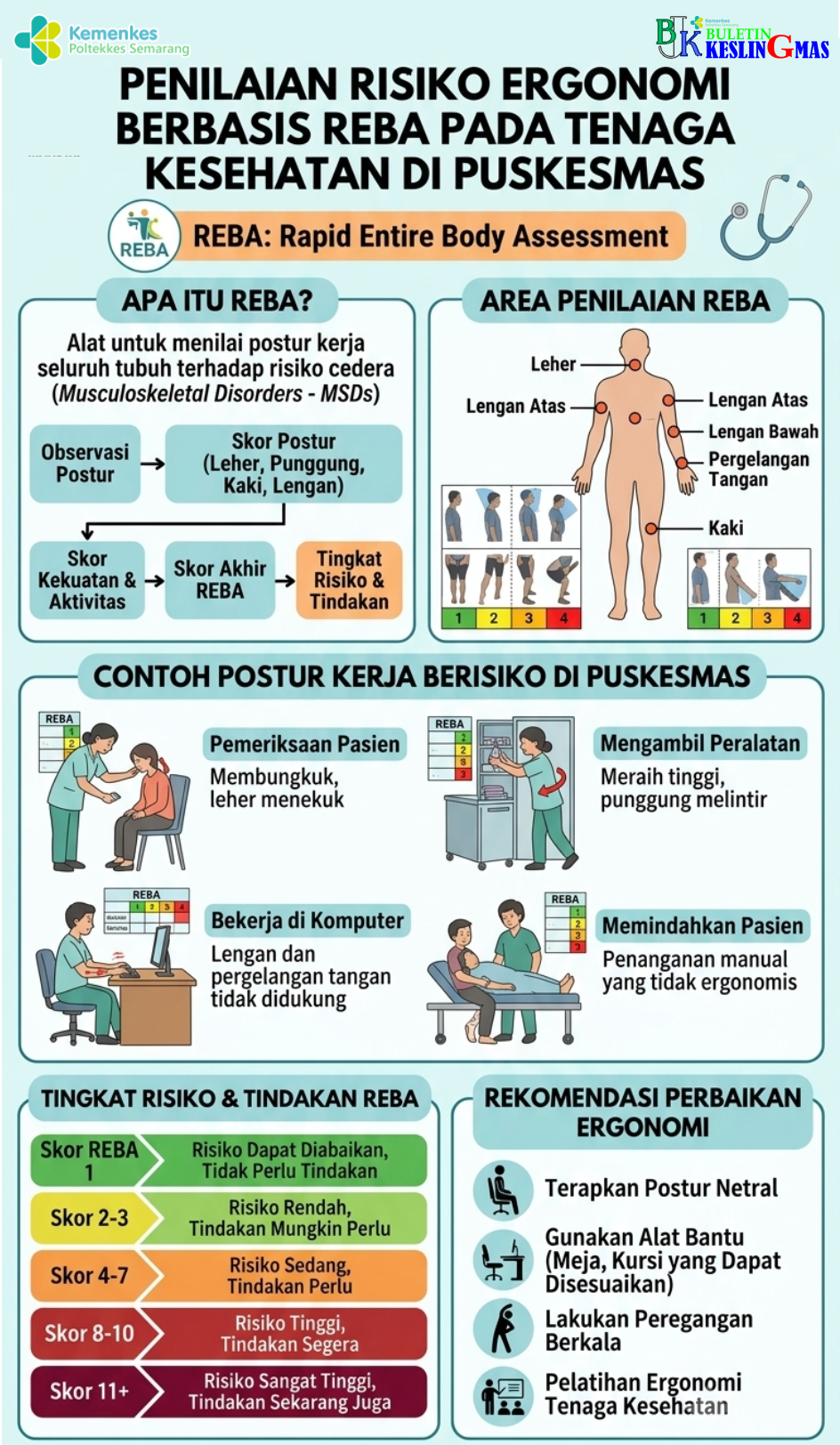
Musculoskeletal disorders (MSDs) are a major occupational health problem among healthcare workers in primary care facilities. Tlogosari Wetan Community Health Center has never conducted a systematic ergonomic risk assessment despite its healthcare workers performing various high-risk physical activities daily. Objective To identify ergonomic risk levels in work postures of healthcare workers at Tlogosari Wetan Community Health Center Semarang using the Rapid Entire Body Assessment (REBA) method and to formulate intervention recommendations based on the hierarchy of controls. Observational descriptive study with a cross-sectional design. Twenty healthcare workers from nine professions were observed using total sampling. Each respondent was assessed on one most representative work posture using the REBA worksheet covering all body segments (neck, trunk, legs, upper arm, lower arm, and wrist) without exclusion, alongside force/load, coupling, and activity scoring. 20 postures assessed (80% female respondents), REBA scores ranged from 3 to 11 (mean 5.50, SD 2.28; 95% CI: 4.43–6.57). Risk distribution: low risk 2 postures (10.0%), medium risk 15 postures (75.0%), high risk 2 postures (10.0%), very high risk 1 posture (5.0%). The highest score (REBA 11) was recorded during a joint wound care procedure performed by a nurse and a doctor. Dominant risk factors: excessive trunk and neck flexion (>20–60°) in 85% of postures, shoulder elevation in 75% of postures, and static-repetitive loading in 100% of postures. All observed postures required ergonomic attention. Staged interventions based on the NIOSH Hierarchy of Controls are recommended for immediate implementation: engineering controls (height-adjustable workstations, hi-low beds, ergonomic chairs, magnifying loupes), administrative controls (micro-breaks, task rotation), and PPE (wrist support, headlamp).
References
1. Jacquier-Bret J, Gorce P. Prevalence of body area work-related musculoskeletal disorders among healthcare professionals: A systematic review. Int J Environ Res Public Health. 2023;20(1):841.
2. Oliveira A, Fonseca C, Escoval A, Lopes M. The effect of interventions on preventing musculoskeletal injuries related to nurses' work: Systematic review. Int J Environ Res Public Health. 2023;20(4):3096.
3. Hignett S, McAtamney L. Rapid Entire Body Assessment (REBA). Appl Ergon. 2000;31(2):201-205.
4. Kee D. Systematic comparison of OWAS, RULA, and REBA based on a literature review. Int J Environ Res Public Health. 2022;19(1):595.
5. National Institute for Occupational Safety and Health (NIOSH). Hierarchy of controls. CDC. 2015. Available from: https://www.cdc.gov/niosh/topics/hierarchy/default.html
6. Hedge A. REBA Employee Assessment Worksheet. Cornell University Ergonomics Web. 2000.
7. Ayvaz O, Ozyildirim BA, Issever H, Oztan G, Atak M, Ozel S, et al. Ergonomic risk assessment of working postures of nurses with REBA and RULA methods. Proc Inst Mech Eng H. 2023;238(1).
8. Jahn A, Andersen JH, Christiansen DH, Seidler A, Dalboge A. Occupational mechanical exposures as risk factor for chronic low-back pain: A systematic review and meta-analysis. Scand J Work Environ Health. 2023;49(6):389-402.
9. Kakaraparthi VN, Vishwanathan K, Gadhavi B. An ergonomic risk assessment of ophthalmology residents using the REBA scale. Cureus. 2024;16(2):e53698.
10. Lohne FK, Xu K, Fimland MS, Palarea-Albaladejo J, Redzovic S. Association between musculoskeletal pain and exposures to awkward postures during work. Ann Work Expo Health. 2024;68(5):522-534.
11. Krishnanmoorthy G, Rampal S, Karuthan SR, Baharudin F, Krishna R. Effectiveness of participatory ergonomic interventions on MSDs among nurses: Systematic review. JMIR Hum Factors. 2025;12:e68522.
12. Fan X, Yang L, Young N, Kaner I, Kjellman M, Forsman M. Ergonomics and performance of using prismatic loupes in simulated surgical tasks: A RCT. Front Public Health. 2024;11:1257365.
13. Hemmati P, Nguyen TC, Dearani JA. Ergonomics for surgeons by surgeons - posture, loupes, and exercise. JAMA Surg. 2022;157(9):751-752.
14. Kementerian Kesehatan RI. Peraturan Menteri Kesehatan Nomor 52 Tahun 2018 tentang K3 di Fasilitas Pelayanan Kesehatan. Jakarta: Kemenkes RI; 2018.
15. Vitoulas S, Konstantis V, Drizi I, Vrouva S, Koumantakis GA, Sakellari V. The effect of physiotherapy interventions through active micro-break activities. Healthcare. 2022;10(10):2073.
16. Purnomo BC, Bahri B. Analisis faktor risiko ergonomi pada petugas kesehatan di fasilitas layanan primer menggunakan metode REBA. Buletin Keslingmas. 2023;42(1):45-52.
17. Kementerian Ketenagakerjaan RI. Peraturan Menteri Ketenagakerjaan Nomor 5 Tahun 2018 tentang K3 Lingkungan Kerja. Jakarta: Kemenaker RI; 2018.
18. World Health Organization. Musculoskeletal Conditions [Internet]. Geneva: WHO; 2023. Available from: https://www.who.int/news-room/fact-sheets/detail/musculoskeletal-conditions
19. International Organization for Standardization. ISO 45001:2018 Occupational health and safety management systems. Geneva: ISO; 2018.
20. Takala EP, Pehkonen I, Forsman M, Hansson GA, Mathiassen SE, Neumann WP, et al. Systematic evaluation of observational methods assessing biomechanical exposures at work. Scand J Work Environ Health. 2010;36(1):3-24.
Downloads
Published
How to Cite
Issue
Section
License
Copyright (c) 2026 Buletin Keslingmas

This work is licensed under a Creative Commons Attribution 4.0 International License.