Analysis of Knowledge, Attitudes, and School Facilities toward the Practice of Reducing Single-Use Plastic in Junior High Schools
DOI:
https://doi.org/10.31983/keslingmas.v45i2.15016Keywords:
Attitudes, Knowledge, School facilities, Single-use plastic, Student behaviorAbstract
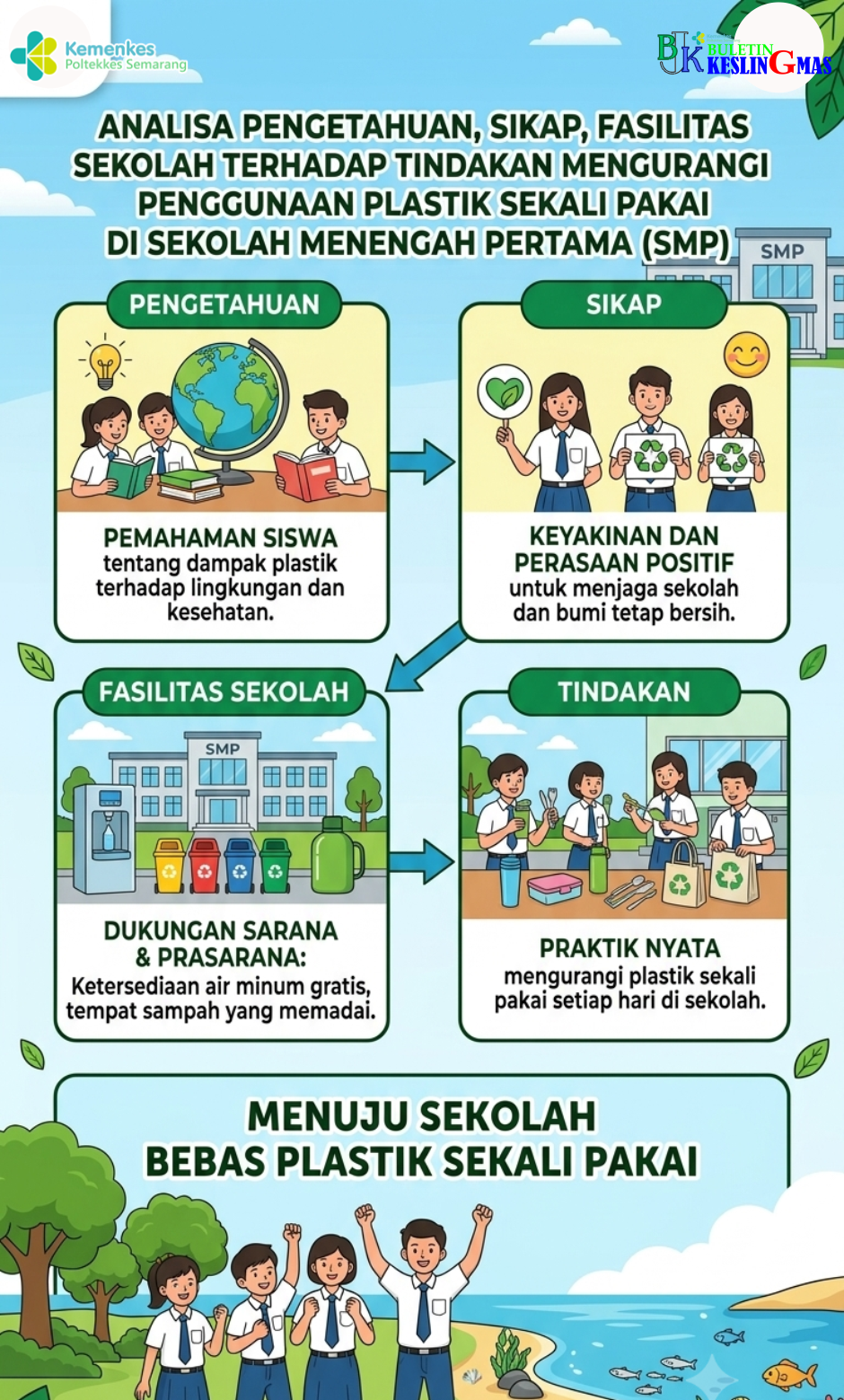
Plastic waste and microplastics are an increasingly serious environmental problem due to the high use of single-use plastics, particularly in school environments. This condition not only causes environmental pollution but also poses potential risks to the health of living organisms. This study aims to analyze the relationship between knowledge, attitudes, and school facilities and students' actions in reducing single-use plastic consumption among MTs and Muhammadiyah Junior High School students in Samarinda City. This study used a quantitative design with a cross-sectional approach. A total of 236 respondents were selected using a cluster sampling technique. Data were collected through questionnaires measuring students' knowledge, attitudes, perceptions of school facilities, and actions, as well as observation sheets to verify the actual availability of school facilities. Data were analyzed using the Chi-Square test and Fisher's Exact Test at a significance level of 0.05. Statistical analysis showed no significant relationship between knowledge and action (p=0.366), whereas significant relationships were found between attitudes and action (p=0.025; PR=6.740) and between school facilities and action (p=0.043; PR=2.571). These findings indicate that students' actions in reducing plastic use are more strongly influenced by attitudes and the availability of school facilities than by knowledge. This study concludes that there is a significant relationship between attitudes and school facilities and students' actions in reducing single-use plastic use, suggesting that improving school facilities and strengthening positive attitudes should be prioritized in efforts to reduce single-use plastic in school environments.
References
1. Maskun, Kamaruddin H, Pattitingi F, Assidiq H, Bachril SN, Al Mukarramah NH. Hasanuddin LawReview Plastic Waste Management in Indonesia : Current Legal Approaches and Future Perspectives. Hasanuddin Law Rev. 2023;9(1):106–25. doi:10.20956/halrev.v9i1.3683
2. Kibria MG, Masuk NI, Safeyat R, Nguyen HQ, Mourshed M. Plastic Waste : Challenges and Opportunities to Mitigate Pollution and Effective Management. Int J Environ Res. 2023;17(1):1–37. doi:10.1007/s41742-023-00507-z
3. UNEP. From Pollution to Solution: a Global Assessment of Marine Litter and Plastic Pollution [Internet]. United Nations Environment Programme; 2021. Available from: https://www.unep.org/resources/pollution-solution-global-assessment-marine-litter-and-plastic-pollution
4. Osman AI, Hosny M, Eltaweil AS, Omar S, Elgarahy AM, Farghali M, et al. Microplastic sources, formation, toxicity and remediation: a review. Environmental Chemistry Letters [Internet]. Springer International Publishing; 2023. Available from: https://doi.org/10.1007/s10311-023-01593-3 doi:10.1007/s10311-023-01593-3
5. Putri M, Setiawan G. Implikasi Cemaran Mikroplastik Terhadap Kesehatan Lingkungan Pada Ekosistem Sungai : Literatur Riview. J Kesehat Tambusai. 2025;6(4):16877–86.
6. Chartres N, Cooper CB, Bland G, Pelch KE, Gandhi SA, Bakenra A, et al. Effects of Microplastic Exposure on Human Digestive, Reproductive, and Respiratory Health: A Rapid Systematic Review. Environ Sci Technol. 2024;58(52). doi:10.1021/acs.est.3c09524
7. Permana MA. Mikroplastik pada Manusia : Rute Paparan , Mekanisme Toksikologi , dan Risiko Kesehatan – Sebuah Studi Literatur. J Kedokt Univ Lampung. 2025;9(2):273–83.
8. Raheel H, Ferguson A, Leslie SL, Guardado-menjivar V, Chen K, Merceron A, et al. Behavioral interventions related to plastic waste management in low-and middle-income countries : a systematic review using the behavior change wheel and the theoretical domains framework. Environ Res Lett. 2026;21(5):53003. doi:10.1088/1748-9326/ae49a3
9. Alshahrani MS, Gannamaneni VK, Kakaraparthi VN, Reddy RS. Health behaviors in school-aged children : global trends in education , socioeconomic status , and adolescent health. Front Public Heal. 2025;13(June):1–16. doi:https://doi.org/10.3389/fpubh.2025.1514386
10. Qurrota A, Noerjoedianto D, Lesmana O. Knowledge , Attitudes , Age , Education Level Factors to Waste Management. J Appl Nurs Heal. 2022;4(1):9–15. doi:https://doi.org/10.55018/janh.v4i1.27
11. Bancin LJ, Christy J. Pengaruh Penyuluhan Kesehatan Terhadap Pengetahuan Pencemaran Sampah Makroplastik Dan Mikroplastik Pada Mahasiswa Prodi D-III Perekam Dan Informasi Kesehatan Stikes Imelda. J Ilm Perekam dan Inf Kesehat Imelda [Internet]. 2020;5(2):156–64. Available from: https://scholar.google.com/citations?view_op=view_citation&hl=en&user=06cDI2AAAAAJ&citation_for_view=06cDI2AAAAAJ:BUYA1_V_uYcC
12. Oguge N, Oremo F, Adhiambo S. Investigating the Knowledge and Attitudes towards Plastic Pollution among the Youth in Nairobi , Kenya. Soc Sci. 2021;10(11):1–13. doi:https:// doi.org/10.3390/socsci10110408
13. Sulistyawati S, Sukesi TW, Mulasari SA, Tentama F, Djannah SN. Knowledge , Attitude and Practice towards Waste Management among Primary School Children. Vol. 8. 2020;8(4):24–30. doi:10.9734/AJESS/2020/v8i430234
14. Pramaningsih V, Rusdi, Farehah RN, Kumalasari VP. Edukasi bahaya sampah plastik , mikroplastik , dan pengelolaannya bagi siswa SMK Istiqomah Muhammadiyah 4 , Samarinda. SELAPARANG J Pengabdi Masy Berkemajuan. 2025;9(1):1231–7.
15. Sulistiyorini D. Pengetahuan, Sikap, Sarana, dan Petugas Kebersihan dengan Perilaku Masyarakat Dalam Pengelolaan Sampah Plastik. Lontara J Heal Sci Technol. 2024;5(2):119–30. doi:https://doi.org/10.53861/lontarariset.v5i2
16. Notoatmodjo S. Metodologi Penelitian Kesehatan. PT RINEKA CIPTA, Jakarta; 2010.
17. Wijayanti N, Amyati. Korelasi Pengetahuan , Sikap , dan Motivasi terhadap Perilaku Pengelolaan Sampah Berbasis Sekolah di Yogyakarta. SURYA Med J Ilm ILMU KEPERAWATAN DAN ILMU Kesehat Masy. 2024;19(03):214–21. doi:10.32504/sm.v19i3.1208
18. Pakpahan M, Siregar D, Susilawaty A, Mustar T, Ramdany R, Manurung EI, et al. Promosi Kesehatan&Perilaku Kesehatan. Watrianthos R, editor. Yayasan Kita Menulis. 1st ed. 2021. 1–184 p.
19. Eriskaputriyani, Novio R. Peranan Lingkungan Sekolah Terhadap Pembentukan Sikap Peduli Lingkungan Di SMA Pembangunan Laboratorium Universitas Negeri Padang. J Pendidik Tambusai. 2024;8(2):10389–99. doi:https://doi.org/10.31004/jptam.v8i1.13948
20. Karmila J, Amizera S, Susanti R. Peran Kantin Sehat Dalam Menumbuhkan Perilaku Peduli Lingkungan di Kalangan Siswa. Pros Semin Nas Pendidik IPA KE-III FKIP UNSRI. 2026;578–92.
Downloads
Published
How to Cite
Issue
Section
License
Copyright (c) 2026 Buletin Keslingmas

This work is licensed under a Creative Commons Attribution 4.0 International License.