
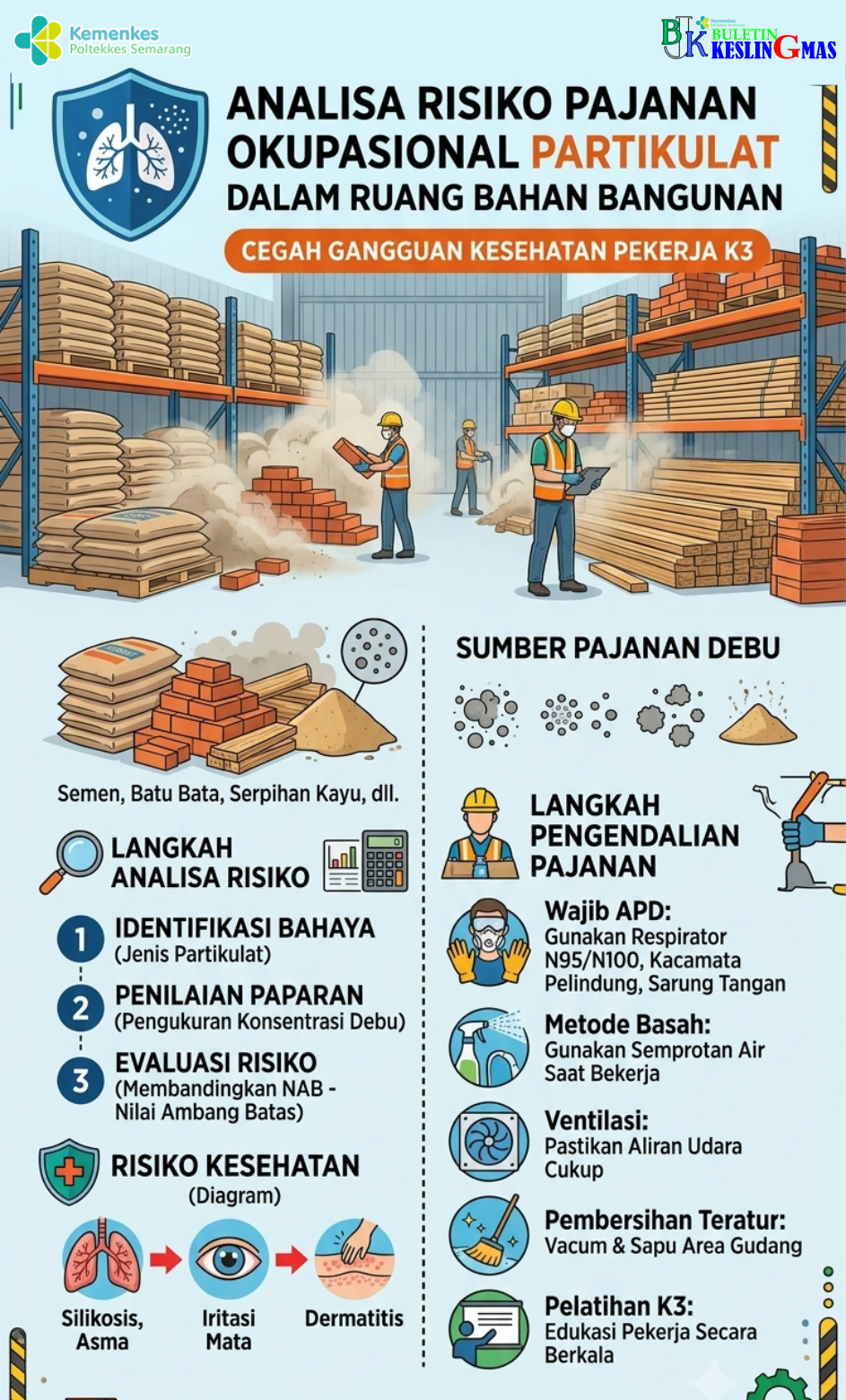
Risk Analysis of Indoor Occupational Exposure to Particulate Matter from Building Materials
DOI:
https://doi.org/10.31983/keslingmas.v45i2.15146Keywords:
Environmental Health Health Risk Assessment, Indoor Air Quality, PM10, Building Material Stores, Respiratory ComplaintsAbstract
Loading and unloading activities in building material stores generate suspended coarse particulate matter (PM10) emissions, risking respiratory disorders among workers due to inadequate ventilation. This study aimed to evaluate PM10 concentrations, estimate environmental health risk levels (Risk Quotient/RQ), and quantitatively analyze their relationship with the severity of workers' respiratory complaints in Gorontalo City. This cross-sectional observational analytic study utilized an Environmental Health Risk Assessment (EHRA) approach involving 15 workers via total sampling. PM10 concentrations were measured using a Portable Dust Monitor across three work zones: Cement Warehouse, Display Area, and Mixed Material Warehouse. Bivariate data analysis applied Fisher's Exact Test and Spearman Rank correlation. The results demonstrated an extreme concentration disparity where the Cement Warehouse (177.79 µg/m³) significantly exceeded the daily threshold limit of 70 µg/m³ due to a pollutant trap effect, far surpassing the Display Area (11.43 µg/m³) and Mixed Warehouse (11.61 µg/m³). Respiratory complaint prevalence was remarkably high at 93.3% (dominated by sneezing at 60%). Fisher's Exact Test showed no categorical association between risk status and complaint occurrence (p=1.000) due to high baseline prevalence across all zones. However, the Spearman Rank test proved a strong and statistically significant positive correlation between direct PM10 concentrations and respiratory complaint severity (r=0.640; p=0.010). In conclusion, particulate matter triggers mass initial mucosal irritation, but the clinical severity of respiratory disorders is strictly dose-dependent on concentration levels. The high severity of complaints in pollutant trap areas strictly demands engineering controls, specifically Local Exhaust Ventilation (LEV), to suppress PM10 concentrations and prevent respiratory deterioration.
References
1. World Health O. WHO global air quality guidelines: particulate matter (PM2. 5 and PM10), ozone, nitrogen dioxide, sulfur dioxide and carbon monoxide. World Health Organization. 2021.
2. Tanjung LA, Marsaulina I. Relationship Between PM10 Exposure and Lung Dysfunction in The Workers of Rice Mill, Deli Serdang, in 2019. International Journal of Public Health and Clinical Sciences. 2020;7(3):61-71.
3. Tiotiu AI, Novakova P, Nedeva D, Chong-Neto HJ, Novakova S, Steiropoulos P, et al. Impact of air pollution on asthma outcomes. International journal of environmental research and public health. 2020;17(17):6212.
4. Azarov VN, Sakharova AA, Lupinogin VV, Evtushenko AI, Nikolenko MA, editors. Analysis of the chemical composition of dust particles in the warehouse of building materials2019: IOP Publishing.
5. Cincinelli A, Guerranti C, Martellini T, Scodellini R. Residential wood combustion and its impact on urban air quality in Europe. Current opinion in environmental science & health. 2019;8:10-4.
6. Evtushenko A, Lupinogin V, Kaluzgina E, Strelyaeva A, Sakharova A, editors. Investigation of air pollution with fine dust during repair and construction work inside premises2021: IOP Publishing.
7. Benabed A, Boulbair A, Limam K. Experimental study of the human walking-induced fine and ultrafine particle resuspension in a test chamber. Building and Environment. 2020;171:106655.
8. Boulbair A, Benabed A, Janssens B, Limam K, Bosschaerts W. Numerical study of the human walking-induced fine particles resuspension. Building and Environment. 2022;216:109050.
9. Wang B, Tang Z, Li Y, Cai N, Hu X. Experiments and simulations of human walking-induced particulate matter resuspension in indoor environments. Journal of Cleaner Production. 2021;295:126488.
10. He R, Zhang J, Mainelis G. Resuspension of particles deposited by nano‐enabled consumer sprays: The role of product type, flooring material, and resuspension force. Indoor air. 2022;32(11):e13157.
11. Licina D, Nazaroff WW. Clothing as a transport vector for airborne particles: Chamber study. Indoor air. 2018;28(3):404-14.
12. Zhang H, Liu H, Ferro AR, Lai ACK. Effects of triboelectric charging, flooring materials, relative humidity, and shoe sole materials on human walking-induced particle resuspension. Building and Environment. 2023;244:110838.
13. Cetintepe SP, Demirbas OB, Dinke B, Ilhan MN. Is exposure to cement dust and heavy metals associated with reduced pulmonary function? A cross-sectional study among cement factory workers in Türkiye. BMJ open. 2025;15(7):e102214.
14. Meskhi B, Evtushenko A, Startseva Y, Cherhushenko A, Sakharova A, editors. Investigation of the dispersed composition of dust of inert materials exposed to overload in the manufacture of building materials2021 2021: IOP Publishing.
15. Njagi TN, Were FH, Onyatta JO, Wafula GA. PM10 Levels and Prevalence of Respiratory Diseases in Communities around the Cement Industries. Asian J Env Ecol. 2023;20(3):11-23.
16. Zhuang X, Xu Y, Zhang L, Li X, Lu J. Experiment and numerical investigation of inhalable particles and indoor environment with ventilation system. Energy and Buildings. 2022;271:112309.
17. Al-Rikabi IJ, Karam J, Alsaad H, Ghali K, Ghaddar N, Voelker C. The impact of mechanical and natural ventilation modes on the spread of indoor airborne contaminants: A review. Journal of Building Engineering. 2024;85:108715.
18. Ham Y-B, Cheriyan D, Kim H-U, Han J-G, Kim YH, Priyanka PRJ, et al. Particulate matter reduction efficiency analysis of sprinkler system as targeted control measures for construction activity. Heliyon. 2024;10(7).
19. Grahn K, Gustavsson P, Andersson T, Lindén A, Hemmingsson T, Selander J, et al. Occupational exposure to particles and increased risk of developing chronic obstructive pulmonary disease (COPD): A population-based cohort study in Stockholm, Sweden. Environmental research. 2021;200:111739.
20. Nishida C, Yatera K. The impact of ambient environmental and occupational pollution on respiratory diseases. International journal of environmental research and public health. 2022;19(5):2788.
21. Su X, Gu H, Li F, Shi D, Wang Z. Global, Regional, and National Burden of COPD Attributable to Occupational Particulate Matter, gases, and fumes, 1990–2019: findings from the global burden of Disease Study 2019. International Journal of Chronic Obstructive Pulmonary Disease. 2023:2971-83.
22. Krishna L, Pandarikkal JR, Sreedharan R, Sampson U, Annamala PT, Unni KM. Assessment of respiratory morbidity among loading and unloading workers exposed to cement dust. Int J Res Med Sci. 2019;7:2422-7.
23. Linda J, Pospíšil J, Köbölová K. Identification of wind-induced particle resuspension in urban environment using CFD modelling. Atmosphere. 2022;14(1):57.
24. Sadek EA, Hany AMM, Rashad A. Evaluation of lung function in relation to employment years among workers exposed to cement dust in Qena cement factory. SVU-International Journal of Medical Sciences. 2023;6(2):729-35.
25. Kumar DU, Reddy VM, editors. Analysis and design of reinforced concrete silo by conventional method2023 2023: EDP Sciences.
26. Raqqad ZK. Environmentally Sustainable Construction by Reducing Embodied Carbon Emissions in the Construction of Large-Scale Projects: a Study on High-Rise Buildings. 2024.
27. dos Santos-Silva JC, Potgieter-Vermaak S, Medeiros SHW, da Silva LV, Ferreira DV, Moreira CAB, et al. A new strategy for risk assessment of PM2.5-bound elements by considering the influence of wind regimes. Science of The Total Environment. 2023;872:162131.
28. Doumbia T, Liousse C, Ouafo-Leumbe M-R, Ndiaye SA, Gardrat E, Galy-Lacaux C, et al. Source apportionment of ambient particulate matter (PM) in Two Western African urban sites (Dakar in Senegal and Bamako in Mali). Atmosphere. 2023;14(4):684.
29. Cholianawati N, Sinatra T, Nugroho GA, Permadi DA, Indrawati A, Halimurrahman, et al. Diurnal and daily variations of PM2. 5 and its multiple-wavelet coherence with meteorological variables in Indonesia. Aerosol and Air Quality Research. 2024;24(3):230158.
30. Abidin AU, Munawaroh AL, Rosinta A, Sulistiyani AT, Ardianta I, Iresha FM. Environmental health risks and impacts of PM2. 5 exposure on human health in residential areas, Bantul, Yogyakarta, Indonesia. Toxicology Reports. 2025;14:101949.
31. Susetyo SH, Abidin AU, Nagaya T, Kato N, Matsui Y. Environmental health risk assessment and acute effects of sulfur dioxide (SO2) inhalation exposure on traditional sulfur miners at Ijen Crater Volcano, Indonesia. Toxicology Reports. 2024;13:101772.
32. Yoon H, Seo J, Yoo S-K, Kim P-J, Park J, Choe Y, et al. Updated general exposure factors for risk assessment in the Korean population. Journal of exposure science & environmental epidemiology. 2023;33(6):1013-20.
33. Kemenkes RI. Peraturan Menteri Kesehatan Republik Indonesia Nomor 2 Tahun 2023 Tentang Peraturan Pelaksanaan Peraturan Pemerintah Nomor 66 Tahun 2014 Tentang Kesehatan Lingkungan. Kemenkes RI2023.
34. Gharpure A, Heim JW, Vander Wal RL. Characterization and hazard identification of respirable cement and concrete dust from construction activities. International journal of environmental research and public health. 2021;18(19):10126.
35. Hwang J, Kim WJ, Chae KJ, Jin GY, Lee CH, Cui X, et al. A numerical study on airflow and particle transport characteristics of subjects with cement dust exposure. Aerosol Science and Technology. 2024;58(12):1432-52.
36. Ervik TK, Hammer SE, Notø H, Ellingsen DG, Thomassen Y, Weinbruch S, et al. Physicochemical characterization of particulate matter in a cement production plant. Environmental Science: Processes & Impacts. 2022;24(8):1243-56.
37. Dhooria S, Sehgal IS, Agarwal R. Silica-associated lung disease in developing countries. Current Opinion in Pulmonary Medicine. 2023;29(2):65-75.
38. Wang A-B, Zhang X, Gao L-J, Zhang T, Xu H-J, Bi Y-J. A review of filtration performance of protective masks. International journal of environmental research and public health. 2023;20(3):2346.
39. Senthilselvan A, Coonghe WVL, Beach J. Respiratory health, occupation and the healthy worker effect. Occupational Medicine. 2020;70(3):191-9.
40. Li X, Liu X. Effects of PM2. 5 on chronic airway diseases: a review of research progress. Atmosphere. 2021;12(8):1068.
41. Anlimah F, Gopaldasani V, MacPhail C, Davies B. A systematic review of the effectiveness of dust control measures adopted to reduce workplace exposure. Environmental science and pollution research international. 2023;30(19):54407-28.
Downloads
Published
How to Cite
Issue
Section
License
Copyright (c) 2026 Buletin Keslingmas

This work is licensed under a Creative Commons Attribution 4.0 International License.