Concentration of Total Suspended Particulates and Lead in Ambient Air
DOI:
https://doi.org/10.31983/keslingmas.v45i2.14531Keywords:
Air pollution, Ambient air, HVAS, Total Suspended Particulate, LeadAbstract
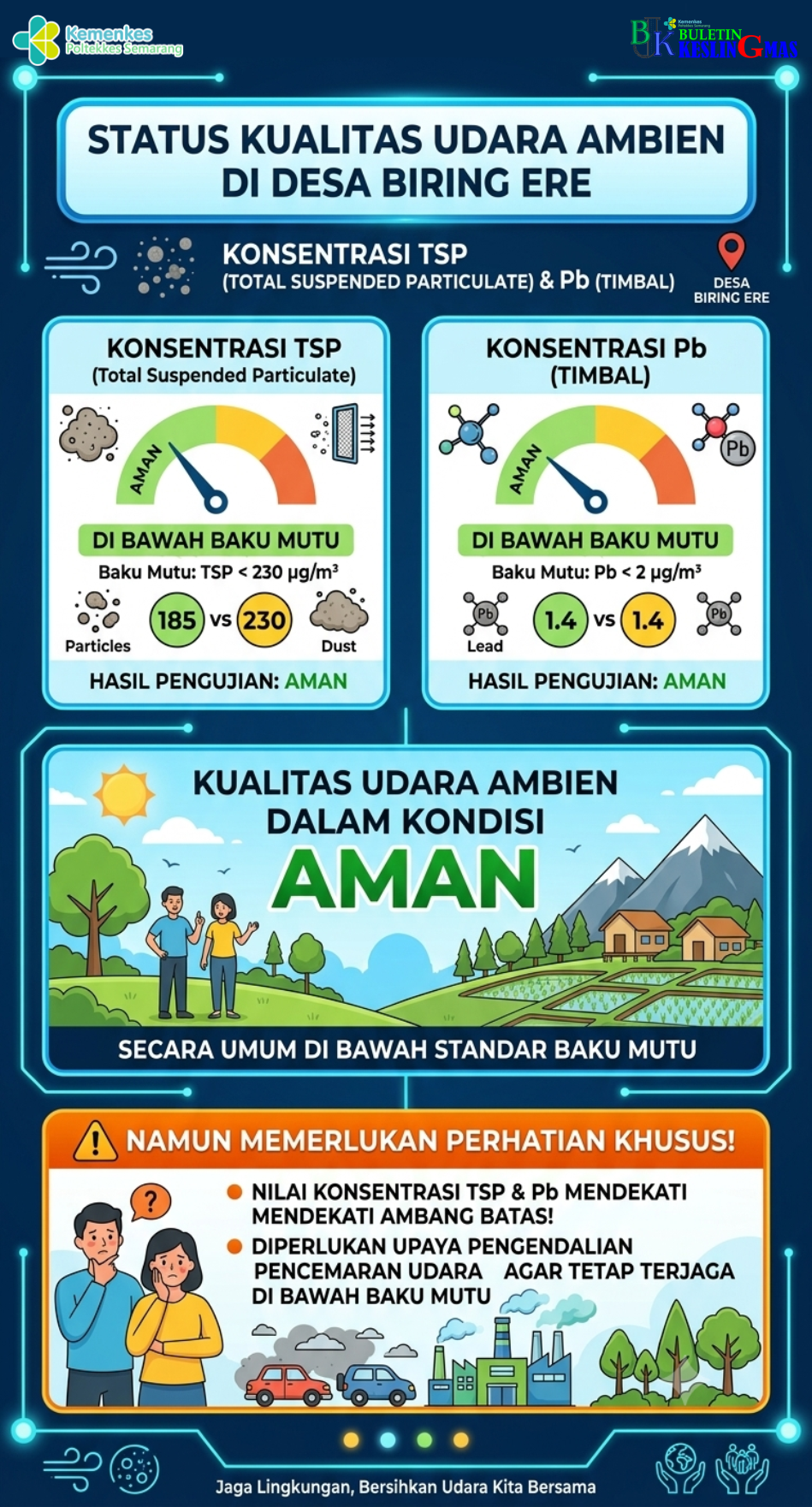
Air pollution is a vital environmental issue, especially in areas close to industrial activities and heavy transportation. Biring Ere Village, located in Pangkep Regency, is vulnerable to air quality degradation due to vehicle mobility and other sectoral activities. The study aims to analyze the concentration of Total Suspended Particulate (TSP) and heavy metal Lead (Pb) in ambient air in Biring Ere Village and compare it with quality standards based on Government Regulation of the Republic of Indonesia No. 22 of 2021 and SNI 7119-3:2017. The research method used was field observation with air sampling using a High-Volume Air Sampler (HVAS), which was then analyzed in the laboratory. Laboratory test results showed that in residential areas, the concentration of TSP was 121 μg/m3 and lead (Pb) was 0.01 μg/m3, while in industrial areas, the concentration of TSP was 216 μg/m3 and the concentration of lead (Pb) was 1.4 μg/m3. Based on a comparison with Government Regulation No. 22 of 2021 and SNI 7119-3:2017, the results show that both parameters are still below the established quality standards (TSP < 230 μg/m³ and Pb < 2 μg/m³). The ambient air quality in Biring Ere Village is categorized as safe. However, the concentration levels of Total Suspended Particulate (TSP) and Lead (Pb) are close to the threshold, requiring special attention in air pollution control efforts to ensure that they remain below the quality standards.
References
1. S. Murniasih, K. Rozana, and D. S. Prabasiwi, “Asesmen logam berat sampel partikulat udara pada TSP di sekitar PLTU Pacitan,” Indones. J. Chem. Anal., vol. 3, no. 2, pp. 74–82, 2020.
2. World Health Organization (WHO), World Health Statistics. 2018.
3. F. S. Fauzianto and M. Ali, “Analisis Komparatif Pemantauan Kualitas Udara Ambien di Surabaya Pada Tahun 2023,” Ocean Eng. J. Ilmu Tek. dan Teknol. Marit., vol. 3, no. 2, pp. 1–13, 2024.
4. E. P. Pamungkas, “Analisis Konsentrasi Polutan TSP, PM2. 5, PM10, dan PB Bengkel Motor Resmi (Studi Kasus: UD. Utama Motor Sleman),” 2022.
5. F. E. Longoria-Rodríguez et al., “Sequential SEM-EDS, PLM, and MRS microanalysis of individual atmospheric particles: A useful tool for assigning emission sources,” Toxics, vol. 9, no. 2, p. 37, 2021.
6. S. Mico, E. Tsaousi, A. Deda, and P. Pomonis, “Characterization of airborne particles and source identification using SEM/EDS,” Eur. Chem. Bull, vol. 4, pp. 224–229, 2015.
7. H. S. Huboyo and S. Syafrudin, “Analisis Resiko Konsentrasi Debu (Tsp) dan Timbal (Pb) di Pinggir Jalan terhadap Kesehatan Manusia Studi Kasus Kota YOGYAKARTA,” Teknik, vol. 28, no. 2, pp. 142–148, 2007.
8. P. R. Peraturan Pemerintah, “Peraturan Presiden Republik Indonesia,” No. 72 Tahun 2021, 2021.
9. N. A. N. Malik, “Analisis Kualitas Udara Pada Kawasan Sekolah Berdasarkan Parameter Total Suspended Particulate (Tsp)= Analysis Of Air Quality In School Area Based On Total Suspended Particulate (Tsp) Parameter,” 2024, Universitas Hasanuddin.
10. F. S. Anwar, A. Mallongi, and M. A. Maidin, “Kualitas udara ambien CO dan TSP di permukiman sekitar kawasan industri PT. Semen Tonasa,” J. Kesehat. Masy. Marit., vol. 2, no. 2, 2019.
11. G. G. Gunawan, “Tingkat Pencemaran Udara Debu dan Timbal di Lingkungan Gerbang Tol,” J. Jalan Jemb., vol. 32, no. 2, pp. 115–124, 2015.
12. D. S. Wijaya, S. Sunarto, and S. Rachmawati, “Analisis Risiko Kesehatan Lingkungan dengan Total Suspended Particulate Sebagai Risk Agent di Area Produksi Industri Manufaktur (Studi Kasus PT X Sukoharjo Jawa Tengah),” J. Ilmu Lingkung., vol. 22, no. 3, pp. 678–686, 2024.
13. I. Rosyadi and I. P. Wulandari, “Penegakan hukum lingkungan terhadap pencemaran udara akibat aktivitas industri di Kabupaten Gresik,” Al-Qanun J. Pemikir. Dan Pembaharuan Huk. Islam, vol. 24, no. 2, pp. 279–307, 2021.
14. M. S. Nugraha, A. Saefumillah, and A. Sopaheluwakan, “Perbandingan Karakteristik Kimia dan Morfologi Total Suspended Particulate (TSP) di Area Urban dan Background,” PROSIDING, p. 1, 2021.
15. A. R. Nurfadillah, “Penilaian Risiko Pajanan Total Suspended Particulate Pada Masyarakat,” Jambura Heal. Sport J., vol. 5, no. 2, pp. 104–113, 2023.
16. R. Virgia and A. Djamil, “Analisis Kadar Debu Total Suspended Particulate (TSP) di Udara Ambien terhadap Keluhan Kesehatan Saluran Pernapasan,” Bul. Keslingmas, vol. 42, no. 3, pp. 141–146, 2023.
17. V. T. Siringoringo, D. Pringgenies, and A. Ambariyanto, “Kajian Kandungan Logam Berat Merkuri (Hg), Tembaga (Cu), dan Timbal (Pb) pada Perna viridis di Kota Semarang,” J. Mar. Res., vol. 11, no. 3, pp. 539–546, 2022.
18. T. F. Prasetyo, A. Gani, and Z. Mufid, “Pengaruh Suhu, Kelembapan dan Angin terhadap Polusi Udara: Studi Kasus Dataset Air Quality,” INSANtek, vol. 6, no. 1, pp. 43–51, 2025.
19. United States Environmental Protection Agency. (2020). NAAQS Table. Retrieved from https://www.epa.gov/criteria-air-pollutants/naaqs-table
20. International Journal of Environmental Research and Public Health. (2019). Impact of Air Pollution on Health: A European and North American Approach. Retrieved from https://www.mdpi.com/journal/ijerph
Downloads
Published
How to Cite
Issue
Section
License
Copyright (c) 2026 Buletin Keslingmas

This work is licensed under a Creative Commons Attribution 4.0 International License.