
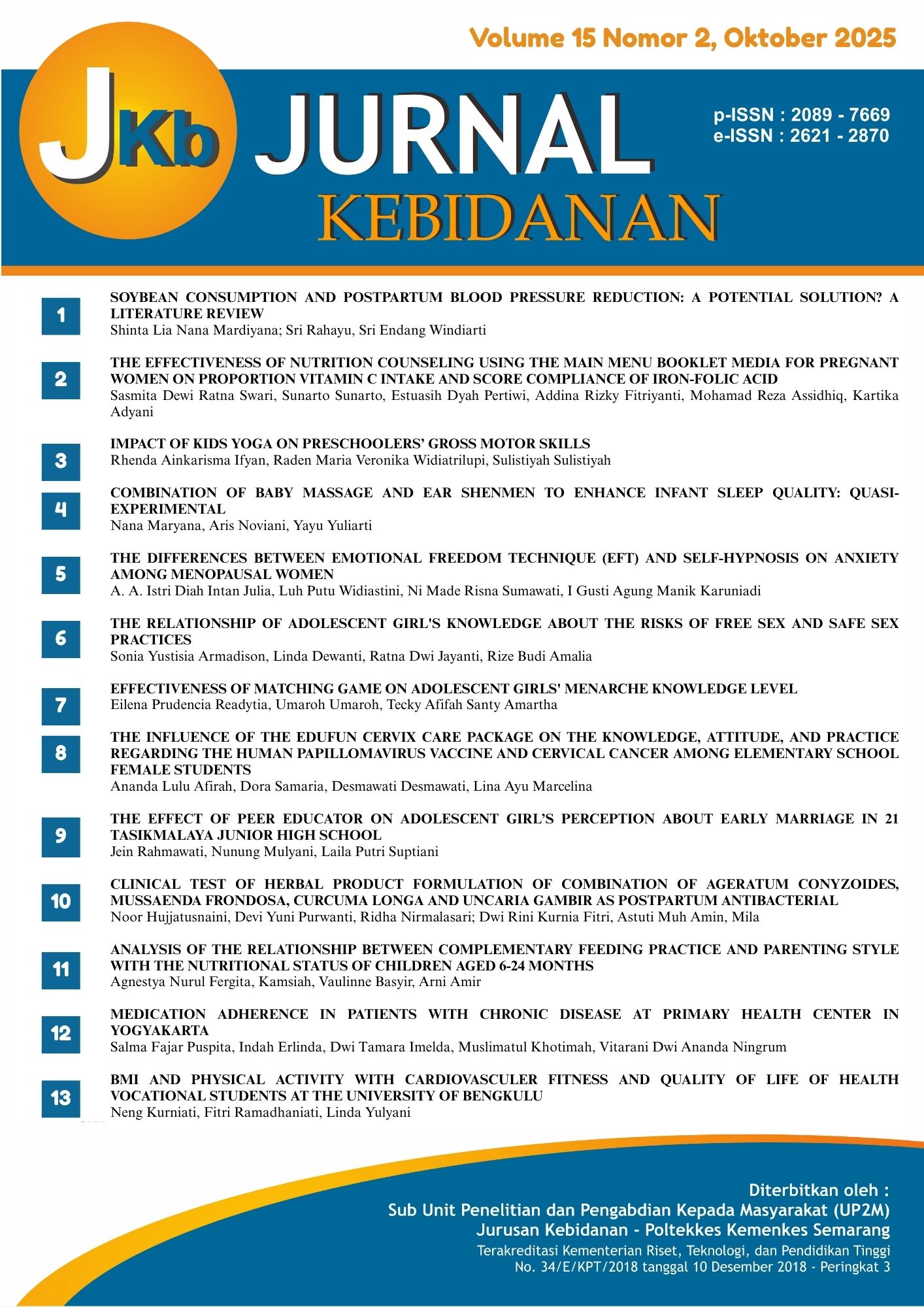
Analysis of The Relationship Between Complementary Feeding Practice and Parenting Style with the Nutritional Status of Children Aged 6-24 Months
##plugins.themes.academic_pro.article.sidebar##
##plugins.themes.academic_pro.article.main##
Abstract
The nutritional status of children is currently a global concern, with two million children under the age of five suffering from severe acute malnutrition, a lifethreatening condition if left untreated. Millions of Indonesian children remain at risk due to high rates of stunting and wasting, as well as the double burden of malnutrition, where both undernutrition and overnutrition occur. Globally in 2020 (WHO), 149.2 million children under the age of five (22%) were stunted, 45.4 million children (6.7%) were wasted, and 38.9 million children (5.7%) were overweight. The purpose of this study was to analyze the relationship between complementary feeding practices and parenting patterns with the nutritional status of children aged 6– 24 months in the Pegambiran Health Center working area in Padang City. Study method is a quantitative research method with a cross-sectional study design. The results of the statistical analysis in this study using the chi- square test showed a significant association between complementary feeding practices and the nutritional status of children aged 6– 24 months (p- value = 0.000) and between parenting styles and the nutritional status of children aged 6– 24 months (p- value = 0.000). The conclusion of this study is that there is a relationship between the practice of providing complementary foods and the nutritional status of children aged 6– 24 months.
##plugins.themes.academic_pro.article.details##

This work is licensed under a Creative Commons Attribution 4.0 International License.
References
- [1] UNICEF/WHO/WORLD BANK, “Levels and trends in child malnutrition UNICEF / WHO / World Bank Group Joint Child Malnutrition Estimates Key findings of the 2021 edition,” World Heal. Organ., pp. 1–32, 2021.
- [2] WHO/NMH/NHD, Global Nutrition Targets 2025 Stunting Policy Brief. 2021.
- [3] K. K. Mejos, M. S. Ignacio, R. Jayasuriya, and J. Arcot, “Use of Linear Programming to Develop Complementary Feeding Recommendations to Improve Nutrient Adequacy and Dietary Diversity Among Breastfed Children in the Rural Philippines,” Food Nutr. Bull., vol. 42, no. 2, pp. 274–288, 2021.
- [4] S. Munawaroh, “Pola Asuh Mempengaruhi Status Gizi Balita Relationship of Parenting Pattern and Toddlers’ Nutrititional Status,” J. Keperawatan, vol. 6, no. 1, pp. 44–50, 2015.
- [5] RPJMN, “Rencana Aksi Program 2020-2024,” Jakarta, 2020.
- [6] S. Eka Masturina, K. Hardjito, and D. Estuning Rahayu, The relationship between feeding patterns and nutritional status of toddlers, vol. 11, no. 1. Atlantis Press International BV, 2023.
- [7] H. S. Twabi, S. O. M. Manda, and D. S. Small, “Evaluating the Effect of Appropriate Complementary Feeding Practices on Child Growth in Malawi Using Cross-Sectional Data: An Application of Propensity Score Matching,” Front. Nutr., vol. 8, no. November, 2021.
- [8] M. Roberts, T. Tolar-Peterson, A. Reynolds, C. Wall, N. Reeder, and G. Rico Mendez, “The Effects of Nutritional Interventions on the Cognitive Development of Preschool-Age Children: A Systematic Review,” Nutrients, vol. 14, no. 3, pp. 1–15, 2022.
- [9] L. Rosalina, B. F. Yustanta, N. W. Wardani, D. Mahendika, P. I. A. Sari, and T. Djafar, “Relationship Between Parenting and Nutrition-Aware Family Behavior with The Incidence of Stunting in Toddlers at Klaten Regency Central Java Province,” J. Penelit. Pendidik. IPA, vol. 9, no. 8, pp. 6213–6218, 2023.
- [10] A. Jeyakumar et al., “Determinants of complementary feeding practices among children aged 6–24 months in urban slums of Pune, Maharashtra, in India,” J. Heal. Popul. Nutr., vol. 42, no. 1, pp. 1–13, 2023.
- [11] D. Chilot et al., “Triple burden of malnutrition among mother-child pairs in low-income and middle-income countries: A cross-sectional study,” BMJ Open, vol. 13, no. 5, pp. 1–9, 2023.
- [12] T. D. Tsega et al., “The effect of parity on time to initiate complementary feeding among mother-infant pairs in Awi Zone, Northwest Ethiopia,” Ital. J. Pediatr., vol. 50, no. 1, pp. 1–13, 2024.
- [13] J. Čvorović, “The Association Between Maternal Age at Childbirth and Child Nutritional Outcomes: A Cross-sectional Study From Serbian Roma Communities,” Glob. Pediatr. Heal., vol. 11, 2024.
- [14] Y. B. Prasetyo, P. Permatasari, and H. D. Susanti, “The effect of mothers’ nutritional education and knowledge on children’s nutritional status: a systematic review,” Int. J. Child Care Educ. Policy, vol. 17, no. 1, 2023.
- [15] A. Talib Eidan, | Adraa, and H. Shawq, “Effect of Educational Programs on Mothers`Mothers`Knowledge and Children`s Nutritional Status: Narrative Review,” Curr. Med. Res. Opin., vol. 07, pp. 2606–2617, 2024.
- [16] S. Supadmi et al., “Factor related to stunting of children under two years with working mothers in Indonesia,” Clin. Epidemiol. Glob. Heal., vol. 26, no. February, p. 101538, 2024.
- [17] A. Stochel-Gaudyn, A. Koziol-Kozakowska, and E. Łuszczki, “Evaluation of complementary feeding practices and mothers’ nutritional knowledge in reference to current Polish recommendations,” J. Heal. Inequalities, vol. 8, no. 2, pp. 145–154, 2022.
- [18] B. Ketema, T. Bosha, and F. W. Feleke, “Effect of maternal employment on child nutritional status in Bale Robe Town, Ethiopia: a comparative cross-sectional analysis,” J. Nutr. Sci., vol. 11, pp. 1–14, 2022.
- [19] N. Thamaria, Peniaian Status Gizi. Indonesia: Pusat Pendidikan SDM Kesehatan Kementerian Kesehatan Republik Indomesia, 2017.
- [20] L. Harrison et al., “Dietary Strategies for Complementary Feeding between 6 and 24 Months of Age: The Evidence,” Nutrients, vol. 15, no. 13, 2023.
- [21] M. Zheng et al., “Understanding the pathways between prenatal and postnatal factors and overweight outcomes in early childhood: a pooled analysis of seven cohorts,” Int. J. Obes., vol. 47, no. 7, pp. 574–582, 2023.
- [22] N. Nurfatimah, K. Ramadhan, C. Entoh, L. W. Longgupa, and F. Hafid, “Continuity of Midwifery Care Implementation to Reduce Stunting,” Open Access Maced. J. Med. Sci., vol. 9, no. E, pp. 1512–1516, 2021.
- [23] M. A. Abeshu, A. Lelisa, and B. Geleta, “Complementary Feeding: Review of Recommendations, Feeding Practices, and Adequacy of Homemade Complementary Food Preparations in Developing Countries – Lessons from Ethiopia,” Front. Nutr., vol. 3, no. October, 2016.
- [24] N. V Lopez et al., “HHS Public Access,” pp. 205–213, 2020.
- [25] D. T. Esan, O. E. Adegbilero-Iwari, A. Hussaini, and A. J. Adetunji, “Complementary feeding pattern and its determinants among mothers in selected primary health centers in the urban metropolis of Ekiti State, Nigeria,” Sci. Rep., vol. 12, no. 1, pp. 1–9, 2022.
- [26] N. M. Nida and F. Hartanto, “Pengaruh Pola Asuh terhadap Perilaku Makan Anak Usia 4-6 Tahun,” Sari Pediatr., vol. 23, no. 3, p. 150, 2021.
- [27] J. A. Ahmed, K. K. Sadeta, and K. H. Lembo, “Complementary Feeding Practices and Household Food Insecurity Status of Children Aged 6-23 Months in Shashemene City West Arsi Zone, Oromia, Ethiopia,” Nurs. Res. Pract., vol. 2022, 2022.
- [28] M. E. Capra et al., “Complementary Feeding: Tradition, Innovation and Pitfalls,” Nutrients, vol. 16, no. 5, pp. 1–29, 2024.
- [29] A. Busnel et al., “Food consumption, nutritional intakes and the role of milk formulas in nutrient adequacy among young children from birth to 2 years living in urban Algeria,” Public Health Nutr., vol. 26, no. 1, pp. 171–181, 2023.
- [30] A. U. Zogara, M. S. Loaloka, and M. G. Pantaleon, “Faktor Ibu Dan Waktu Pemberian Mpasi Berhubungan Dengan Status Gizi Balita Di Kabupaten Kupang,” J. Nutr. Coll., vol. 10, no. 1, pp. 55–61, 2021.
- [31] N. Afraihana, A. Rizqiawan, I. Istianah, and S. H. Afrizal, “The Relationship Between , Mother Attitude And Mother Parenting Pattern With The Nutritional Status Of Child 2-5 Years,” vol. 6, no. April, pp. 26–35, 2024.
- [32] B. Chen, K. Kattelmann, C. Comstock, L. McCormack, H. Wey, and J. Meendering, “Parenting styles, food parenting practices and dietary intakes of preschoolers,” Nutrients, vol. 13, no. 10, pp. 1–15, 2021.
- [33] L. F. Nadhila, A. Gita Ningrum, and M. Tri Arif Sampurna, “Effect of Parenting Style on Nutritional Status of Toddlers in Surabaya,” Indones. Midwifery Heal. Sci. J., vol. 7, no. 3, pp. 267–275, 2023.
- [34] A. Costa and A. Oliveira, “Parental Feeding Practices and Children’s Eating Behaviours: An Overview of Their Complex Relationship,” Healthc., vol. 11, no. 3, pp. 1–15, 2023.
- [35] R. Abdulaziz, N. Suryanti, and A. S. Setiawan, “A Review on Maternal Parenting, Child’s Growth Stunting, and Oral Health,” Eur. J. Dent., vol. 18, no. 1, pp. 26–40, 2024.