Different of Electrode Spacing in Electrocoagulation Method in Domestic Waste Water Treatment
DOI:
https://doi.org/10.31983/keslingmas.v45i2.13450Keywords:
Electrode Spacing, Electrocoagulation, Oil and Grease, WastewaterAbstract
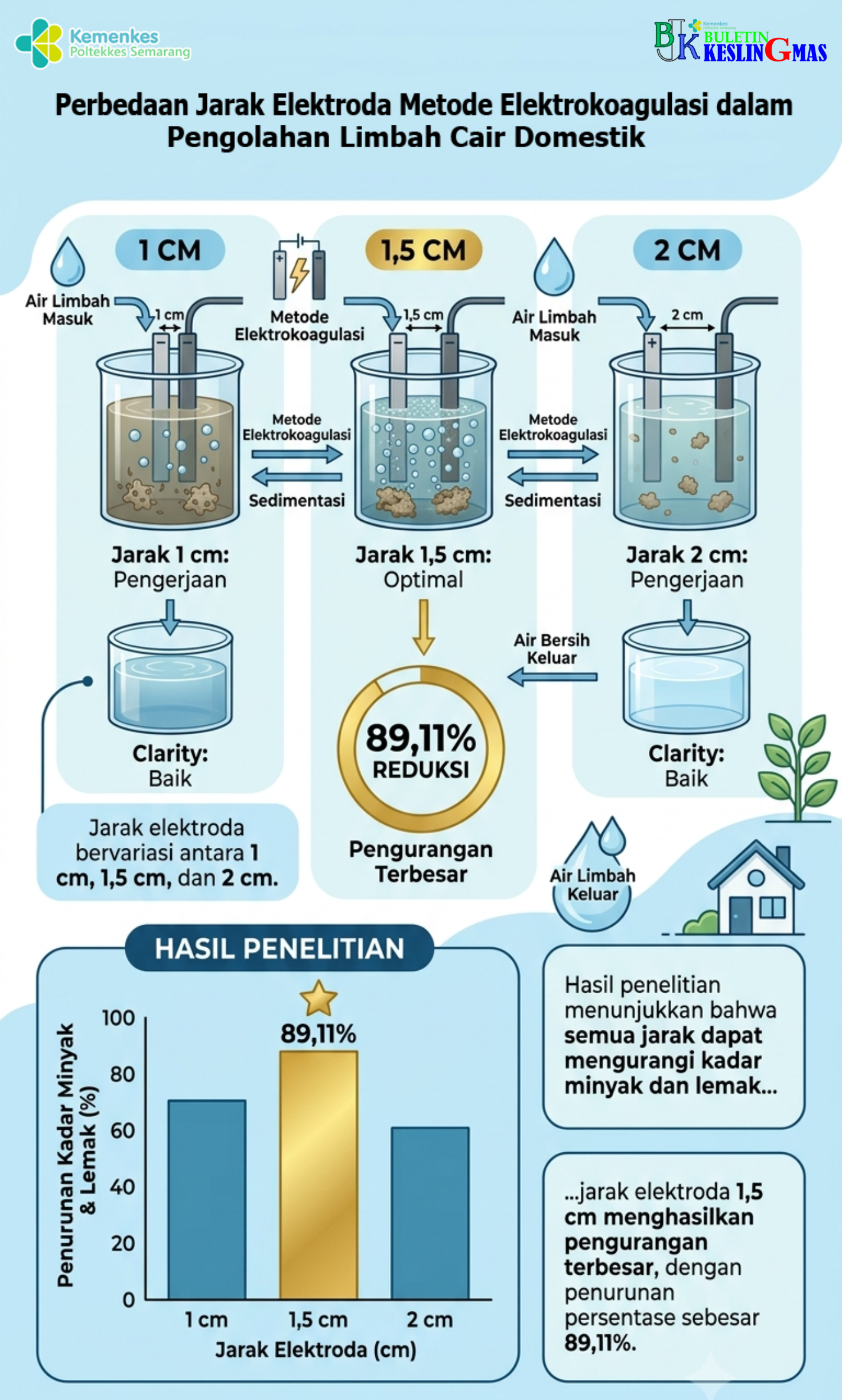
The industry is expected to manage the garbage it generates. PT. X does not yet have a waste treatment facility for canteen waste, thus the wastewater goes directly into the river. Canteen wastewater contains a significant concentration of oil and fat, reaching 30.6 mg/L, above the quality standard of 5 mg/L. waste water is treated using the electrocoagulation process. The purpose of this study is to determine the difference in electrode spacing used in the electrocoagulation method for lowering the oil and fat content of home waste water. This study employed an experimental design with a pretest-posttest structure. Electrode spacing varied between 1 cm, 1.5 cm, and 2 cm. The findings revealed that all distances may reduce oil and fat levels, but the 1.5 cm electrode spacing produced the greatest reduction in oil and fat levels, with a percentage drop of 89.11%. The ANOVA test revealed significant differences across treatment changes (p < 0.05). The 1.5 cm electrode spacing was deemed beneficial because it was within the ideal range, allowing the electrochemical reaction in the electrocoagulation method to perform efficiently to absorb the oil and fat contained in the wastewater and form flocs. This study offers a simple, practical, and efficient solution for enterprises dealing with domestic waste water treatment issues in canteens.
References
1. Kambono H, Budiningsih T, Setyo Wardoyo T, Dasel Manuputty R. Peranan Sektor Industri dan Jasa Dalam Perekonomian Indonesia. 2024;10(1). Available from: http://ejurnal.pps.ung.ac.id/index.php/Aksara
2. Surat Edaran Menteri Tenaga Kerja dan Transmigrasi. Surat Edaran Menteri Tenaga Kerja dan Transmigrasi No. SE.01/MEN 1979 Tentang Pengadaan Kantin dan Ruang Tempat Makan [Internet]. 1979 [cited 2025 Apr 1]. Available from: https://drive.google.com/file/d/0B-3dC1HEsaNlOTFjYzQwODgtNmM2Mi00OGJkLTkyMTItZTEwNjJkMWU3OTgw/view?usp=sharing&resourcekey=0-pDmyINHA-xXsNwZmS7KKww
3. Permen LHK. Peraturan Menteri Lingkungan Hidup dan Kehutanan Nomor P.68/MENLHK/SETJEN/KUM.1/8/2016 tentang Baku Mutu Air Limbah Domestik [Internet]. 2016 [cited 2025 Apr 1]. Available from: https://jdih.maritim.go.id/en/peraturan-menteri-lingkungan-hidup-dan-kehutanan-no-p68menlhksetjenkum182016-tahun-2016
4. Wacana G, Hasan NY, Pujiono. Penurunan Kadar Minyak Dan Lemak Pada Limbah Cair Kantin Menggunakan Metode Adsorpsi Zeolit. J Kesehat Siliwangi. 2021 Dec 29;2(2):477–84.
5. Wicaksono BA. Efisiensi Rancang Bangun Alat Pengolahan Limbah Cair. 39(1):46–54.
6. Aniska S, Hasan NY, Nurjaman U. Penurunan Minyak Dan Lemak Pada Limbah Cair Kantin Menggunakan Modifikasi Grease Trap Media Zeolit. J Kesehat Siliwangi [Internet]. 2022 [cited 2025 Apr 4];2(3). Available from: https://doi.org/10.34011/jks.v2i3.1058
7. Kautsar EI, Hidayah N, Hasan NY, Hanurawaty NY. Perbedaan Variasi Luas Permukaan Plate Settler Pada Grease Trap Dalam Menurunkan Kadar Minyak Dan Lemak Kantin PT . X. 2024;7.
8. Rachmawati S, Irmawartini, Kahar. Perbedaan Waktu Kontak Media Saring Karbon Aktif Menggunakan Grease Trap Termodifikasi Terhadap Kadar Minyak Dan Lemak Limbah Cair Penyamakn Kulit Di Pt. Garut Makmur Perkasa. J Kesehat Siliwangi. 2021 Dec 27;2(2):431–9.
9. Sallam Mohammed M, El A, Sayed A El, Shehawy R El, Afify H. Treatment of Industrial Oil and Soap Wastewater by Using the Application of Electrocoagulation Process [Internet]. Vol. 78, American Scientific Research Journal for Engineering. 2021. Available from: http://asrjetsjournal.org/
10. Suseno HP. Penurunan Konsentrasi Minyak Lemak Dan Cod Pada Limbah Cair Cuci Mobil Dan Motor Secara Elektroflokulasi. 2021.
11. Koto I. Pengolahan Limbah Cair Kelapa Sawit Dengan Memvariasikan Elektroda Melalui Proses Elektrokoagulasi. 2021;
12. Sutanto, Widjajanto D. Pengaruh Arus Listrik terhadap Penurunan Kandungan Minyak dan Lemak pada Perpaduan Proses Oksidasi dan Elektrokoagulasi Air Limbah. Vol. 10, Prosiding Seminar Nasional Teknik Elektro. 2024.
13. Abdelaleem E, Abd-Elaziz ES, Mohamed A, Ahmed EM. Efficiency Evaluation of the Continuous Flow Electrocoagulation Process for the Treatment of Oily-Contaminated Wastewater. Ecol Eng Environ Technol [Internet]. 2024 [cited 2025 Mar 25];25(12):203–17. Available from: https://www.ecoeet.com/pdf-194187-115752?filename=Efficiency Evaluation of.pdf
14. Hernaningsih T. Tinjauan Teknologi Pengolahan Air Limbah Industri Dengan Proses Elektrokoagulasi. 2016;9(1):31–46.
15. Maghfirah I. Penurunan kadar pencemar pada limbah cair rumah tangga dengan metode elektrokoagulasi non kontinu. 2022;
16. Muvel H, Jindal MK, Tewari PK, Anand V. Advancements in electrocoagulation for oily wastewater treatment: Mechanisms, efficiency, and applications. J Water Process Eng [Internet]. 2024 Dec 1 [cited 2025 Jul 28];68:106291. Available from: https://www.sciencedirect.com/science/article/abs/pii/S221471442401523X
17. Azis Ramadani T, Azzahro A, Setiawan A, Mayangsari NE, Dermawan D. Peningkatan Kinerja Proses Elektrokoagulasi Melalui Aerasi Untuk Mengurangi Parameter Minyak Dan Lemak Dari Industri Minyak Kelapa. Vol. 11, Jukung Jurnal Teknik Lingkungan. 2025.
18. Masrullita, Hakim L, Nurlaila R, Azila N. Pengaruh Waktu dan Kuat Arus pada Pengolahan Air Payau menjadi Air Bersih dengan Proses Elektrokoagulasi. J Teknol Kim Unimal. 2021 May;
19. Edy Saputra, Farida Hanum. Pengaruh Jarak Antara Elektroda Pada Reaktor Elektrokoagulasi Terhadap Pengolahan Effluent Limbah Cair Pabrik Kelapa Sawit. J Tek Kim USU [Internet]. 2017 Jan 24 [cited 2025 Jun 12];5(4):33–8. Available from: https://www.researchgate.net/publication/336649171_Pengaruh_Jarak_Antara_Elektroda_Pada_Reaktor_Elektrokoagulasi_Terhadap_Pengolahan_Effluent_Limbah_Cair_Pabrik_Kelapa_Sawit
20. Raiqa S. Pengolahan Limbah Cair Pencucian Kendaraan Bermotor menggunakan Metode Elektrokoagulasi dengan Pasangan Elektroda Aluminium dan Besi. 2022;
Downloads
Published
How to Cite
Issue
Section
License
Copyright (c) 2026 Buletin Keslingmas

This work is licensed under a Creative Commons Attribution 4.0 International License.