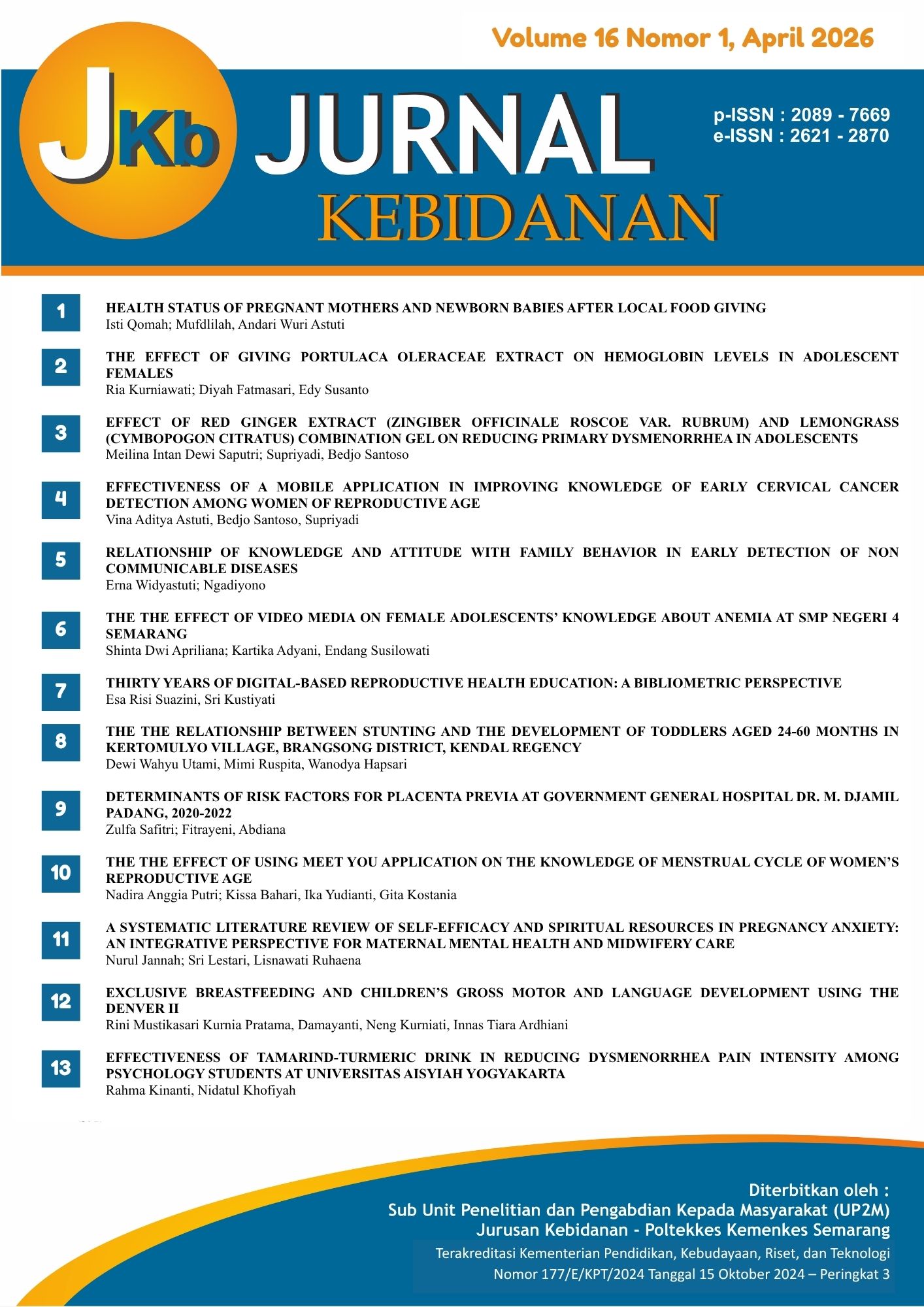
A A Systematic Literature Review of Self-Efficacy and Spiritual Resources in Pregnancy Anxiety: An Integrative Perspective for Maternal Mental Health and Midwifery Care
Department of Psychology, Doctoral Program University Muhammadiyah Surakarta, Indonesia
Sri Lestari
Department of Psychology, Doctoral Program University Muhammadiyah Surakarta, Indonesia
Lisnawati Ruhaena
Department of Psychology, Doctoral Program University Muhammadiyah Surakarta, Indonesia
Abstract
Pregnancy-related anxiety is a common maternal mental health concern with important implications for maternal well-being and obstetric outcomes. Although self-efficacy and spiritual resources have been identified as protective factors, the available evidence remains fragmented. This systematic literature review aimed to synthesize and integrate evidence on self-efficacy and spiritual resources in relation to pregnancy-related anxiety within maternal mental health care. Following PRISMA 2020 guidelines, a systematic search of Scopus and Google Scholar identified 16 eligible studies published between 2010 and 2025. The findings show that higher maternal, parental, or childbirth self-efficacy is associated with lower pregnancy anxiety and fear of childbirth, with interventional studies demonstrating self-efficacy as a modifiable and mediating factor. Spiritual well-being and positive religious coping were also associated with reduced pregnancy anxiety, although evidence was limited to cross-sectional designs. No study examined self-efficacy and spiritual resources simultaneously within a single analytical model or intervention. This review consolidates fragmented evidence into a resource-oriented, integrative framework that informs holistic antenatal and midwifery mental health care and guides future longitudinal and interventional research.
Jannah, N., Lestari , S., & Ruhaena, L. (2026). A A Systematic Literature Review of Self-Efficacy and Spiritual Resources in Pregnancy Anxiety: An Integrative Perspective for Maternal Mental Health and Midwifery Care. JURNAL KEBIDANAN, 16(1). https://doi.org/10.31983/jkb.v16i1.14405
[1] A. Biaggi, S. Conroy, S. Pawlby, and C. M. Pariante, “Identifying the women at risk of antenatal anxiety and depression: A systematic review,” J. Affect. Disord., vol. 191, pp. 62–77, 2016, doi: 10.1016/j.jad.2015.11.014.
[2] R. Brunton, N. Simpson, and R. Dryer, “Pregnancy-related anxiety, perceived parental self-efficacy and the influence of parity and age,” Int. J. Environ. Res. Public Health, vol. 17, no. 18, pp. 1–17, 2020, doi: 10.3390/ijerph17186709.
[3] R. Ma et al., “Resilience mediates the effect of self-efficacy on symptoms of prenatal anxiety among pregnant women: a nationwide smartphone cross-sectional study in China,” BMC Pregnancy Childbirth, vol. 21, no. 1, 2021, doi: 10.1186/s12884-021-03911-5.
[4] F. Effati Daryani, A. Mohammadi, and M. Mirghafourvand, “Childbirth self-efficacy and fear of childbirth and their predictors in adolescent and adult pregnant women referring to health centres of Urmia-Iran: A cross-sectional study,” BMJ Open, vol. 13, no. 10, 2023, doi: 10.1136/bmjopen-2023-077043.
[5] E. T. Olivas et al., “An intervention to address prenatal anxiety improves maternal-infant bonding, with effects mediated by maternal-infant responsiveness, maternal self-efficacy, and postpartum depression,” Infant Ment. Health J., vol. 46, no. 6, pp. 842–854, 2025, doi: 10.1002/imhj.70022.
[6] and N. T. Yousefi Afrashteh, F. Ghodrati, “The relationship between spiritual well-being and anxiety in pregnant women,” BMC Pregnancy Childbirth, 2021, doi: 10.1186/s12884-021-03864-1.
[7] N. Ghodrati, F., & Tayebi, “Religious coping and pregnancy anxiety: A cross-sectional study,” J. Relig. Health, vol. 62, no. 2, pp. 1150–1164, 2023.
[8] F. Mirzaee, S. B. Hasanpoor-Azghady, and L. Amiri-Farahani, “Correlation between religious coping, demographic and fertility factors, and pregnancy anxiety of Iranian primiparous women: a cross-sectional study,” BMC Psychiatry, vol. 22, no. 1, p. 298, Dec. 2022, doi: 10.1186/s12888-022-03922-2.
[9] M. Flykt et al., “Effectiveness and treatment moderators of parenting interventions in Finnish perinatal primary care,” Infant Ment. Health J., vol. 46, no. 5, pp. 577–603, 2025, doi: 10.1002/imhj.70007.
[10] I. Hildingsson, C. Nordin-Remberger, M. B. Wells, and M. Johansson, “Cluster Analysis of Fear of Childbirth, Anxiety, Depression, and Childbirth Self-Efficacy,” JOGNN - J. Obstet. Gynecol. Neonatal Nurs., vol. 53, no. 5, pp. 522–533, 2024, doi: 10.1016/j.jogn.2024.04.004.
[11] P. Varela, I. Zervas, V. Vivilaki, A. Lykeridou, and A. Deltsidou, “Validity and reliability of the Greek version of Wijma delivery expectancy/experience questionnaire (Version A) among low-risk pregnant women,” BMC Psychol., vol. 12, no. 1, 2024, doi: 10.1186/s40359-024-01662-4.
[12] C. V. Azambuja, A. M. Renner, A. Bonatti, and A. X. Arteche, “Prevalence and Psychosocial Risk Factors associated with mental disorders during pregnancy,” Estud. Psicol., vol. 40, 2023, doi: 10.1590/1982-0275202340e220061.
[13] N. Çıtak Bilgin, H. Coşkun, D. Coşkuner Potur, E. İbar Aydın, and E. Uca, “Psychosocial predictors of the fear of childbirth in Turkish pregnant women,” J. Psychosom. Obstet. Gynecol., vol. 42, no. 2, pp. 123–131, 2021, doi: 10.1080/0167482X.2020.1734791.
[14] M. Chehrazi, M. Faramarzi, S. Abdollahi, M. Esfandiari, and S. Shafie rizi, “Health promotion behaviours of pregnant women and spiritual well-being: Mediatory role of pregnancy stress, anxiety and coping ways,” Nurs. Open, vol. 8, no. 6, pp. 3558–3565, 2021, doi: 10.1002/nop2.905.
[15] P. Özkan, S. Süer, İ. K. Keser, and İ. D. Kocakoç, “The effect of service quality and customer satisfaction on customer loyalty: The mediation of perceived value of services, corporate image, and corporate reputation,” Int. J. Bank Mark., vol. 38, no. 2, pp. 384–405, 2020, doi: 10.1108/IJBM-03-2019-0096.
[16] P. Serçekuş and H. Başkale, “Effects of antenatal education on fear of childbirth, maternal self-efficacy and parental attachment,” Midwifery, vol. 34, pp. 166–172, 2016, doi: 10.1016/j.midw.2015.11.016.
[17] L. Goldkuhl, L. Dellenborg, M. Berg, H. Wijk, and C. Nilsson, “The influence and meaning of the birth environment for nulliparous women at a hospital-based labour ward in Sweden: An ethnographic study,” Women and Birth, vol. 35, no. 4, pp. e337–e347, 2022, doi: 10.1016/j.wombi.2021.07.005.
[18] M. Naghi-Beyranvand and S. F. Mousavi, “The Relationship between Spiritual health and anxiety in nursing students,” … Dev. Heal. J., vol. 21, 2021, doi: 10.1186/s12884-021-03864-1.
[19] F. Mirzaee, S. B. Hasanpoor-Azghady, and L. Amiri-Farahani, “Correlation between religious coping, demographic and fertility factors, and pregnancy anxiety of Iranian primiparous women: a cross-sectional study,” BMC Psychiatry, vol. 22, no. 1, 2022, doi: 10.1186/s12888-022-03922-2.
[20] N. Ghodrati, F., & Tayebi, “Religious coping and pregnancy anxiety: A cross-sectional study,” J. Relig. Health, vol. 62, no. 2, pp. 1150–1164, 2023, doi: https://doi.org/10.1007/s10943-022-01657-3.