
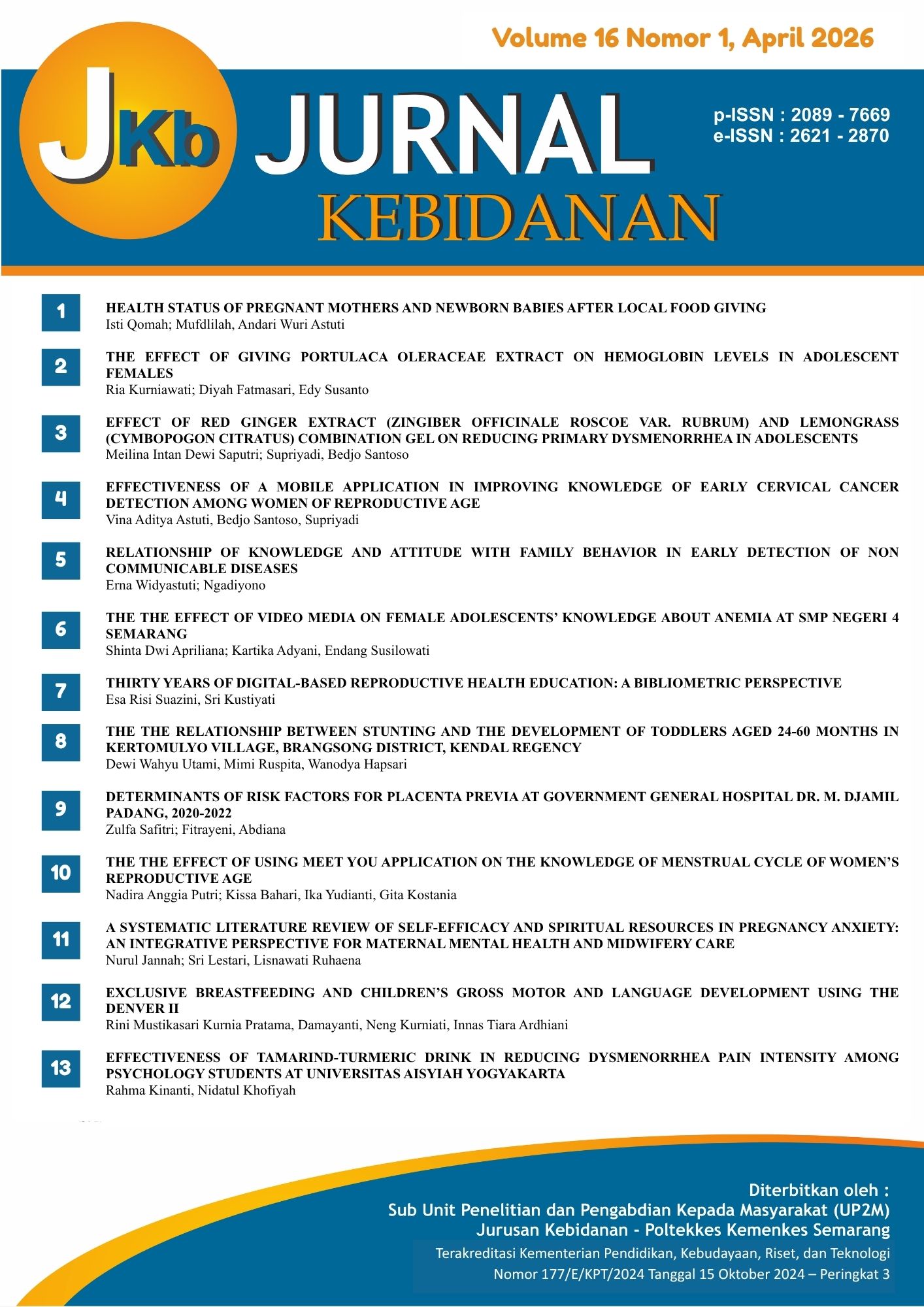
Thirty Years of Digital-Based Reproductive Health Education: A Bibliometric Perspective
##plugins.themes.academic_pro.article.sidebar##
##plugins.themes.academic_pro.article.main##
Abstract
Background: Reproductive health education is essential for improving individual quality of life and sexual well-being. Advances in digital technology have transformed educational approaches in this field over the past decades.
Objective: To analyze global scientific publication trends on digital-based reproductive health education over the past 30 years (1994–2024).
Methods: A bibliometric approach was employed. Articles were retrieved using the keywords “sexual health education” OR “reproductive health education” AND “mobile technology”, along with 33 additional digital-related terms. Data were collected from the Scopus database (retrieval date: May 10, 2025). A total of 308 records were identified, and after applying relevance and inclusion criteria, 272 articles were retained for analysis. VOSviewer software was used to examine keyword co-occurrence, co-authorship networks, productive journals, institutions, and countries.
Results: The VOSviewer visualization revealed sparse networks with limited interconnecting lines, indicating low levels of collaboration among researchers in this field. The most frequent keyword was “human”. Mustanski B emerged as the most prolific author, Sex Education as the leading journal, and the University of Toronto as the most productive institution. The United States dominated overall publication output. Indonesia appeared in the network with a relatively small cluster, reflecting modest publication volume.
Conclusion: Research on digital-based reproductive health education remains limited, with low collaboration intensity across authors and institutions. These findings highlight substantial opportunities for future research expansion, particularly in underexplored keyword clusters.
##plugins.themes.academic_pro.article.details##

This work is licensed under a Creative Commons Attribution 4.0 International License.
References
- [1] U. A. L. E. maria L. S. P. M. C. I. G. J. A. L. Rodrigo, “sobre Educación Sexual en el ámbito no-formal disponibles en España,” Rev. Esp. Salud Publica, vol. 97, no. 22, pp. 1–58, 2023.
- [2] UNFPA, “Child Marriage,” UNFPA. 2025.
- [3] B. Lefa, “The Piaget Theory of Cognitive Development : An Educational,” Educ. Psychol., vol. 1, no. 9, 2014.
- [4] S. A. N. I. Setiawan, “Pembangunan Manusia Berbasis Gender,” Kementerian Pemberdayaan Perempuan dan Perlindungan Anak (Kemen PPPA). Kementerian Pemberdayaan Perempuan dan Perlindungan Anak (Kemen PPPA), Jakarta, pp. 1–305, 2023.
- [5] G. M. M. Joyce C. Abma, “National Health Statistics Reports,” Natl. Health Stat. Report., vol. 196, no. 14, pp. 2015–2019, 2023.
- [6] WHO, “Indonesia HIV Country Profile 2023,” HIV Country Intelegence. WHO HIV Country Inteleigence, 2024.
- [7] G. B. A. B. J. T. B. R. B. A. M. C.-S. A. G. L. L. M. R. Ann M Starr; Alex C Ezeh, Z. A. S. L. S. G. I. S. S. S. K. S. M. T. A. B. A. Popinchalk, and C. S. L. S. Ashford, “Accelerate progress—sexual and reproductive health and rights for all: report of the Guttmacher–Lancet Commission,” Lancet, vol. 391, no. 10140, pp. 2642–2692, 2018, doi: https://doi.org/10.1016/S0140-6736(18)30293-9.
- [8] Ş. Pehlivanoğlu, O. T. Çelik, Y. Tok, and M. Sağlam, “The Trends and Hotspots of Research on Adolescent Pregnancy: A Bibliometric Analysis,” J. Prev., 2025, doi: 10.1007/s10935-025-00836-z.
- [9] A. A. Azis, N. Kurnia, and S. Bulan, “Pengetahuan dan Sikap terhadap Kesehatan Reproduksi Siswa SMA 10 Makassar,” Univ. Negeri Makasar, pp. 632–645, 2022.
- [10] M. W. M. S. N. dkk; W. P. Erna, Modul Kesehatan Reproduksi Remaja Luar Sekolah. Jakarta: Kementerian Kesehatan RI, 2021.
- [11] S. dkk. Afika Choirrun Nisa; Apriliani Nurida Dwi Aswarawati; Ari Purbowati; Astrid Mashita, “Kajian Fertilitas Remaja Umur 10−14 Tahun di Indonesia Hasil Long Form SP2020,” Badan Pusat Statistik dan UNFPA. BPS dan UNFPA, p. 78, 2023.
- [12] J. A. Ackah, K. Esia-Donkoh, A. P. Amponsah, W. Agbemavi, V. B. Bediako, and G. N. A. A. Tettey, “Use of digital media by adolescents for sexual and reproductive health and rights communication in sub-Saharan Africa: a protocol for systematic review,” Syst. Rev., vol. 13, no. 1, p. 130, 2024, doi: 10.1186/s13643-024-02534-z.
- [13] N. Waleed, Z. Alhussaini, U. Elshaikh, K. Abdulrashid, and S. Elashie, “Sexual and reproductive health literacy of higher education students : a scoping review of determinants , screening tools , and effective interventions,” Glob. Health Action, vol. 18, no. 1, 2025, doi: 10.1080/16549716.2025.2480417.
- [14] S. Islam, R. Shahriyar, A. Agarwala, M. Zaman, S. Ahamed, and R. Rahman, “Artificial intelligence ‑ based risk assessment tools for sexual , reproductive and mental health : a systematic review,” BMC Med. Inform. Decis. Mak., vol. 5, 2025, doi: 10.1186/s12911-025-02864-5.
- [15] R. Amiruddin et al., “Application-based Reproductive Health Education on Reproductive Health Risk Behavior among Adolescents in Ternate City Characteristics of Respondents,” Pharmacogn J, vol. 16, no. 4, pp. 942–948, 2024, doi: 10.5530/pj.2024.16.152.
- [16] N. Isaacs, X. Ntinga, T. Keetsi, L. Bhembe, and B. Mthembu, “Are mHealth Interventions Effective in Improving the Uptake of Sexual and Reproductive Health Services among Adolescents ? A Scoping Review,” Int. J. Environ. Res. Public Heal., vol. 21, no. 165, pp. 1–17, 2024, doi: 10.3390/ ijerph21020165.
- [17] S. R. Lafontan, F. Jones, and N. Lama, “Exploring comprehensive sexuality education experiences and barriers among students , teachers and principals in Nepal : a qualitative study,” Reprod. Health, 2024, doi: 10.1186/s12978-024-01876-0.
- [18] G. A. O. Portillo, J. B. Fletcher, L. E. Young, and J. D. Klausner, “Virtual avatars as a new tool for human immunodeficiency virus prevention among men who have sex with men : a narrative review,” pp. 0–2, 2023, doi: 10.21037/mhealth-22-33.
- [19] J. Natosba, “Pengembangan Aplikasi Kesehatan Reproduksi dan Seksual Sepanjang Siklus Kehidupan Manusia,” Bookchapter Matern., vol. 1, no. 1, 2024.
- [20] W. B. Permatasari and S. S. Alamiyah, “Analisis Resepsi Konten Pendidikan Seksual Berbasis Islam dalam Instagram @ taulebih . id,” J. Ilm. Ilmu Pendidik., vol. 6, no. 2021, pp. 8031–8039, 2023.
- [21] Y. Jia, Q. Hu, H. Liao, H. Liu, Z. Zeng, and H. Yu, “Global research trends and hotspots in gestational diabetes and long-term cardiovascular health: A bibliometric analysis,” Diabetes Metab. Syndr. Clin. Res. Rev., vol. 18, no. 10, p. 103144, 2024, doi: 10.1016/j.dsx.2024.103144.
- [22] M. Pehlivanoğlu, Şeyma; Çelik; Tayyar, Osman; Tol, Yasin; Sağlam, “The Trends and Hotspots of Research on Adolescent Pregnancy: A Bibliometric Analysis,” J. Prev., 2025, doi: https://doi.org/10.1007/s10935-025-00836-z.
- [23] H. Zhu et al., “Global Research Trends on Infertility and Psychology From the Past Two Decades: A Bibliometric and Visualized Study,” Front. Endocrinol. (Lausanne)., vol. 13, no. July, pp. 1–20, 2022, doi: 10.3389/fendo.2022.889845.
- [24] Audrey Azoulay at all, “International technical guidance on sexuality education,” United Nations Educational, Scientific and Cultural Organization (UNESCO). UNESCO, UNAIDS, UNFPA, UNICEF, UN Women, WHO, France, pp. 1–139, 2018.
- [25] Furizal et al., “Concerns of Ethical and Privacy in the Rapid Advancement of Artificial Intelligence: Directions, Challenges, and Solutions,” J. Robot. Control, vol. 5, no. 6, pp. 2015–2026, 2024, doi: 10.18196/jrc.v5i6.24090.
- [26] V. A. Goodyear, Young people, social media and health: A pedagogical perspective on influencers. United Kingdom, 2022.
- [27] R. Amiruddin, A. I. Moedjiono, V. Hadju, and U. Salmah, “Effectiveness of Health Education for Teenagers in the Digital Era : A Review,” Malaysian J. Med. Heal. Sci., vol. 2016, no. 14, pp. 399–406, 2023, doi: 10.47836/mjmhs19.5.45.
- [28] A. R. E.-C. Alyafei, The Health Belief Model of Behavior Change. Treasure Island: StatPearls Publishing LLC, 2024.
- [29] N. B. S. Purwanto, Theory of Planned Behavior, 1st ed. Malang: CV. Literasi Nusantara Abadi, 2022.
- [30] N. H. B. El Malouf, Diffusion of innovations: A Review., vol. 1–2. 2023.