
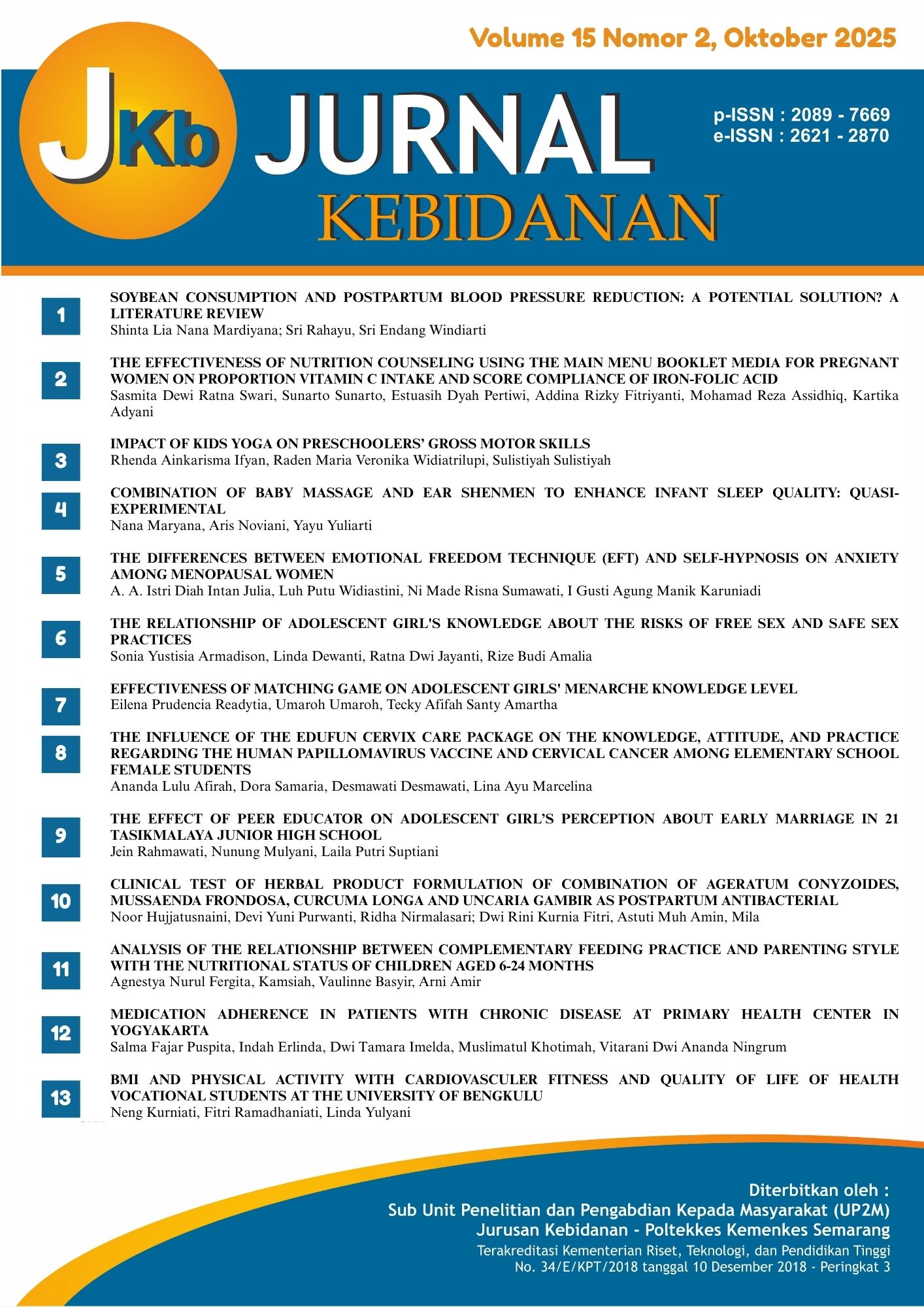
Clinical Test of Herbal Product Formulation of Combination of Ageratum conyzoides, Mussaenda frondosa, Curcuma longa and Uncaria gambir as Postpartum Antibacterial
##plugins.themes.academic_pro.article.sidebar##
##plugins.themes.academic_pro.article.main##
Abstract
Indonesia is a maritime country with tropical forests that possess various natural resources utilized to fulfill needs in clothing, shelter, and medicine. Certain medicinal plants such as Ageratum conyzoides, Mussaenda frondosa, Curcuma longa, and Uncaria gambir have medicinal properties, including antibacterial effects for postpartum infections. The limited knowledge among the public regarding the benefits of traditional medicinal plants is due to restricted dissemination of information through digital media, among other factors. Therefore, it is crucial that information about the clinical trials of herbal products containing a combination of Ageratum conyzoides, Mussaenda frondosa, Curcuma longa, and Uncaria gambir as postpartum antibacterials is conveyed to the younger generation, especially millennials, and those unfamiliar with the diversity of plants. A non-parametric research design method was employed, testing the pharmacological effects of the herbal product formulation through preliminary data. Data collection involved obtaining responses from 50 participants who used the herbal product, including 15 with vaginal discharge, 10 postpartum individuals, 10 with dysmenorrhea, 5 with postpartum infections, 5 unmarried healthy individuals, and 5 married healthy individuals, using the Wilcoxon test. The research results indicate that the combined herbal formulation significantly affected the test groups with indicators such as vaginal discharge, postpartum without infection, postpartum with infection, dysmenorrhea, and married and healthy individuals, with a significance level of 0.01. These results suggest positive potential. Further analysis reveals that the group without infection complaints did not show a significant impact. In conclusion, the combination formulation demonstrates positive effectiveness in groups with specific complaints related to infection and reproductive disorders. However, the response to the formulation may vary depending on initial health conditions and the characteristics of the target group.
##plugins.themes.academic_pro.article.details##

This work is licensed under a Creative Commons Attribution 4.0 International License.
References
- [1] A. C. Evaluation, O. F. P. Depression, And I. N. Coastal, “Original Article A Clinical Evaluation Of Post-partum Depression In Coastal Karnataka,” 3 (78), Pp. 4242–4245, 2016, doi: 10.18410/jebmh/2016/903.
- [2] Bulette Coakley, A., & Duffy, M. E. (2010). The effect of therapeutic touch on postoperative patients. Journal of Holistic Nursing, 28(3), 193–200.
- [3] Cai, F.-F., & Zhang, H. (2015). Effect of therapeutic touch on agitated behavior in elderly patients with dementia: A review. International Journal of Nursing Sciences, 2(3), 324– 328.
- [4] Cheraghi, M. A., Sadat, A., Hosseini, S., Gholami, R., & Bagheri, I. (2017). Therapeutic Touch efficacy : A Systematic Review, 5(4), 52–59.
- [5] Coakley, A. B., & Hospital, M. G. (2015). The Effect of Therapeutic Touch on Postoperative Patients, (October). https://doi.org/10.1177/0898010110368861
- [6] Cox, C., & Hayes, J. (1999). Physiologic and psychodynamic responses to the administration of therapeutic touch in critical care, 44(0), 87–92.
- [7] D. H. Tavish, M.H. and M. Martosupono, “An Economic Study of Essential Oil Production In the UK: A Case Study Comparing Non-UK Lavender/Lavandin Production And Peppermint/Spearmint Production With UK Production Techniques And Cost,” Adas Consult. Ltd, 137(11), p. 62, 2015.
- [8] Fitriana, Lisna Anisa., & Nurbaeti, Siti. (2016). Gambaran kejadian postpartum pada ibu nifas berdasarkan karakteristik di rumah sakit umum tingkat IV sariningsih kota bandung. Jurnal Pendidikan Keperawatan Indonesia. 2(1). 44-5.
- [9] Friska, Y. D., Hujjatusnaini, N., & Amin, A. M. (2021). The Potential of Purple Leaves Ethanol Extract (Graptophyllum pictum L .) Against The Growth of Staphylococcus aureus and Candida albicans. JUATIKA 3(2). 196-207.
- [10] Gonidakis, F., Rabavilas, A. D.,Varsou, E., Kreatsas, G., &Christodoulou, G.N. (2007). Maternity blues in athens,greece: A study during thefirst 3 days after delivery. Journal of Affective Disorders, 99, 107–115.
- [11] H. VanderMeulen, J. Petrucci, G. Floros, F. Meffe, K. N. Dainty, and M. Sholzberg, “The experience of postpartum bleeding in women with inherited bleeding disorders,” Res. Pract. Thromb. Haemost., 3(4), pp. 733–740, 2019, doi: 10.1002/rth2.12246.
- [12] Hujjatusnaini, N. (2022). Perbandingan Kemampuan Adaptasi Bakteri Staphylococcus aureus dan Bakteri Escherichia coli Pada Ekstrak Daun Karamunting (Melastoma malabathrium). Biology Science and Education.11(1), 102–110. 2022.
- [13] Hujjatusnaini, N., Amin, A. M., & Nur, L. I. (2021). Antibacterial Effectiveness of Methanol Extract Combination Formula 3 : 2 : 1 of Tambora Leaf ( Ageratum conyzoides ), Sembalit Angin Leaf ( Mussaenda frondosa L ), Turmeric Rhizome ( Curcuma longa L ) on the growth of Staphylococcos aureus. Sainstek: Jurnal Sains dan Teknologi. 13(1), 1–6.
- [14] Hujjatusnaini, N., Muh, A., Feyby, H., & Perditson, A. Inovasi Minuman Tepache Berbahan Baku Kulit Nanas ( Ananas comosus ( L .) Merr .) Tersuplementasi Probiotik Lactobacillus casei Suplemented Probiotic Lactobacillus. Journal of Food Technologi and Nutrition, 21 (1), 47–54. 2022.
- [15] Indah, B., Hujjatusnaini, N., Amin, A. M., & Nur, L. I. Methanol Extracts Formulation of Tambora Leaves ( Ageratum conyzoides L .), Sembalit Angin Leaves ( Mussaendafrondosa L .) and Turmina Rhizome ( Curcuma longa ) as Candida albicans Antifungal. Sainstek: Jurnal Sains dan Teknologi. 13(2), 105–111. 2021,
- [16] Jekti, R. P. and Suarthana, E. (2011) ‘Risk factors of post partum haemorrhage in Indonesia’, Health Science Journal of Indonesia, 2(2), pp. 66–70.
- [17] Kemenkes, R. I. (2021) ‘Profil Kesehatan Indonesia 2020’, Kementrian Kesehatan Republik Indonesia.https://pusdatin.kemkes.go./resources/download/pusdatin/profil -kesehatan-indonesia/Profil-Kesehatan-Indonesia-Tahun-2020.pdf.
- [18] L. A. Fitriana and S. Nurbaeti, “Gambaran Kejadian Postpartum Blues Pada Ibu Nifas,” Pendidik. Keperawatan, 2(1), pp. 44–51, 2016, [Online]. Available: file:///C:/Users/amira/Downloads/2852-5244-1-PB.pdf
- [19] Maesaroh, S. and Iwana, I. P. ‘Hubungan Riwayat Anemia Dan Jarak Kelahiran Dengan Kejadian Perdarahan Postpartum Di Rsud Dr. H.Abdul Moeloek’, Midwifery. Journal:Jurnal Kebidanan UM. Mataram, 3(1), pp. 21–25. 2018
- [20] Ningsih, F., Tambunan, L. N. and Raynaldi, R.‘Analisis Faktor Kejadian Perdarahan Post Partum Di RSUD DR. Doris Sylvanus Kota Palangka Raya Provinsi Kalimantan Tengah’, Dinamika Kesehatan: Jurnal Dan Keperawatan, 9(2),pp. 352–365. 2018.
- [21] R. V. Garvita, “Pemanfaatan Tumbuhan Obat Secara Tradisional untuk Memperlancar Persalinan oleh Suku Dayak Meratus di Kalimantan Selatan,” War. Kebun Raya, 13(2), pp. 51–58, 2015.
- [22] Rahmandani, A., Karyono, Dewi, E.K. Strategi penanggulangan (coping) pada ibu yang mengalami postpartum di Rumah Sakit Umum Daerah kota Semarang. Jurnal Psikologi Undip, 5(1). 2019
- [23] Rohmah, Nikmatur. Manajemen nyeri non invansive pada ibu postpartum dengan pendekatan evidence based practice. Jurnal Ners. 6 (2). 201-209. 2011.
- [24] Sefriyanti, A. Jayuska, and A. H. Alimuddin, “Uji Aktivitas Antibakteri Minyak Atsiri Sereh Wangi ( Cymbopogon bernadus L .) terhadap Bakteri Escherichia coli dan Staphylococcus aureus,” J. Kim. Khatulistiwa, vol. 8, no. 4, pp. 1–4, 2020.
- [25] Shetty, Annapa. A clinical evaluation of post-partum depression in coastal karnataka. Jebmh.com. 3(78). 4242-4245. 2016.
- [26] Thrombosis and Haemostasis, 3(4), p.e12246. (2012) WHO recommendations for the prevention and treatment of postpartum haemorrhage. World Health Organization.
- [27] VanderMeulen, H. et al. (2019) ‘The experience of postpartum bleeding in women with inherited bleeding disorders’, Res Pract Thromb Haemost. 2019;00:1–8.
- [28] Widyastuti, R., Hujjatusnaini, N., Septiana, N., & Amin, A. M. (2021). Antimicrobial Potential Combination Formulation of 1 : 2 : 3 Methanol Extract of Tambora Leaf (Ageratum conyzoides L ), Sembalit Angin Leaf ( Mussaenda frondosa L ), and Turmeric Rhiz ome ( Curcuma longa ) Against Escherichia coli. Sainstek: Jurnal Sains dan Teknologi. 13(2), 121–126.