Tentang Jurnal Ini
 |
Jaringan Laboratorium Medis (Medical Laboratory Network)Is a peer-reviewed journal that publishes scientific articles in the field of Medical Laboratories such as Immunology, Bacteriology, Parasitology, Toxicology, Hematology, Cytohistotechnology, and Blood research. |
History of the Journal
With e-ISSN 2685-8495 and is published by the Health Analyst Department of Health Polytechnic of the Ministry of Health Semarang every year 6 months, in May and November every year. SINTA 3 Indonesian Acreditation Jurnal
The aims of the Jaringan Laboratorium Medis (Medical Laboratory Network) journal is to publish original scientific research findings and new scientific reviews. Articles published in the journal undergo a peer-review process. The decision to accept scientific articles rests with the Editorial Board, based on recommendations from reviewers. As of 2019, the journal accepts only articles based on original research (top priority) and new scientific reviews (lower priority).
Articles received can be in the form of Research Results Articles, Book Reviews, Literature Studies, Comments/Opinions, Scientific News, and Letters to the Editor.
Focus & scopes journal of Jaringan Laboratorium Medis covers the fields of Immunology, Bacteriology, Parasitology, Toxicology, Hematology, Cytohistotechnology, and Blood research.
Peer-Review Policy
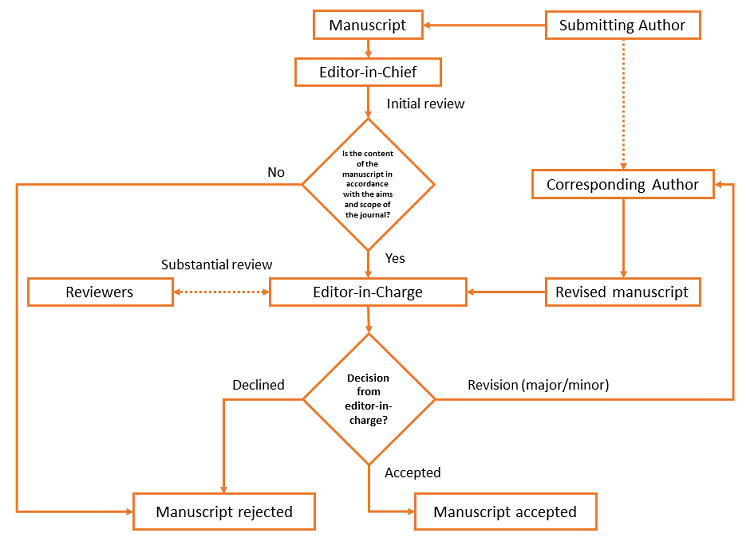
The peer-review process is the core of scientific publication, relying on peer reviewers who have the same area of expertise as the manuscript's topic. Thus, the Editor-in-Charge and the peer-reviewers are important figures to ensure the peer-review process goes well. The peer-review process in the Jaringan Laboratorium Medis (Medical Laboratory Network) applies as follows:
- Submitting author submits the manuscript via OJS Jaringan Laboratorium Medis.
- Editor-in-Chief Conduct an initial review to assess the suitability of the manuscript's contents with the aims and scope of the Jaringan Laboratorium Medis. If the manuscript does not match, the Editor-in-Chief will immediately reject the article (desk rejection). Those rejected at this stage also are insufficiently original or have serious scientific flaws.
- If the manuscript is by its aims and scope and meets the minimum criteria, the Editor-in-Chief will assign one editor to continue the peer-review process of the manuscript. Editor-in-Charge is an editor whose areas of expertise match the substance of the manuscript. Although very rare, it is entirely feasible for an exceptional manuscript to be accepted at this stage.
- Editor-in-Charge asks 2-3 reviewers with appropriate areas of expertise to conduct a substantial review of the manuscript. The reviewer will be asked to evaluate whether the manuscript is scientifically sound and coherent, whether it duplicates the already published works, and whether or not the manuscript is sufficiently clear for publication. Reviewers are not expected to correct or copyedit manuscripts since language correction is not part of the peer-review process and will be done by the Editor-in-Charge. The selection of reviewers is made by ensuring there is no conflict of interest between authors and reviewers. One is ensuring that the authors and reviewers are not from the same institution since the method used is a double-blind peer review. The peer-review process by reviewers is estimated to take 4 to 8 weeks.
- After obtaining the reviewers' consideration, the Editor-in-Charge decides to accept, reject, or return it to the authors via the corresponding author for revision. There are two possible types of revision: minor and major. Minor revisions indicate that the Editor-in-Charge will review the corrected results from the authors without involving the previously on-duty reviewers. In contrast, the major revisions suggest that previously on-duty reviewers will review the authors' improvements for re-examination before being forwarded to the Editor-in-Charge for a final decision.
- After the authors make revisions, the Editor-in-Charge re-evaluates the manuscript. If needed, especially if the previous decision was a major revision, the Editor-in-Charge can conduct a 2nd round review.
- The final decision to accept or reject the manuscript rests with the Editor-in-Charge, considering the reviewers' previous recommendations, manuscript revisions, and other things required, such as a similarity level of not more than 20%. The Editor-in-Charge decision is final, and the authors are not allowed to challenge any of the final Editor-in-Charge decisions. The average time from initial submission to the first decision is usually between 6-10 weeks. If the revision process goes smoothly, the average time between submission and publication of articles is 12-16 weeks.
Becoming a Reviewer
If you are not currently a reviewer for the Jaringan Laboratorium Medis but would like to be added to the list of reviewers, please contact us. The benefits of reviewing for the Jaringan Laboratorium Medis include the opportunity to see and evaluate the latest work in the related research area at an early stage and to be acknowledged in our list of reviewers. You may also be able to cite your work for the Jaringan Laboratorium Medis as part of your professional development requirements. Jaringan Laboratorium Medis's reviewers are volunteers who contribute their expertise to the science. Thus no financial payments are made. If you are interested in becoming a reviewer for the Jaringan Laboratorium Medis , please get in touch with [email protected]
Publication Frequency
The Jaringan Laboratorium Medis Journal is published online twice a year, in May and November.
Open Access Policy
Jaringan Laboratorium Medis (Medical Laboratory Network) provides immediate open access to its content on the principle that making research freely available to the public supports a greater global exchange of knowledge. All articles published in the Jaringan Laboratorium Medis are open access and free for access as stated on Budapest Open Access Initiative:
"By 'open access' to this literature, we mean its free availability on the public internet, permitting any users to read, download, copy, distribute, print, search, or link to the full texts of these articles, crawl them for indexing, pass them as data to software, or use them for any other lawful purpose, without financial, legal, or technical barriers other than those inseparable from gaining access to the internet itself. The only constraint on reproduction and distribution, and the only role for copyright in this domain, should be to give authors control over the integrity of their work and the right to be properly acknowledged and cited.”

Benefits of open access for the author include:
- Free access for all users worldwide
- Authors retain copyright to their work
- Increased visibility and readership
- Rapid publication
- No spatial constraints
However, works/articles in this journal are bound to Creative Commons Attribution-ShareAlike 4.0 International License.
Licensing
Jaringan Laboratorium Medis (Medical Laboratory Network) is published by Medical Laboratory Technology Program Health Polytechnic of the Ministry of Health Semarang under license:
 Creative Common Attribution-ShareAlike 4.0 International (CC BY-SA 4.0)
You are free to:
- Share — copy and redistribute the material in any medium or format
- Adapt — remix, transform, and build upon the material
- for any purpose, even commercially.
The licensor cannot revoke these freedoms as long as you follow the license terms.
Under the following terms:
- Attribution — You must give appropriate credit, provide a link to the license, and indicate if changes were made. You may do so in any reasonable manner, but not in any way that suggests the licensor endorses you or your use.
- ShareAlike — If you remix, transform, or build upon the material, you must distribute your contributions under the same license as the original.
- No additional restrictions — You may not apply legal terms or technological measures that legally restrict others from doing anything the license permits.
Notices:
- You do not have to comply with the license for elements of the material in the public domain or where your use is permitted by an applicable exception or limitation.
- No warranties are given. The license may not give you all of the permissions necessary for your intended use. For example, other rights such as publicity, privacy, or moral rights may limit how you use the material.
Copyright Notice
Authors continue to retain the copyright to the article if the article is published in the Jaringan Laboratorium Medis (Medical Laboratory Network) They will also retain the publishing rights to the article without any restrictions.
Authors who publish in this journal agree to the following terms:
- Any article on the copyright is retained by the author(s).
- The author grants the journal the right of first publication with the work simultaneously licensed under a Creative Commons Attribution License that allows others to share work with an acknowledgment of the work authors and initial publications in this journal.
- Authors can enter into separate, additional contractual arrangements for the non-exclusive distribution of published articles (e.g., post-institutional repository) or publish them in a book, with acknowledgment of their initial publication in this journal.
- Authors are permitted and encouraged to post their work online (e.g., in institutional repositories or on their websites) before and during submission. This can lead to productive exchanges and earlier and greater citations of published work.
- The article and any associated published material are distributed under the Creative Commons Attribution-ShareAlike 4.0 International License.
Article Processing Fee
This journal charges the following author fees:
Article Submission: 0,- (IDR)
Authors are required to pay an Article Submission Fee as part of the submission process to contribute to review costs.
International authors (non-Indonesian afiliated authors) will be funded by Poltekkes Kemenkes Semarang.
Article Publication SINTA 3 : 500.000,- (IDR)
If this paper is accepted for publication, you will be asked to pay an Article Publication Fee to cover publications costs.
If you do not have funds to pay such fees, you will have an opportunity to waive each fee, by conveying your complaints and reasons. We do not want fees to prevent the publication of worthy work.
Sponsors
Privacy Statement
It should also be noted that the provisions regarding the systematics and format of writing articles given by the editorial board are not intended to produce a formal and rigid communication style. Apart from the need to consistently follow these provisions, it is necessary to always strive for a narrative communication style that is fluent, easy to read, and familiar to the reader.
Archiving Policy
The Jurnal Jaringan Laboratorium Medis (Medical Laboratory Network) is committed to ensuring the long-term preservation, protection, and accessibility of all published scientific articles. To achieve this goal, JLM implements a digital archiving policy utilizing the LOCKSS (Lots of Copies Keep Stuff Safe) and CLOCKSS (Controlled Lots of Copies Keep Stuff Safe) systems.
1. LOCKSS Archiving System
Jaringan Laboratorium Medis utilizes the LOCKSS system, which is integrated into the Open Journal Systems (OJS) platform.
- Function: This system creates a distributed archiving network among participating libraries.
- Benefits: It enables these libraries to create permanent archives of the journal for preservation purposes and to fully restore original manuscripts in the event of technical issues with the main server.
2. CLOCKSS Archiving System
In addition to LOCKSS, JLM also supports the CLOCKSS system to guarantee the security of digital content on a global and permanent basis.
- Function: CLOCKSS relies on a network of secure archiving nodes located at leading universities and publishers worldwide.
- Benefits: Content archived within the CLOCKSS system is protected against digital format degradation. Should the journal cease operations in the future (a "triggered event"), the content remains publicly available via open access through the CLOCKSS network.